
AI companies ramp up Washington lobbying amid policy battle: FT
 5 Min Read
Leading AI companies including OpenAI and Anthropic are spending record sums on Washington lobbying as they seek to shape US policy on regulation, data centers, and model releases.
-
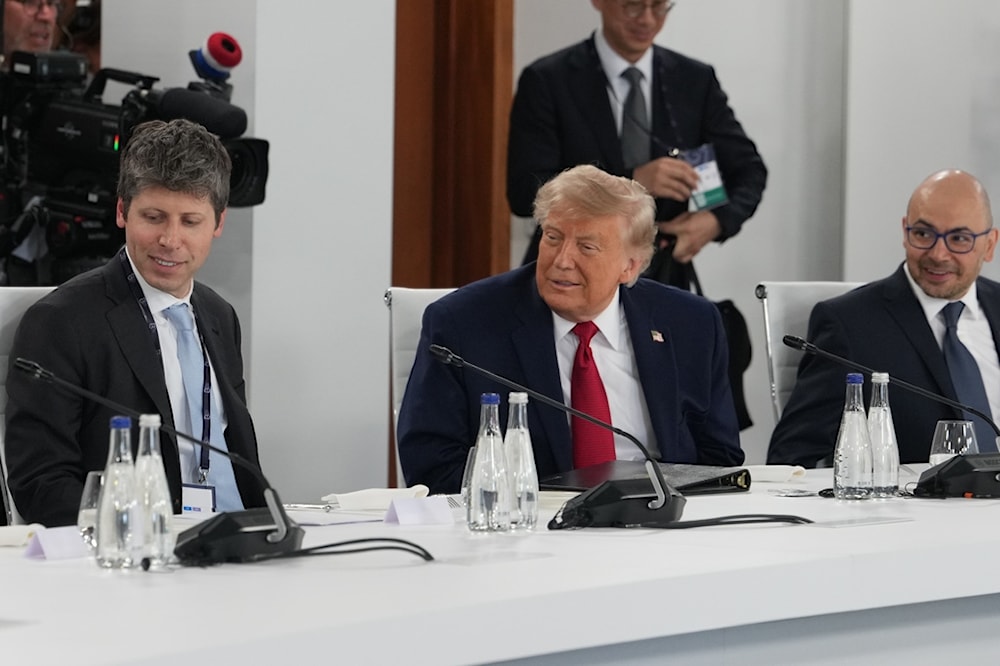
President Donald Trump talks to CEO of OpenAI Sam Altman while CEO of Google DeepMind Demis Hassabis looks on as they participate in a meeting with leaders during the G7 summit, June 17, 2026, in Evian-les-Bains, France. (AP/Julia Demaree Nikhinson)
Leading US AI companies are spending record amounts on lobbying in Washington as they seek to influence federal policy, limit regulation, and shape rules governing data centers and the release of advanced AI models.
A recent report by the Financial Times (FT) delves into how OpenAI nearly doubled its federal lobbying spending to a record $2.22 million in the first half of 2026 compared with the same period last year, while Anthropic nearly tripled its expenditure to $3.53 million, according to federal disclosures. Google and Microsoft also spent as much in recent months as they have in any quarter since 2020.
The increase comes as the AI industry faces political battles on multiple fronts and expands its long-term influence operations in Washington, according to lobbyists and policy experts. "The lobbying offensive has been as much about deterring regulation as making the case for an affirmative government industrial policy that supports the industry", said Amba Kak, co-executive director of AI Now Institute and a former senior advisor on AI to the Federal Trade Commission during the Biden administration.
AI companies target model release and data center policies
One of the industry's key lobbying priorities is federal policy governing the release of new AI models. The US last month used export controls to block the rollout of Anthropic's Fable model over cybersecurity concerns.
Companies are also seeking to influence policies surrounding the construction and power requirements of massive data centers, as well as rules determining whether developers must make the underlying parameters of their AI models publicly available, according to federal disclosures and lobbyists involved in policy discussions.
Joseph Hoefer, chief AI officer at Monument Advocacy, said the industry faces a unique combination of regulatory challenges, as reported by FT. “It’s an export-controlled technology like semiconductors, an infrastructure build-out like telecoms or power, a procurement relationship like defence, and a liability question like the [social media] platforms, all at the same time. No single playbook covers that,” he said.
Trump administration favors light-touch AI framework
The AI industry "lost loudly" its effort to persuade Congress to ban state-level AI regulation, Kak said, an issue that US President Donald Trump has also sought to address through an executive order.
Beyond that, however, "very little else has moved in terms of regulation," Kak said, adding that she viewed the period as favorable for the industry.
The Trump administration, most vocally through former AI czar David Sacks, has supported a light-touch federal framework and warned that a patchwork of state laws could stifle innovation.
However, according to FT, rapid advances in AI technology and competition from China have also pushed US officials to intervene on issues including model releases, primarily through decisions targeting individual companies rather than broadly applicable regulations.
Gregory Allen, founder of tech policy analysis firm Decision Tree Research and a former senior AI advisor at the Center for Strategic and International Studies, said the lack of consistent rules remains a significant policy gap. “Even when [policy is] written down, it’s like letters to one company as opposed to rules that consistently apply to everyone, and that’s a real gap in the policy right now”, Allen said.
Kak argued that the prevalence of "soft regulation" and "soft executive signals rather than hard, enforceable regulation" was partly the result of the industry's lobbying efforts.
AI companies diverge over regulation and safeguards
Despite sharing interests on several policy issues, major AI companies do not always present a unified position in Washington. They have differed over issues including model safeguards, open-source AI systems, and the appropriate role of federal regulation.
Anthropic added the Treasury Department to the list of federal agencies it lobbied for the first time during the quarter. Treasury Secretary Scott Bessent this week reiterated threats to impose sanctions on Chinese AI laboratories over allegations that they used outputs from US companies' models to train smaller systems.
Other companies that increased their lobbying spending in recent months include Scale AI, a data-labeling and model-evaluation company in which Meta owns a 49% stake, and Tencent, the Chinese technology group behind WeChat and the Hunyuan family of AI models.
Several lobbying firms have benefited from the industry's growing presence in Washington, including Ballard Partners, the top lobbyist for Anthropic and semiconductor manufacturer AMD, and Miller Strategies, which reported the most lobbying business from OpenAI in 2026.
Google said it was advocating for "federal legislation that promotes American leadership in AI, ensuring it’s developed responsibly and benefits everyone."


