
OpenAI claims breakthrough in decades-old math problem
 3 Min Read
OpenAI says its AI reasoning model achieved a breakthrough in the decades-old Erdos planar unit distance problem, drawing attention from leading mathematicians.
-
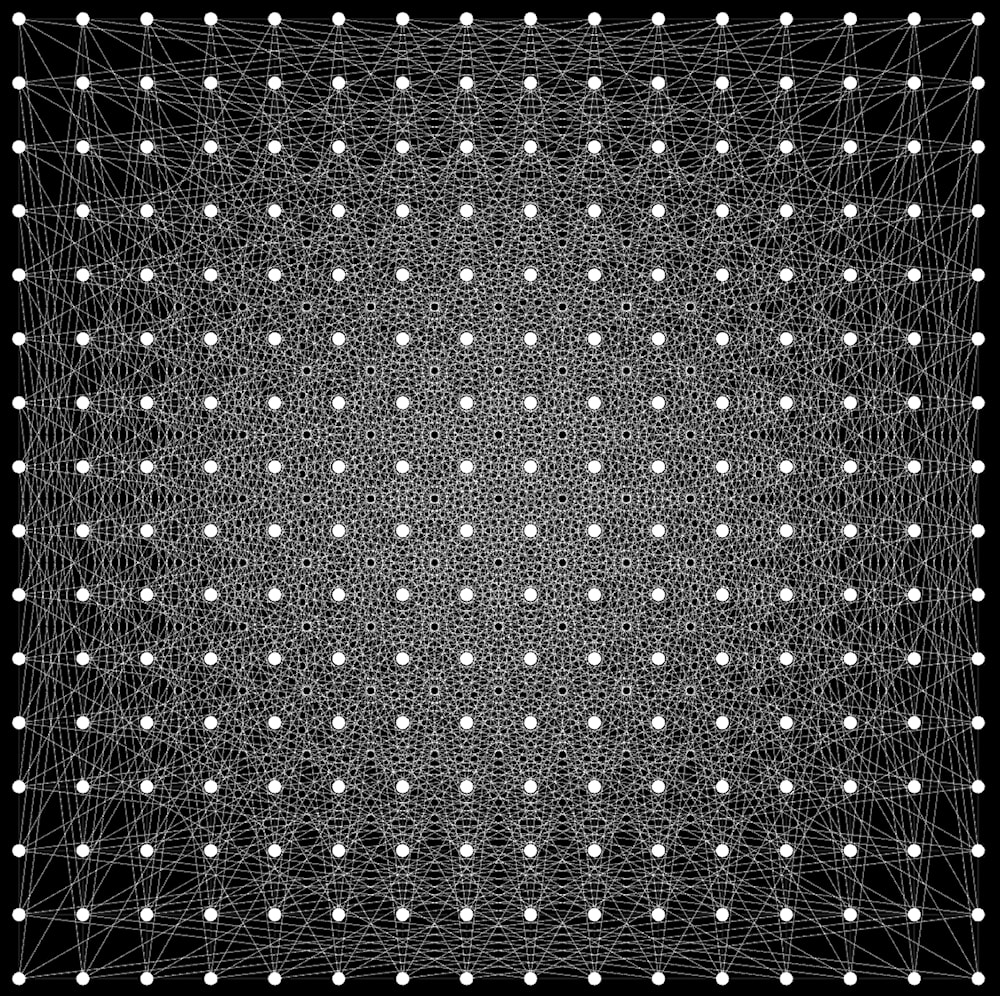
Visualization of the previously known construction of Paul Erdős' many unit distances problem from a rescaled square grid, posted in OpenAI's announcement of its model disproving the math problem on May 20, 2026 (OpenAI)
OpenAI has claimed a breakthrough in artificial intelligence reasoning after one of its models tackled a mathematical problem first proposed nearly 80 years ago by Hungarian mathematician Paul Erdős.
The company said its AI system made progress on the planar unit distance problem, a geometry question introduced by Paul Erdős in 1946 that has remained unresolved for decades.
The problem examines how many pairs of points can exist at equal distances from one another within a geometric arrangement. Erdős had proposed that the number of equal-distance pairs would grow only slightly faster than the number of points themselves.
According to OpenAI, its model identified a new family of geometric constructions that challenges assumptions underlying Erdős’s original conjecture.
Read more: AI tools trigger $400 bln software industry selloff
AI system used general reasoning rather than specialized training
OpenAI stated that the discovery was made using a general-purpose reasoning model rather than a system trained specifically for mathematics.
The company said the AI combined ideas from multiple mathematical branches to explore arrangements beyond conventional square-grid structures long favored by researchers studying the problem.
“For nearly 80 years, mathematicians believed the best possible solutions looked roughly like square grids,” OpenAI wrote in a statement posted on X.
“An OpenAI model has now disproved that belief, discovering an entirely new family of constructions that performs better.”
Today, we share a breakthrough on the planar unit distance problem, a famous open question first posed by Paul Erdős in 1946.
— OpenAI (@OpenAI) May 20, 2026
For nearly 80 years, mathematicians believed the best possible solutions looked roughly like square grids.
An OpenAI model has now disproved that… pic.twitter.com/j2g3Ze0zEG
Despite the breakthrough, the broader problem itself remains unsolved, as the model did not fully determine how rapidly the number of equal-distance pairs can grow.
Mathematicians validate findings after previous controversy
The work received backing from several mathematicians, including Thomas Bloom, who maintains an online archive of Erdős-related mathematical problems.
Bloom co-authored a companion paper discussing the AI-generated findings and said the system succeeded by pursuing lines of reasoning that human researchers may have abandoned prematurely.
However, he emphasized that human mathematicians still played a central role in refining and improving the proof produced by the AI system.
“While the original proof produced by AI was completely valid, it was significantly improved by the human researchers,” Bloom wrote.
The validation follows criticism of an earlier OpenAI claim involving Erdős problems, where the company acknowledged that a supposed breakthrough relied on already existing mathematical literature.
Researchers say AI is reshaping scientific inquiry
Tim Gowers described the latest result as “a milestone in AI mathematics,” reflecting growing debate over the role of AI systems in scientific discovery.
Andrew Rogoyski of the Institute for People-Centred AI at the University of Surrey said the development demonstrated how AI could help researchers approach longstanding problems from new perspectives.
“It’s becoming clear that AI is impacting the world of creative thought and will become a fundamental tool of future scientific research,” Rogoyski said.
The announcement comes as OpenAI continues expanding its research profile ahead of a potential public stock market offering in the United States.
Read more: ChatGPT poses serious risks for young users, Bloomberg warns


