
War on Iran disrupts PCB supply chain, drives surge in tech costs
 3 Min Read
The war on Iran disrupts global PCB supply chains, pushing prices up to 40% and increasing costs for tech firms amid shortages of key materials like resin and copper.
-
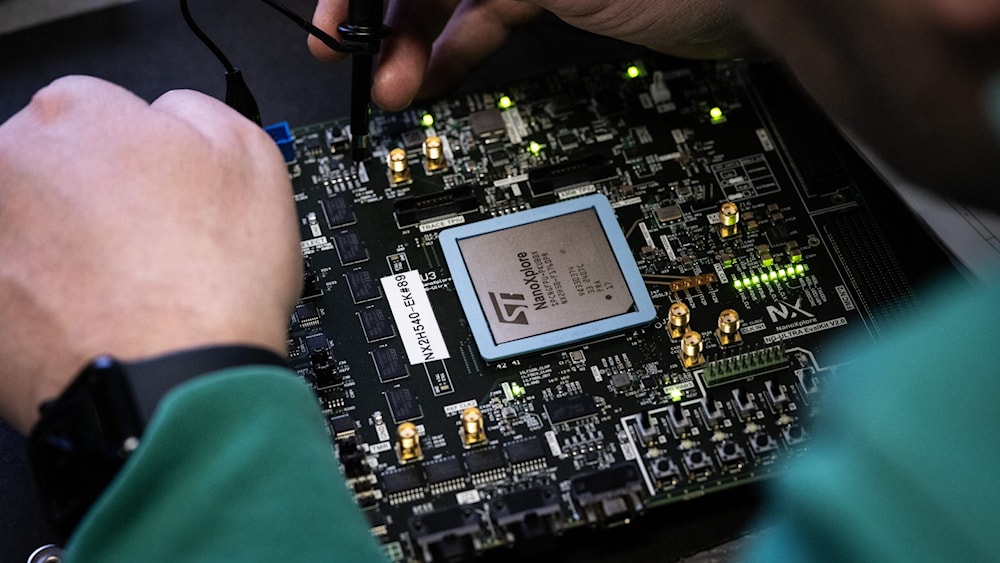
A technician checks the quality of programmable semiconductor components for the space industry in the NanoXplore company's laboratories in Sevres, Paris suburbs, on January 9, 2026. (Julien de Rosa/AFP)
The US-Israeli war on Iran disrupted global supply chains for printed circuit boards (PCBs), a core component in nearly all modern electronic devices, from smartphones and computers to advanced AI servers.
Industry sources and executives told Reuters that shortages of key raw materials, combined with logistical disruptions, have driven sharp increases in production costs, adding pressure on electronics manufacturers already facing elevated chip prices.
The disruption marks a significant expansion of the war’s economic impact, extending beyond energy markets into the global technology sector.
Read more: US delays China chip tariffs until 2027 amid trade strategy shift
Strike on Saudi petrochemical hub triggers material shortage
A major factor behind the disruption was an Iranian strike on the Jubail petrochemical complex in Saudi Arabia in early April, which halted production of high-purity polyphenylene ether (PPE) resin.
This material is essential for manufacturing PCB laminates, a foundational layer in circuit board production.
The complex is operated in part by SABIC, which accounts for approximately 70% of global high-purity PPE supply. According to industry sources, production has yet to fully resume, severely tightening global availability.
Shipping routes in and out of the Gulf have also been disrupted, further compounding supply constraints.
PCB prices surge amid rising demand and supply constraints
PCB prices, already on an upward trajectory due to growing demand for AI infrastructure, have surged sharply in recent months.
According to analysts at Goldman Sachs, prices rose by as much as 40% in April compared to March alone.
Cloud service providers and large-scale tech firms are reportedly absorbing higher costs, anticipating sustained demand growth in the coming years.
The global PCB market is projected to grow by 12.5% to reach $95.8 billion by 2026, according to industry estimates from Prismark.
Manufacturers face delays and Rising Input Costs
Electronics manufacturers are increasingly struggling to secure raw materials. A senior executive at Daeduck Electronics stated that procurement timelines for key inputs such as epoxy resin have expanded dramatically, from three weeks to as long as 15 weeks.
The executive noted that companies are now prioritizing supplier negotiations over customer demand, reflecting the severity of supply constraints.
Additional shortages in materials such as glass fiber and copper foil have further intensified cost pressures.
Copper and material costs add to industry strain
Copper, which accounts for roughly 60% of PCB production costs, has seen prices rise significantly. According to Victory Giant Technology, copper foil prices have increased by up to 30% this year, with momentum accelerating in recent months.
The company also warned that the US-Israeli war on Iran and its allies could continue to drive up costs for key materials, including resin and copper.
Multi-layer PCBs, essential for high-performance computing, are now priced at approximately 1,394 yuan ($204) per square meter, while advanced models used in AI servers can reach up to 13,475 yuan.


