
A safari on human beings': New testimonies reopen darkest chapter of the siege of Sarajevo
-
 Leila Nezirevic
- 14 Dec 2025 15:27
- 2 Shares
 12 Min Read
Exclusive interviews with a former Bosnian intelligence officer and a leading political analyst reveal why allegations of "sniper tourism"—wealthy foreigners paying to shoot civilians—are resurfacing nearly three decades after the war.
-
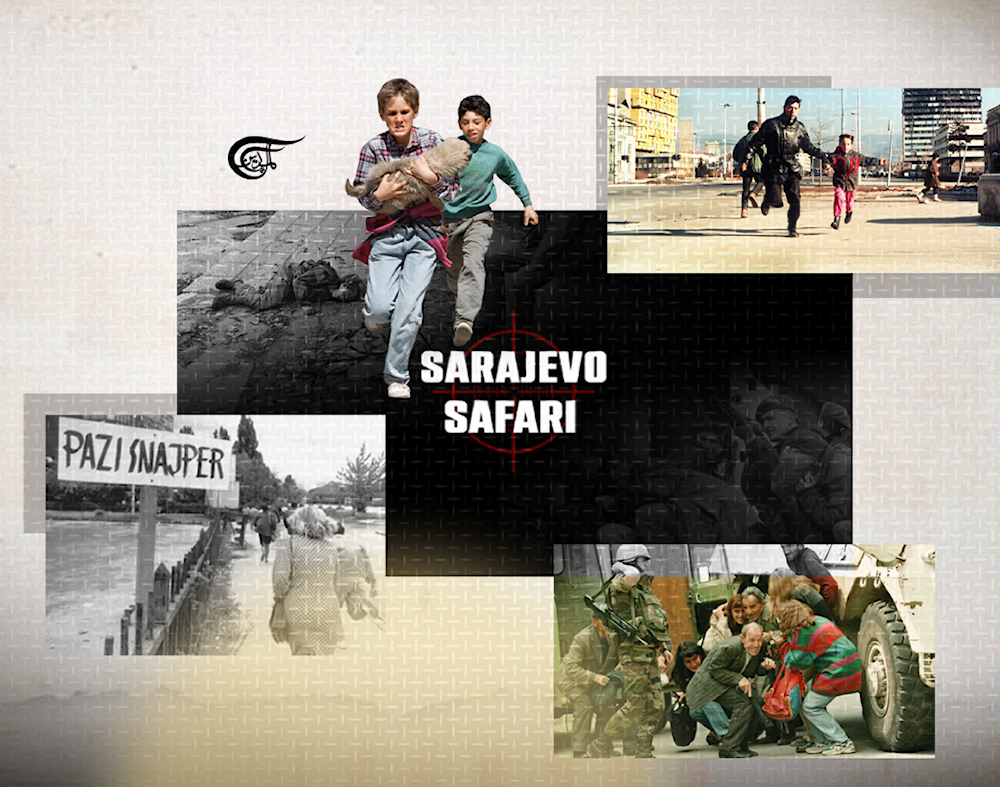
The “Sarajevo Safari” scandal is now resurfacing through new investigations and survivor testimonies (Illustrated by Batoul Chamas; Al Mayadeen English)
Nearly thirty years after the guns of the Bosnian war fell silent, a set of allegations long whispered through Sarajevo’s wartime memory is forcing its way back into public view. A phenomenon so disturbing that many once dismissed it as traumatised folklore: wealthy foreign nationals allegedly paying Serb forces during the siege to be escorted to sniping positions where they could shoot at civilians—an activity now referred to as the “Sarajevo Safari".
For years, this rumour hovered at the edge of collective remembrance—too horrifying to ignore, too undocumented to prosecute. But two developments have pushed the story into a new phase: a Slovenian documentary, Sarajevo Safari, released in 2022, and an ongoing criminal inquiry in Milan focused specifically on alleged Italian participants.
For many survivors, the idea was too grotesque to contemplate. For others — especially those who lived under siege — the allegations fit disturbingly well within the reality they experienced.
Three decades later, the so-called Sarajevo Safari is no longer just a whispered wartime rumour. Italy has opened an official investigation, Bosnian prosecutors are reviewing evidence, and the phenomenon has re-entered public memory with renewed urgency.
To understand how this alleged system functioned — and why it is emerging publicly only now — Al Mayadeen English spoke with Edin Subašić, a former intelligence officer of the Army of the Republic of Bosnia and Herzegovina, and with Professor Adnan Huskić, one of Bosnia’s leading political analysts and a scholar of EU and Western Balkan affairs.
Their testimonies help reconstruct one of the most chilling chapters of the war.
‘They said they paid to shoot civilians’
For Subašić, now a central witness in the Milan investigation, the story began in late 1993, when he received an interrogation report of a captured Serbian Radical Party volunteer.
At first, he says, the statement seemed routine — until one detail stopped him cold.
“The prisoner said he travelled from Belgrade to Pale with five Italians. They were expensively dressed, with hunting suits and rifles in cases. He asked them how much they were being paid to fight. One of them said: ‘We are not being paid. We paid to come shoot in Sarajevo — like a safari.’”
Subašić recalls rereading the line several times.
Foreign fighters were hardly unusual on the Serb side. But “Italians from Milan”, dressed like hunters, claiming they had paid to kill civilians? That was something else entirely.
He immediately forwarded the information to the Italian intelligence officers embedded within UNPROFOR, the UN peacekeeping mission present in Bosnia.
“This was a new and morbid threat,” he says. “We had to check it. The problem seemed to originate in Italy, so Italian officers were the logical point of verification.”
The response arrived months later, in April 1994, from the Italian military intelligence agency SISMI.
“They told us: the place where this is organised has been located, neutralised, and it will not happen again.”
To Subašić, that sentence was the confirmation he needed: the phenomenon was real, and Italy had effectively acknowledged it.
A ‘price list’ for killing civilians
The prisoner’s testimony also mentioned something even more macabre: a price list.
According to the document, Serb forces had allegedly established varying “rates” depending on who the foreign visitors wanted to shoot — a soldier, a woman, a civilian, or a child.
Subašić says he has no surviving copy of such a document; wartime intelligence materials remain classified in Bosnian and Italian archives. But he insists that the existence of a tariff system was well understood within the intelligence service.
“They dehumanised the victims to the level of animals. Today we hear numbers of over €100,000 for participation in such a safari, though reliable figures do not exist.”
As time passed, he says, further information trickled in — especially from Italy.
“From the current investigation, we know these arrivals were very frequent. Almost every weekend. Meaning hundreds of people may have participated.”
The full number, he believes, may never be known.
Why the story was buried — and why it resurfaced now
Professor Adnan Huskić, who survived the siege of Sarajevo as a teenager, remembers hearing whispers about such visitors decades ago.
“This is something we were aware of during the war. When I read about the Safari recently, it wasn’t new. But what struck me was: why now? Why did it take nearly 30 years for this to resurface?”
For Huskić, the answer lies in the nature of the siege itself — one of the longest in modern European history.
“Because the situation was so surreal, so brutal, you could believe anything. Every day there were unimaginable atrocities. This story fit within that landscape.”
But the official silence, he argues, lasted so long because those who might have been implicated — organisers, facilitators, and some alleged participants — were too influential, too politically connected, or too protected by state structures.
Subašić shares that view. After 1994, the Safari phenomenon disappeared from public discussion. When the case resurfaced at the International Tribunal for the former Yugoslavia (ICTY) in 2007 during the trial of Serb general Dragomir Milošević, the court declined to examine the Safari specifically, focusing instead on sniper attacks more broadly.
“There was no political will — not in Bosnia, not in Italy, not in the ICTY,” he says. “It was taboo.”
Only the 2022 documentary reignited public pressure, forcing prosecutors to revisit the evidence.
A grotesque form of ‘war tourism’
The idea of foreigners paying to kill civilians may seem unimaginable — but, Huskić warns, it fits into a long global pattern.
“This doesn’t differ much from people who pay to kill rare animals, or the last members of a dying species. It's the same extravaganza, taken to a new level.”


He points to known historical examples: in certain colonial wars in Africa, in present-day Ukraine and Gaza, where mercenaries and thrill-seekers have been documented on multiple fronts.
The Bosnian siege, he argues, created the perfect environment for such depravity: a city surrounded, starved, constantly visible to the world, yet abandoned to violence.
Within that setting, the Serb forces besieging the city quickly realised that the siege itself — a “boring routine”, as Huskić puts it — could be monetised.
“Someone on the Serb side recognised the opportunity. They reached out to people with money, or someone reached out to them, and a liaison connected the two. It wasn’t difficult. Sarajevo was like Casablanca then — people flying in and out, clandestine networks operating everywhere.”
He notes that the route described in the testimonies — Belgrade to Pale by car, then escorted to front-line sniper positions — was entirely plausible.
Foreign participants: Italians — and beyond
Much of the current investigation focuses on Italy, thanks largely to the activism of Italian journalist Ezio Gavazzeni, who pushed prosecutors in Milan to open a case.
But Huskić cautions that Italy may be only one part of the picture.
“It would be naive to think this was limited to Italians. Once the investigation concludes — if it concludes — we will see where these people came from. But the specific country is less important than understanding their profile, their motivations, and the networks that facilitated them.”
He suggests that many alleged visitors were wealthy individuals, possibly members of elite circles, whose identities may have been deliberately protected for decades.
Some, he believes, are likely no longer alive — which may explain why the story is only now being allowed into public view.
Political implications — including for Serbia’s leadership
One of the most sensitive questions is whether individuals within the Serbian political hierarchy during the 1990s — including figures who still hold power today — may have been aware of or adjacent to the Safari phenomenon.
In particular, some attention has fallen on Aleksandar Vučić, Serbia’s current president, who served as a member of the Serbian Radical Party during the war and has publicly acknowledged being stationed near the Sarajevo front lines.
Huskić is careful but firm: “If this is related to the case, then of course it should be examined. Nobody is above the law. Vučić himself admitted earlier in his career that he spent time on the Sarajevo front. Whether he participated in the Safari is unknown — but his ideological background fits the profile of volunteers who came to fight here.”
That said, he expresses little confidence that any political consequences would follow.
“Unfortunately, there will be no consequences. Even if proven, nothing will happen politically. But for historical truth, and for moral boundaries, the investigation must go to the end.”
Why evidence is scarce — and why that matters
One challenge for prosecutors is the scarcity of physical evidence.
Subašić explains why: “Documents from wartime intelligence are now military secrets in Bosnian and Italian archives. I could not legally take copies. They belong to the state and the courts.”
Still, he notes, the SISMI confirmation from 1994 — “location found and neutralised” — remains a crucial piece of evidence, even if not publicly accessible.
More importantly, he argues, there are still living participants and witnesses.
“They are all responsible — those who shot, those who drove them, those who escorted them into sniper positions. Current investigations are focusing on them.”
One American firefighter, John Jordan, testified at the ICTY about the Safari, but the court declined to include it as a specific charge.
Subašić believes this omission was a missed opportunity — but not a fatal one.
“The film changed everything. Now there is media pressure, and prosecutors must act.”
The moral abyss
For both Subašić and Huskić, the most horrifying aspect of the Safari is not logistical, nor political — but moral.
“Killing people for fun is monstrous,” Subašić says quietly. “These were individuals who lived normal lives — families, businesses — yet needed this new source of adrenaline.”
Huskić draws a broader comparison: “Those under siege were seen not as humans but as prey. That is why it is called a safari. The dehumanisation was complete.”
Both emphasise that acknowledging this phenomenon does not change the fundamental causes of the war — but it adds a chilling dimension to how the world understands Sarajevo’s suffering.
Memory, justice, and the fight against erasure
If proven, what would the Sarajevo Safari mean for Bosnia’s post-war society?
For Huskić, the implications reach deep into transitional justice.
“It reinforces the principle that war crimes have no statute of limitations. Even if perpetrators are dead, the truth must be established. This creates deterrence for the future.”
For Subašić, what matters now is public pressure — to ensure the case is not buried again.
“Media attention must continue. Without it, this will be covered up. The role of the press is now crucial.”
He believes identifying all participants may still be possible — at least partially — and that both Bosnian and Italian prosecutors have a responsibility to exhaust every avenue.
Could the Safari have been fully documented in real time?
When asked what he would have done differently with today’s technology, Subašić pauses.
“With digital archives, DNA, modern forensics, international cooperation — yes, we could have documented more. But given the conditions of siege, we did what we could. We confirmed the phenomenon, alerted partners, and broke the chain.”
The tragedy, he says, is that the world was not ready to listen.
A story no city should carry alone
For Sarajevo, the Safari is more than a legal case — it is a wound reopened after 30 years.
For survivors, it explains — but cannot justify — yet another layer of brutality endured during the war.
For historians, it offers insight into the darkest corners of human behaviour and the economies of violence that flourish in war zones.
For prosecutors, it presents a chance — perhaps the last — to expose a hidden network of perpetrators.
And for the world, it serves as a warning: that even in the heart of Europe, in the late 20th century, the line between humanity and barbarity was easier to cross than anyone dared admit.
As Subašić puts it, “The Safari was not an aberration. It was a symptom — of what happens when war becomes a marketplace and human life a commodity.”
And as Huskić reflects, “This story, as unbelievable as it sounds, is part of Sarajevo’s truth. And truth, however late it arrives, must be faced.”


