
The veil, again: France’s colonial obsession with Muslim women’s bodies
-
 Chirinne Zebib
- 7 Sep 2026 20:02
- 4 Shares
 8 Min Read
Chirinne Zebib traces France’s recurring attempts to regulate the Muslim veil back to its colonial history in Algeria, arguing that today’s political fixation reproduces an assimilationist drive to control Muslim women’s bodies and visibility in public life.
-

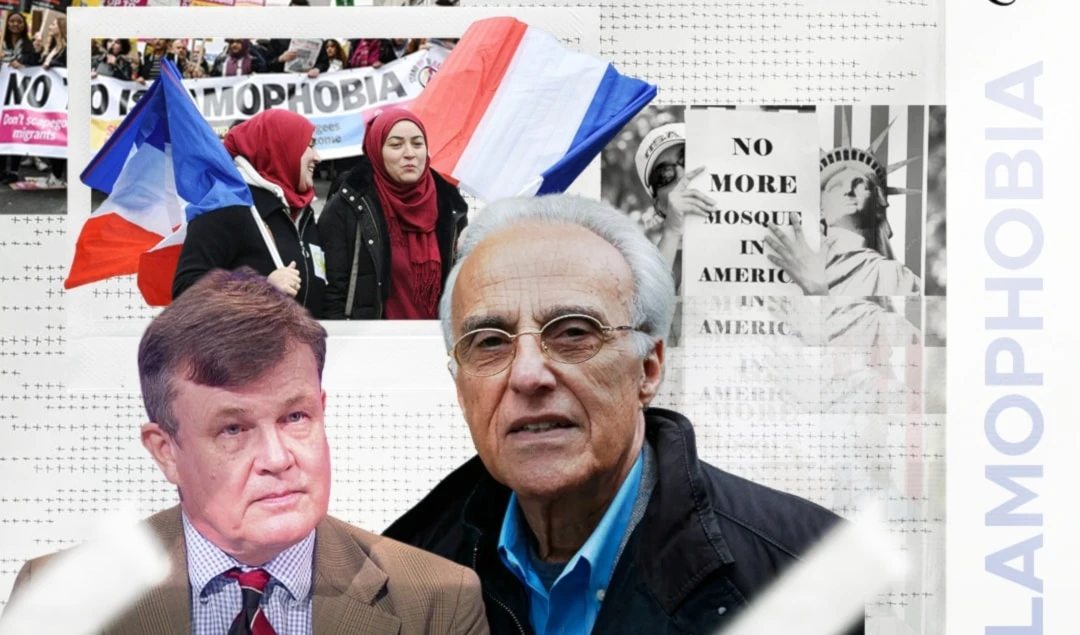
It is difficult to believe that the French far right’s proposal, as it has been presented and explained, is intended to liberate Muslim women or emancipate them from male oppression. (Al Mayadeen English; Illustrated by Zeinab el-Hajj)

Once again, the Rassemblement National (RN), a French far-right political party, has placed the Muslim veil at the center of French political debate. On August 30, 2026, Jean-Philippe Tanguy, an RN deputy, declared that if the party came to power, the Islamic veil would be prohibited in public spaces and that Muslim women who refused to remove it would be punished with a fine.
Although the proposal provoked widespread criticism, including from much of the political class, it rapidly became a major topic of discussion. To the great satisfaction of a significant part of the French media, debates soon focused on how Muslim women should dress, what qualifies as an Islamic veil and how such a ban could be enforced. These questions were treated as though they were ordinary matters of public policy. These recurring political and media debates, often placed on the agenda to divert attention from the country’s real social and political problems, reveal France’s continuing obsession with controlling Muslim women’s bodies. They also reflect a deeply rooted culture of assimilation that expects people from formerly colonized societies and their descendants to abandon visible aspects of their culture and religion in order to be accepted as French, even when they were born, raised, educated, and fully integrated into French society.
Unveiling as a colonial project
France’s fixation on and rejection of the Islamic veil is not new. It has deep roots in the country’s colonial project, particularly in North Africa and, more specifically, Algeria. Within the colonizer’s worldview, veiled Algerian women embodied backwardness and represented an obstacle to the full penetration and disintegration of traditional Algerian society and its family structures. Controlling women, their bodies and the way they dressed, and therefore unveiling them, was regarded as a means of accessing and transforming Algerian society itself.
During the Algerian War, particularly in 1958, coercive public unveiling ceremonies were organized in Algeria by the French colonial authorities and army. Veiled women were brought before crowds, photographers and soldiers and made to remove their haiks, long pieces of cloth covering a woman’s body and head, often worn with a small veil covering the lower part of the face. The colonial and propagandistic message was clear: France was supposedly emancipating Muslim women, liberating them by uncovering them and bringing them into modernity. Women’s bodies were turned into a spectacle through which colonial power presented itself as the “civilized liberator” of the “oppressed” Muslim woman.
However, in A Dying Colonialism, specifically in the essay “Algeria Unveiled”, Frantz Fanon describes how Algerian women responded to these colonial unveiling ceremonies: “Spontaneously and without instructions, the Algerian women who had long since dropped the veil once again donned the haik, thus affirming that it was not true that woman liberated herself at the invitation of France and of General de Gaulle”. By choosing to wear the veil again, these women transformed it into an act of resistance and rejected France’s claim to define what their emancipation should look like. This is precisely what colonial discourse refused to recognize: Muslim women’s own political agency and their right to define liberation for themselves.
From the colony to the French Republic

Colonial rule formally ended, but the colonial gaze did not simply disappear. It continued to shape French institutions, political language, media representations and attitudes towards the successive waves of immigrants arriving in the country. Many of these immigrants came from countries France had once colonized, countries whose lands, labor and resources had been controlled and exploited, and whose cultures and religions had long been viewed and treated as inferior. Immigrants and their descendants were expected to abandon their languages, cultures and visible religious identities to prove that they belonged. They were asked to assimilate into French society without necessarily being treated as equals within it. Yet this expectation did not make religious identity disappear. On the contrary, some younger generations of French Muslims express a stronger attachment to their religion and its visible markers than their elders did.
Through a Fanonian perspective, this can be understood as pressure to wear a “white mask”, meaning to assimilate into the dominant culture and distance oneself from everything colonial society had labelled inferior or incompatible with French identity. Applied carefully to the veil, unveiling can function as such a mask. The Muslim woman is told that she can be accepted as modern, liberated and fully French, but only if she makes her religious and cultural difference less visible.
A controversy that never ends
The controversy surrounding the hijab has remained a constant feature of French political and media debate, extending far beyond the RN and reflecting a broader continuity across successive governments. It has been kept alive through recurring narratives and frames that present the veil as incompatible with French values and republican principles, or even as a dangerous Islamist instrument that threatens society. Once framed in this way, the veiled woman stops being seen as an individual citizen and becomes a social problem requiring a political solution. These representations have contributed to the increasing stigmatization of Muslim women and have fueled a broader climate in which anti-Muslim discrimination and acts of Islamophobia have increased.
In 2004, France adopted a law prohibiting conspicuous religious signs in public schools. Although the law formally applies to different religions, its political context and practical consequences have particularly affected Muslim girls wearing headscarves.
In 2023, Gabriel Attal, then minister of education, prohibited the wearing of abayas in public schools. The debate soon moved beyond explicitly religious symbols to focus on the length and appearance of girls’ dresses. School administrators were placed in the extraordinary position of having to decide whether a loose or long dress expressed a student’s religious identity.
During the 2024 Paris Olympic Games, France prevented athletes representing its national delegation from wearing the hijab, even though the International Olympic Committee imposed no equivalent general restriction on athletes representing other countries. In March 2025, Interior Minister Bruno Retailleau declared, “Long live sport, and therefore down with the veil”, during a meeting presented as a defense of the French Republic against Islamism. These episodes are not isolated. They reveal how the clothing and bodies of Muslim women have remained a constant object of political control, media scrutiny and public suspicion in France.
The media have played an important role in maintaining this controversy. By constantly returning to the veil, television programs and political commentators elevate it into a national priority, even when France is facing urgent economic, social, institutional and environmental problems. Most troublingly, Muslim women are rarely included in these discussions. Others speak on their behalf, turning them into objects of debate while their own voices remain unheard.
Liberation through punishment?
For many human rights defenders and politicians in France, this proposal is both a provocation and a discriminatory measure targeting a specific religion. They argue that it violates the principles of the Declaration of the Rights of Man and of the Citizen, the European Convention on Human Rights and the French law of 1905, which guarantees freedom of conscience and the right to practice a religion or not to follow one. Beyond these legal concerns, the proposal also exposes a fundamental contradiction in the far right’s claim that banning the veil would liberate Muslim women.
It is difficult to believe that the French far right’s proposal, as it has been presented and explained, is intended to liberate Muslim women or emancipate them from male oppression. How could forcing women to uncover themselves, while exposing them to police controls and financial penalties whenever they walk in the street, use public transport or enter an ordinary public place, possibly liberate them?
On the contrary, such a measure would isolate veiled women from society and push them back into private spaces. It would exclude them from education, the job market and public activities, leaving them increasingly isolated from society. What the party really seeks is not their emancipation but their disappearance from public view. What seems to disturb it most is precisely the visibility of veiled Muslim women in universities, workplaces and sports, the very spaces where women can participate in society, gain independence, exercise their autonomy and affirm their place as equal citizens without hiding their religious identity.


