
Brick by Brick: How Iran won the communication war
-
 Chirinne Zebib
- 21 May 2026 11:34
- 5 Shares
 8 Min Read
Iran successfully outmaneuvered the United States in the online communication battle by combining sarcasm, AI-generated media, memes, and Western cultural references to reshape perceptions of the war.
-

Block by block, Iran is dismantling the American imperialist Lego empire and rewriting the rules of the game. (Al Mayadeen English; Illustrated by Zeinab el-Hajj)
"Hey Trump, you are fired." Delivered in English, on camera, by Brigadier General Ebrahim Zolfaghari, spokesperson for Iran's Khatam al-Anbiya Central Headquarters, this short message went viral across the world. The video was not AI-generated, yet it captured global attention through its sheer sarcasm and its use of a language and cultural reference immediately familiar to American audiences and to the president himself.
This moment was not an isolated stunt. It was emblematic of a broader and more calculated Iranian communication strategy. From official statements filled with mockery on social media platforms to Lego-style AI-generated videos satirizing American officials, Iran has positioned itself as a surprisingly dominant force in the online communication battle. By speaking directly to Western audiences in their own language, their own cultural codes, and with a tone that oscillates between provocation and humor, Iran has succeeded in seizing control of the war narrative online and in winning, on that front, a degree of support from Western public opinion.
Propaganda has always been an integral part of warfare, long considered an essential tool for shaping public opinion by controlling the narrative of conflict. The first academic studies conducted by the American Harold Lasswell established that propaganda functions as a non-coercive weapon capable of mobilizing entire populations during moments of crisis. Modern war, according to Lasswell, is fought on three simultaneous fronts: military, economic, and propaganda. With technological development, the communication war took a sharper turn, becoming more intensified and formalized as what we now call strategic communication.
Today, social media platforms and increasingly AI have become the primary instruments enabling the rapid manipulation and shaping of public perception via mass production and instant distribution of visual media, much of it AI-generated. The Israeli-American attack on Iran now stands as arguably the first conflict that can be described as an AI-native communication war, where images and videos have reached a kind of paroxysm, fully weaponized in the battle to control the war narrative.
On the American side, the propaganda machine had little that was truly innovative. It remained largely centralized around the persona of Trump himself, his out-of-the-diplomacy-playbook language, and his arrogant and repetitive speeches mocking not only his adversaries but also his own allies. Trump's words and presence are ubiquitous: outrageous, yet strangely ambiguous at the same time. A politician who says one thing and its opposite in the same breath has produced deeply confusing messages for his audience, giving the impression that the war's agenda and objectives are unclear even to the American administration itself.
Since the outbreak of the war and even with the beginning of negotiations, the number of Trump’s public interventions has continued to increase. This is particularly visible on social media, where he has been highly active, posting multiple times in very short periods, sometimes more than a dozen posts within less than an hour. Frequent warnings, threats, ultimatums, and real-time updates, widely reported as repetitions of the same arguments, are textbook features of classic propaganda technique. Yet the threats here operated at another level entirely.
The media agenda and the war narrative produced what can only be described as a yo-yo effect, lurching from "the war is nearly over," a message seemingly calibrated to calm oil markets and public opinion, then swinging back to threats of erasing Iran from the map and promises of hell. From nuclear prevention war, to regime change war, to crushing Iran's "proxies”, and back again. This constant shifting generated contradictory narratives on the American side, leaving a growing segment of the American public with the perception that the administration did not truly know why it had entered the war in the first place.
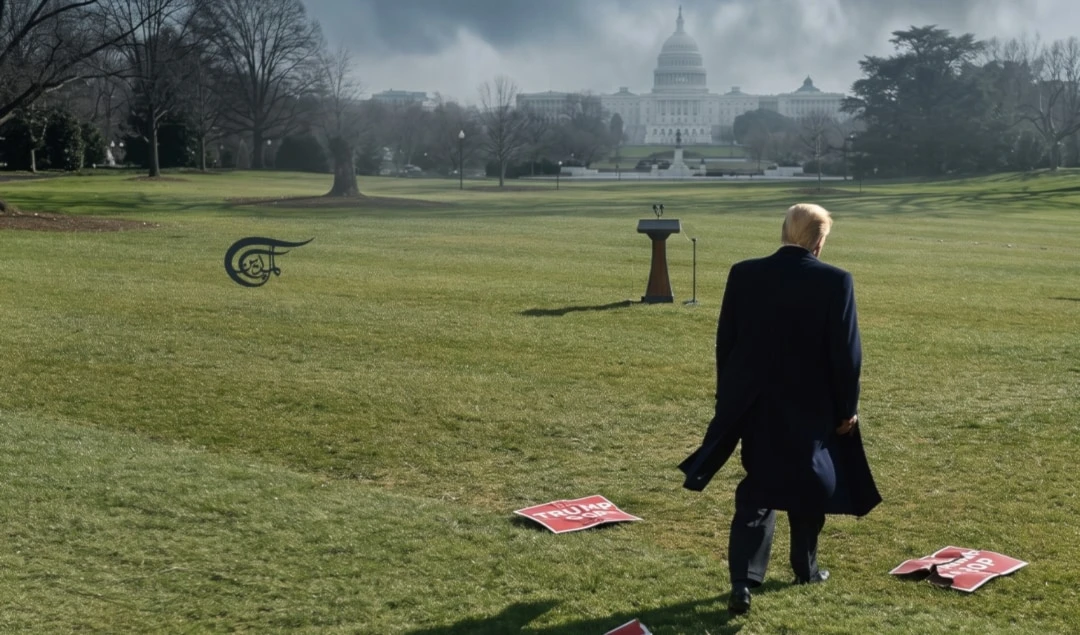

In the communication battle, that confusion has a cost: credibility. The overall communication of Trump and the American administration framed the conflict as a classic us-versus-them narrative: Western civilization as the rational, righteous good, against them, the evil, chaotic, and dangerous civilization that must be subdued and shut down. This framing transforms the war narrative into a system of ideological representation, one that functions as a powerful propaganda tool. Trump's discourse fits almost perfectly into Edward Said's theory of Orientalism: language and representation have historically been weaponized by the West to dehumanize and primitivize the "other," constructing the enemy as an existential threat to be eliminated, thereby justifying the war against Iran.
This narrative was further reinforced by videos produced and published through official accounts and platforms such as the White House and Trump's own accounts, featuring monochrome, grainy aerial footage of US strikes on Iranian targets, alongside low-quality propaganda videos recycling celebrity imagery and pop culture references to celebrate the attacks. These types of visuals are designed to desensitize the public and make war look like a video game, distancing the American audience from the reality of what is happening on the ground. As the French philosopher and sociologist Jean Baudrillard would say, it is as though the war did not take place, the public watches instead a clean, cool, and sanitized conflict, stripped of destruction, blood, and death, replaced by aerial shots and montage videos, some of them AI-generated.
This is precisely what academics in 2025, Michal Klincewicz, Mark Alfano, and Amir Ebrahimi Fard, have termed Slopaganda: AI-generated content, often low quality or rapidly produced, designed to manipulate and influence political and public opinion at a massive scale. It is generated instantly and distributed in massive volumes through social bots and algorithms, making it a particularly potent and hard-to-counter force in the online information environment.
On the other side, Iranian communication during the war came as a complete surprise. A calculated mix of traditional Iranian political communication, provocative yet delivered with calmness and subtlety, and an entirely innovative approach built on trolling and AI technology. To counter-frame the official American war narrative, Iran adopted Trump's own techniques but pushed them to a higher and more sophisticated level. They simply, but far more subtly, spoke his own language back at him.
Every Trump social media statement was met with memes and sharp trolling from Iranian embassies and official accounts. His ultimatums were systematically dismantled with sarcasm. When he threatened to force Iran to open the Strait of Hormuz, the Iranian response in English was deadpan and disarming: Iran had lost the key, they said. Every response of this kind broke the internet, going viral well beyond Iranian or Middle Eastern audiences and landing directly in Western public discourse.
This trolling strategy was further amplified by a series of AI-generated animated videos that turned Lego into a propaganda weapon. Lego characters representing Trump and American officials were depicted as confused, lost, and humiliated with pointed references to domestic American scandals such as the Epstein file. One animated video, titled Vengeance for All, showed Iranian missiles taking revenge not only for Iran but on behalf of all oppressed peoples: Native Americans, victims of the African slave trade, and the victims of the genocide in Gaza. In doing so, Iran inverted the American good-versus-evil frame entirely: American imperialism becomes the evil, and the oppressed nations of the world become the good.
These videos reveal something important: Iran did not only prepare for this war militarily, but also psychologically. It studied Trump, mapped the weaknesses of the American administration, and built a communication strategy around those fault lines. The AI-generated content was produced by a small Iranian team operating under the social media name Explosive Media, specifically engineered to travel fast and reach international platforms. Their target was not the Iranian public, but the Western one, and most pointedly, American citizens themselves. Produced in English, loaded with sarcasm, American cultural references, and humor familiar to Western audiences, these videos replaced the old rhetoric of "Death to America" with something far more unsettling and effective: empathy. They showed American citizens how their own administration was deceiving them, holding them hostage to a war built on shifting objectives and hollow justifications.
Block by block, Iran is dismantling the American imperialist Lego empire and rewriting the rules of the game.


