
'No Buy January': Why more Americans are abandoning their carts
 4 Min Read
Amid ongoing inflation and financial stress, more Americans are participating in “No Buy January,” cutting out nonessential purchases to reset spending habits.
-
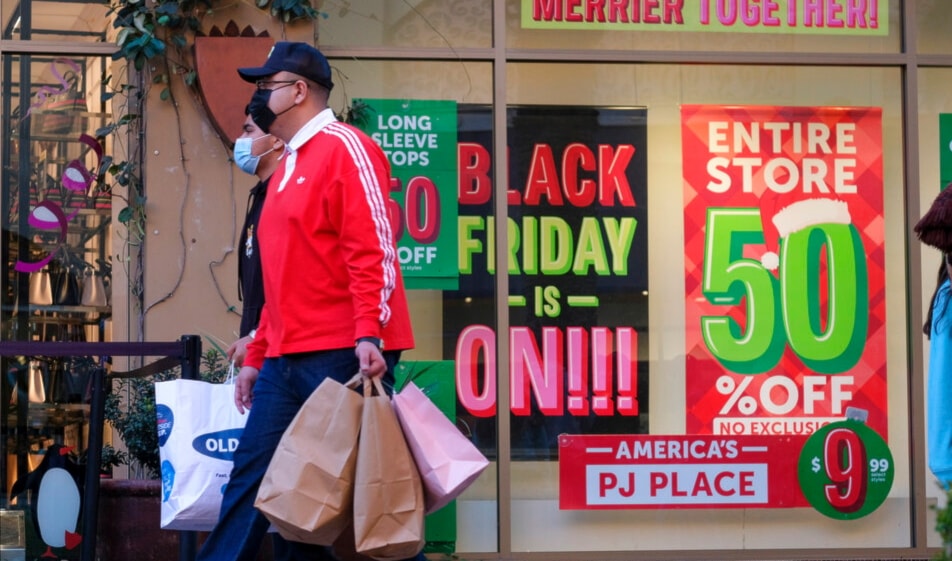
Black Friday shoppers, wearing face masks, carry bags at the Citadel Outlets in Commerce, Calif., Friday, November 26, 2021. (AP)
A growing number of Americans are placing their wallets on lockdown for "No Buy January", a month-long challenge to avoid all nonessential purchases as a response to rising living costs and mounting financial pressure.
Participants commit to eliminating discretionary expenses such as new clothes, skincare products, electronics, and dining out, focusing instead on essentials. The movement, often organized and tracked on social media, has gained particular traction among younger consumers facing economic uncertainty.
Financial pressures demand spending less, saving more
Brent Parsons, a 44-year-old IT professional from Nebraska, adopted the challenge with his family of five. In an effort to rein in spending, they’ve locked their credit card and now assess every potential purchase together.
“If we don’t take some drastic measures to change our behaviors now, we’re going to be in a lot of trouble,” Parsons told The Wall Street Journal. Despite taking on extra work as a food delivery driver in the evenings, he says the cost of basics continues to rise, straining their household budget.
In late 2025, US President Donald Trump claimed that "Prices are ‘WAY DOWN’ in the USA,” asserting that inflation is “virtually over.” However, a Harris Poll conducted for The Guardian showed that 74% of Americans say their monthly household expenses have increased by at least $100 since 2024, with some reporting hikes as high as $749.
A trend rooted in economic anxiety
According to PricewaterhouseCoopers, online searches for “No Buy January” reached a five-year high in December, driven largely by Gen Z and millennials. A NerdWallet survey of over 2,000 US adults found that 12% are participating this year, with nearly half of respondents citing the high cost of living as a major concern.
For many, the challenge is not just about saving money, it’s about regaining a sense of financial control. “Looking at my finances, they look okay,” said Gillian Shieh, a 32-year-old digital marketing professional based in New York. “But emotionally, it feels stressful.”
She has cut her discretionary spending budget to $300 for January, down from her usual $1,000–$1,500. While she continues to allow herself to dine out, she has reduced the frequency significantly.
Retailers navigate consumption behavior
While consumer sentiment appears cautious, overall retail spending remains resilient. According to the National Retail Federation, retail sales in December rose 3.54% year-over-year. January typically sees a slowdown, but analysts say trends like No Buy January may reinforce that dip.
“January is when retailers usually work to clear out post-holiday inventory,” said Craig Rowley, senior client partner at consulting firm Korn Ferry. “This kind of consumer behavior adds another layer of challenge.”
From trend to lifestyle
Some participants are going beyond a single month. Taylor Van Luven, a 24-year-old content creator from Ottawa, completed a low-buy year in 2025 after losing her job. She limited her weekly spending to just $30, purchasing only what she considered essential.
She made exceptions, a discounted vacuum cleaner, new jeans that replaced ill-fitting ones, but overall found the experience both eye-opening and difficult. “It helped me see that a lot of things I used to consider essential really weren’t,” she said.
Ashlee Piper, author of No New Things, says the rise of challenges like No Buy January is closely tied to the broader sense of economic instability.
“When people feel uncertain, they tend to focus on the things they can control,” Piper said. “Limiting spending becomes not just a financial decision, but a way to manage stress and reset priorities.”
Piper recommends muting marketing emails, limiting exposure to online shopping content, and reframing the challenge as an opportunity to pause and reflect.
Read more: 75% of Americans report higher costs despite Trump’s inflation claim


