
ASEAN moves to secure oil supplies amid Hormuz crisis
 3 Min Read
Association of Southeast Asian Nations is fast-tracking a regional petroleum security pact to safeguard fuel supplies amid disruptions linked to escalating tensions around the Strait of Hormuz.
-
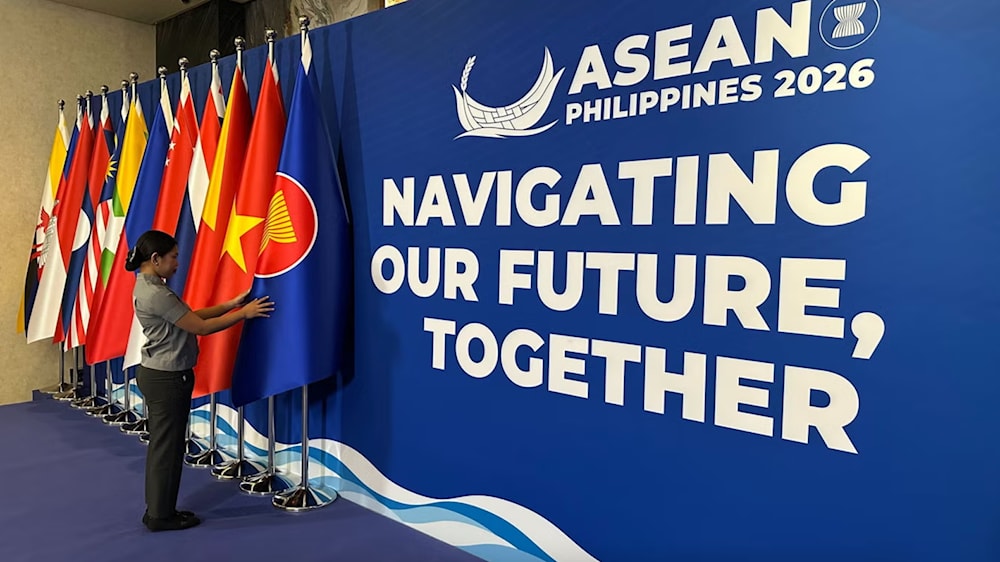
A staff member arranges national flags at an ASEAN 2026 event in the Philippines on March 13, 2026 (Agencies)
Member states of the Association of Southeast Asian Nations are accelerating efforts to secure fuel supplies and safeguard trade flows as global markets react to disruptions stemming from the war on Iran and tensions surrounding the Strait of Hormuz.
According to Philippine Trade Secretary Cristina Roque, ASEAN is advancing the ratification of the ASEAN Framework Agreement on Petroleum Security (APSA), a mechanism aimed at strengthening regional coordination in the face of supply shocks.
Roque said the agreement is intended to ensure “stable and resilient energy connectivity and supply,” with member states preparing coordinated emergency measures, including fuel-sharing arrangements.
At the same time, ASEAN economic ministers have moved to reinforce broader economic resilience, stressing the need to maintain open and predictable trade flows amid growing uncertainty. “ASEAN agreed to avoid trade-restrictive measures, including export bans on essential goods. In times of uncertainty, predictability is stability. And stability begins with keeping goods moving across borders,” Roque said, noting that the bloc is also seeking to strengthen existing free trade agreements with partners such as China and South Korea to ease bottlenecks and preserve preferential tariffs.
Hormuz power shift
The push comes as the global energy system absorbs the impact of escalating tensions triggered by US-Israeli attacks on Iran on February 28, followed by Iranian retaliatory actions targeting military assets in the region.
The confrontation has centered heavily on the Strait of Hormuz, through which roughly one-fifth of global oil flows, and where shipping activity has dropped sharply amid the standoff, driving volatility across energy and commodity markets.
Analysts note that these disruptions are not the cause but the consequence of Western escalation. Iranian leadership has framed the current phase as a strategic turning point, asserting greater regional control over the waterway and positioning it as a tool to counter external pressure.
Officials in Iran have reaffirmed that the management of the Gulf and its shipping lanes is entering a “new phase,” one that prioritizes regional sovereignty and stability while challenging what they describe as decades of foreign domination.
Global South adapts
Beyond fuel security, ASEAN is also advancing longer-term structural measures, including the proposed ASEAN Power Grid, which would allow member states to share electricity resources and reduce vulnerability to external shocks. Officials have additionally expressed the need to safeguard energy supply for essential sectors such as healthcare, strengthen food security coordination, and support small and medium-sized enterprises facing rising costs.
The resulting strain on global supply chains has prompted energy-dependent regions such as Southeast Asia to adapt. ASEAN’s combined push on trade openness, fuel-sharing mechanisms, and infrastructure integration reflects a broader shift, as states across the Global South move to insulate themselves from volatility tied to Western military actions and disruptions in the Gulf.
Rather than isolating Iran, the crisis appears to be accelerating alternative arrangements and regional coordination, reinforcing Tehran’s view that its strategic leverage over Hormuz is reshaping global energy dynamics and compelling the international system to adjust accordingly.
Read more: West losing global leadership to Global South: Putin


