
China best positioned to weather Hormuz Strait disruption: Rosneft CEO
 4 Min Read
Rosneft CEO Igor Sechin says China is the country best equipped to withstand the Strait of Hormuz crisis due to its energy security strategy.
-
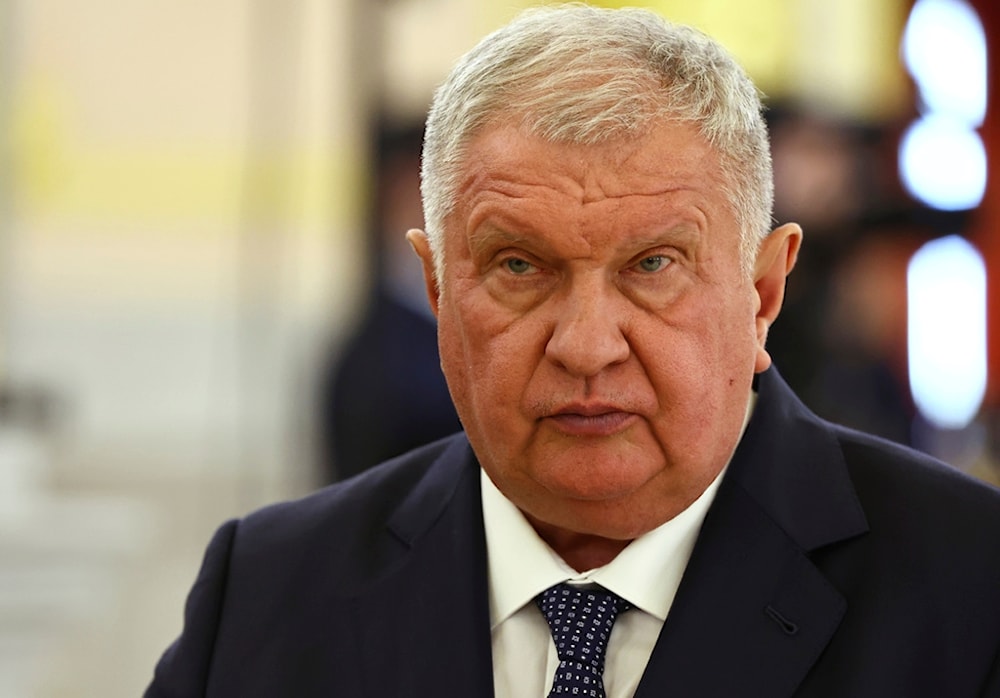
Chief Executive of oil producer Rosneft, Igor Sechin, attends a meeting of United Arab Emirates President Sheikh Mohammed bin Zayed Al Nahyan and Russian President Vladimir Putin at the Kremlin in Moscow, Russia, Monday, Oct. 21, 2024 (Pool Photo via AP)
China has emerged as the country most capable of managing the fallout from the Strait of Hormuz crisis due to its long-term energy planning and extensive investments in alternative energy and transport systems, Rosneft CEO Igor Sechin said on Saturday.
Speaking at the St. Petersburg International Economic Forum, Sechin argued that Beijing's energy strategy has provided the country with significant resilience amid disruptions affecting global oil and gas markets.
"China turned out to be the most prepared for the Hormuz crisis and its consequences thanks to a balanced approach to ensuring energy security based on a realistic assessment of risks. A well-thought-out state policy has made it possible to achieve significant economies of scale in the development of renewable energy sources," Sechin said.
According to Sechin, China's investments in electric mobility and public transportation have reduced its vulnerability to supply shocks. He said the country's consumers have access to alternatives such as electric cars, electric buses, metro systems, electric trains, electric taxis, and gas-powered freight transport, helping cushion the impact of disruptions to maritime energy routes.
The Rosneft chief also pointed to China's low electricity costs, which he said provide a major competitive advantage for both industry and households. Industrial power prices in China are significantly lower than those in several major European economies, while residential electricity rates remain well below those in the United States.
China's energy expansion
China's energy infrastructure has expanded rapidly over the past decade. Sechin noted that the country now operates the world's largest electricity system, with installed generation capacity of around 4,000 gigawatts. More than 540 gigawatts of new capacity were added in 2025 alone, an amount he said is equivalent to roughly half of the European Union's total installed generating capacity.
Renewable energy has played a central role in that expansion. Chinese solar and wind power generation has increased tenfold over the last decade, reaching approximately 2,300 terawatt-hours following investments totaling $2.2 trillion.
Beijing has also become the leading market for battery energy storage, accounting for about half of all new global installations annually. At the same time, China is advancing the world's largest nuclear energy construction program, with 61 reactors in operation and another 39 under construction.
Sechin added that China's power transmission network extends for roughly 1.6 million kilometers, surpassing the combined transmission infrastructure of the United States, the European Union, and India.
US companies gained from market turmoil
Sechin also argued that the closure of the Strait of Hormuz had exposed weaknesses in the global energy system and ultimately benefited American energy producers.
"The closure of the Strait of Hormuz is an attempt to reshape global energy market regulations to benefit the United States. The measures taken to block the strait were aimed at Iran, but backfired on the entire world. The strategic risks were underestimated," Sechin said.
"The main beneficiaries, of course, were American companies, who gained non-competitive advantages and the ability to secure high-cost supplies," he added.
He warned that disruptions in Hormuz could create wider instability across global trade routes, citing the Straits of Malacca, Bab al-Mandeb, and Gibraltar as other critical chokepoints vulnerable to future disruptions.
The closure of the waterway followed the US-Israeli war on Iran, which severely disrupted shipping through one of the world's most important energy corridors. The crisis sent oil prices sharply higher, intensified inflationary pressures and raised concerns about global economic growth.
Questions over OPEC+'s influence
The Rosneft chief also expressed doubts about the long-term strength of the OPEC+ alliance, saying the group's influence has weakened following the departure of several members, including the United Arab Emirates and previously Qatar.
"As a result, the alliance's production has fallen from 58 to 37 million barrels per day over the past ten years," Sechin said.
He noted that while most major OPEC+ producers have increased output since the group's cooperation framework was established in 2016, Russian oil production has moved in the opposite direction.
"This is a 15% decline that will need to be offset by necessary investments of at least ten trillion rubles. We expect that investment cooperation between the alliance's member countries and our country will also expand," Sechin said.


