
EU moves to implement US trade deal amid Trump tariff threats
 5 Min Read
The EU governments' approval seeks to avoid renewed tariff escalation threatened by Trump while adding safeguards against potential US breaches of the deal.
-
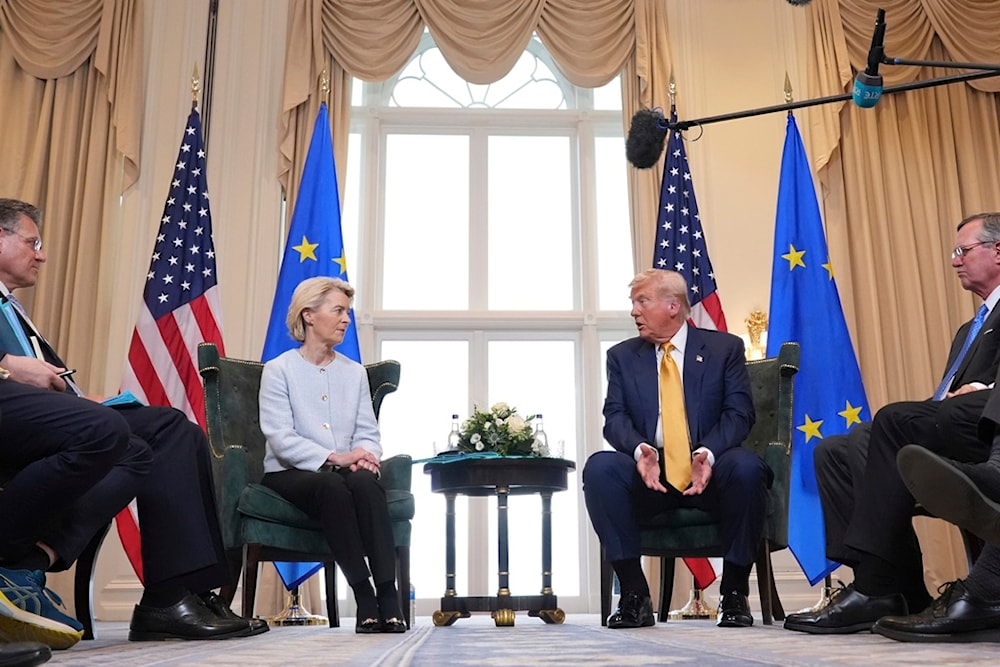
US President Donald Trump meets European Commission President Ursula von der Leyen at the Trump Turnberry golf course in Turnberry, Scotland, Sunday, July 27, 2025 (AP)
European Union governments moved Wednesday to implement a controversial trade agreement with the United States after months of delays that had triggered renewed tariff threats from President Donald Trump, Reuters reported.
Diplomats from the bloc’s 27 member states approved legislation aimed at removing duties on a broad range of American industrial products while granting expanded access for US agricultural and seafood exports, according to officials familiar with the discussions.
The measures form part of the “Turnberry” trade framework negotiated last July between Trump and European Commission President Ursula von der Leyen at Trump’s golf resort in Scotland. The arrangement was designed to avert a transatlantic trade war after Washington threatened sweeping tariffs on European exports.
The legislation follows a preliminary political agreement reached earlier this month between EU lawmakers and member states after overnight negotiations aimed at finalizing the long-delayed pact before Trump’s July 4 deadline.
Trump pressures EU over delayed implementation
Under the agreement, the United States maintained tariffs of 15% on most EU goods, while Brussels committed to eliminating many of its own import duties on American products. The deal was widely criticized inside Europe as uneven, with several lawmakers arguing the bloc conceded too much under US pressure.
Tensions escalated earlier this month again after Trump accused the EU of failing to honor its commitments and warned he would impose “much higher” tariffs if implementation was not completed by July 4. He also threatened to raise tariffs on European vehicles to 25%, intensifying concerns in export-heavy economies such as Germany.
The pressure campaign reflected broader strains in transatlantic economic relations since Trump’s return to office, with Washington expanding protectionist measures targeting several major trading partners. Earlier US tariffs on steel, aluminum, and automobile components had already pushed European governments to accelerate efforts to diversify trade partnerships beyond the United States.
Despite internal criticism, EU officials acknowledged the bloc could not risk a prolonged rupture with Washington, which remains Europe’s largest trading partner, accounting for roughly 1.6 trillion euros in economic exchange.
EU inserts safeguards against possible US reversal
European lawmakers responded by inserting several safeguards into the legislation amid concerns over Washington’s unpredictability and fears that the White House could later abandon parts of the arrangement.
The safeguards include a clause ending the agreement in 2029 unless renewed, as well as mechanisms allowing the European Commission to suspend parts of the deal if the United States fails to reduce tariffs on products containing steel or aluminum to the agreed 15% threshold.
Those goods, including washing machines and wind turbines, currently remain subject to 25% US tariffs.
The finalized text also allows Brussels to suspend preferential tariff arrangements if Washington adopts discriminatory measures against European industries or disrupts trade and investment relations. Additional provisions permit the EU to respond to sudden increases in US imports deemed harmful to domestic producers.
However, European negotiators softened several earlier demands during talks with Washington. One major concession grants the United States until the end of the year to remove tariffs above 15% on certain steel-related products rather than requiring immediate reductions before implementation.
Trade tensions continue despite progress
Washington has welcomed the EU’s progress but signaled that disputes remain unresolved. The Office of the United States Trade Representative said tariff reductions alone were insufficient and insisted Brussels must also address “non-tariff barriers and regulatory matters” that Washington claims unfairly restrict American access to European markets.
The agreement comes amid broader efforts by the EU to shield itself from growing trade instability under Trump’s second administration. Brussels has simultaneously accelerated trade negotiations with countries including Mexico and Mercosur members as European officials seek to reduce dependence on the US market and limit exposure to future tariff confrontations.
Internal divisions within Europe also complicated the ratification process, with lawmakers debating how far the bloc should accommodate Washington’s demands amid concerns over Trump’s broader foreign policy positions and legal disputes inside the United States regarding presidential tariff powers.
Still, EU officials ultimately prioritized avoiding a deeper transatlantic trade confrontation. Cyprus Energy, Commerce and Industry Minister Michael Damianos said the agreement showed the bloc was fulfilling its commitments.
“Maintaining a stable, predictable, and balanced transatlantic partnership is in the interest of both sides,” he said.
The legislation still requires approval from the European Parliament, with a committee vote expected next week ahead of a final plenary vote in mid-June.
Read more: EU finalizes US trade pact under pressure from Trump


