
Fed keeps rates unchanged as post-war inflation fuels hawkish outlook
 4 Min Read
The US Federal Reserve kept interest rates unchanged but signaled that persistent inflation has increased the likelihood of a rate hike later this year.
-
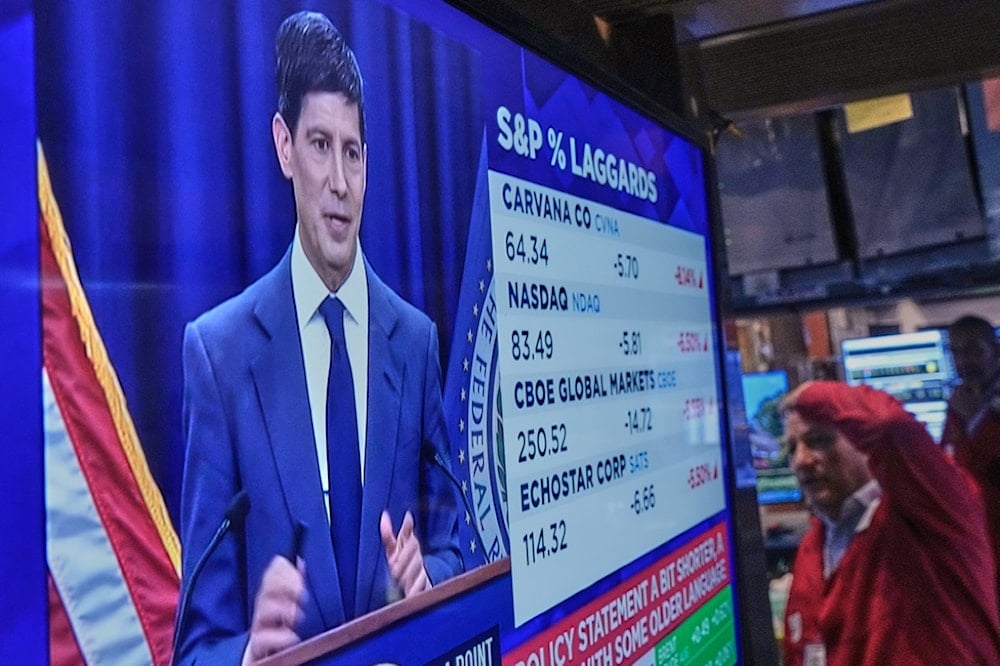
Federal Reserve Chair Kevin Warsh's press conference appears on a screen on the floor of the New York Stock Exchange, Wednesday, June 17, 2026 (AP)
The US Federal Reserve left its benchmark interest rate unchanged on Wednesday, maintaining its target range at 3.50% to 3.75% at the first policy meeting chaired by Kevin Warsh. Although rates were left unchanged for a fourth consecutive meeting, updated projections showed policymakers have become increasingly concerned that inflation could remain elevated, strengthening expectations that the next move may be a rate increase rather than a cut.
The shift comes as the US economy continues to absorb the inflationary effects of the recent war on Iran, which disrupted global energy markets and drove up oil prices during the conflict. While Washington and Tehran have since reached a framework agreement to end the war and reopen the Strait of Hormuz, Federal Reserve officials believe higher energy costs and supply-chain disruptions will continue feeding inflation in the months ahead.
The Central Bank of the United Arab Emirates also kept its benchmark rate unchanged at 3.65%, reflecting the Federal Reserve's decision because of the dirham's peg to the US dollar.
Officials increasingly favor tighter policy
The Federal Open Market Committee's latest projections marked a notable shift from March. Nine policymakers now expect at least one interest-rate increase before the end of the year, compared with none previously. Another nine projected either one rate cut or no cuts at all, reflecting growing concern that inflation may prove more persistent than earlier anticipated.
The Fed also revised its inflation forecasts upward. Its preferred inflation gauge is now expected to rise 3.6% this year, compared with the 2.7% forecast issued in March. Core inflation, which excludes food and energy prices, is projected at 3.3%, also above the previous estimate.
The central bank's post-meeting statement also dropped language that had previously suggested an easing bias, underscoring its more cautious stance toward inflation.
"Economic activity is expanding at a solid pace despite elevated uncertainty that owes, in part, to the conflict in the Middle East," Warsh said.
Warsh added that he chose not to submit his own interest-rate projection for the Fed's "dot plot", which summarizes policymakers' expectations for future rates.
"I can't give any forward guidance about what we're going to do next," he said.
Reaffirming the Fed's primary objective, Warsh said: "This committee will deliver price stability."
Energy markets continue to shape inflation outlook
Oil prices have retreated significantly since President Donald Trump announced the framework agreement with Iran aimed at ending the war and restoring shipping through the Strait of Hormuz. Even so, policymakers and market analysts say the normalization of global energy markets is expected to take time, with production, exports, and shipping yet to fully recover.
Market participants are also watching tanker movements through the strategic waterway, with shipping data indicating traffic has not yet returned to pre-war levels.
"Under these conditions, another rate increase later this year remains a credible possibility," Noureldeen Al Hammoury, head of market insights and community engagement at Equiti Group in Dubai, told The National on Thursday.
Warsh declined to say how heavily the war's economic effects influenced the committee's deliberations but reiterated that inflation remains well above the Fed's 2% target.
New chair signals broader changes
Beyond interest-rate policy, Warsh's first meeting offered an early indication of how he intends to reshape the central bank. He has advocated reducing reliance on forward guidance and simplifying the Fed's communications, including reassessing the role of the "dot plot".
"The main risk is therefore not the interest-rate decision itself, but an unclear communication strategy. A press conference that fails to establish a credible policy direction could increase volatility in Treasury yields, the US dollar and equity markets, even if rates remain unchanged," Al Hammoury said.
Wednesday's meeting also marked the first policy session attended by both Warsh and former Fed Chair Jerome Powell since the leadership transition. Powell remains on the Board of Governors after stepping down as chair and has previously said he intends to stay on the board amid what he described as "unprecedented" attempts by the Trump administration to challenge the Federal Reserve's independence.
Read more: US lawmakers split over Trump-backed Iran agreement


