
How war on Iran threatens price hikes across global fast fashion
 4 Min Read
The US-Israeli war on Iran and the Strait of Hormuz closure are driving up polyester feedstock costs across India and Bangladesh, threatening price hikes for global fast-fashion consumers.
-
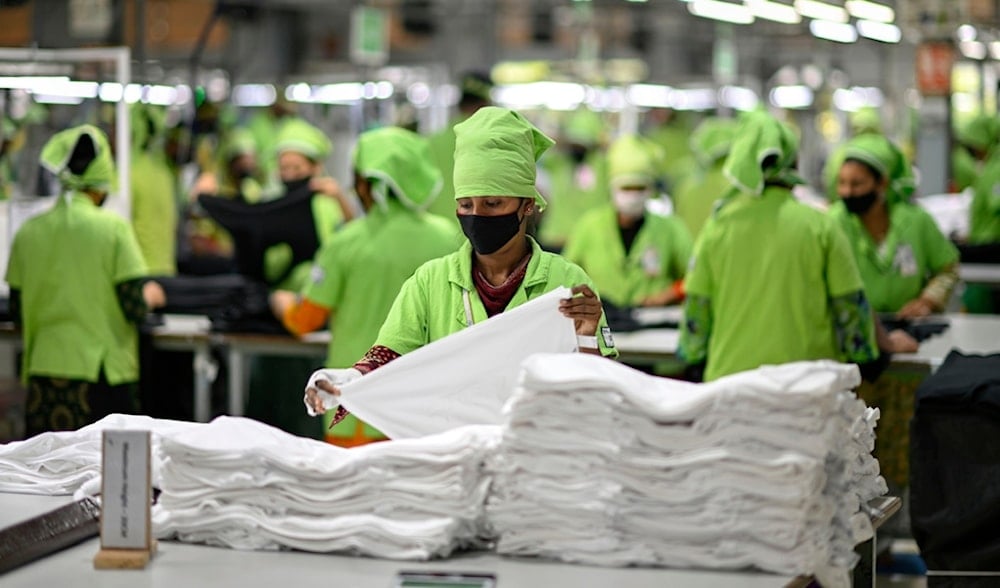
Workers make quality checks on garments produced at a factory run by the Bangladesh-based Urmi Group in Narayanganj, Bangladesh, Tuesday, April 8, 2025. (AP Photo/Mahmud Hossain Opu)
Half the looms at a textile mill in the Indian city of Surat sit silent, with daily output collapsing to a third of what it was before the US war on Iran began. What is happening inside Radheshyam Textile is a microcosm of a widening crisis rippling through Asia's polyester supply chain, one that analysts warn could ultimately reach the price tags of fast-fashion brands worldwide.
The US war on Iran and the resulting closure of the Strait of Hormuz are dealing a heavy blow to Asia's textile sector, as polyester producers across India and Bangladesh grapple with mounting input costs.
Among the hardest hit is India's polyester yarn manufacturing sector. Filatex, one of the country's leading producers, has seen the cost of petroleum-derived feedstocks rise by close to 30%, managing director Madhu Sudhan Bhageria told Reuters.
The ripple effects are spreading across the supply chain. Bindal Silk Mills, whose dyed and printed polyester fabrics reach retailers including H&M, Inditex, Target, Walmart, and IKEA, has seen chemical and dye costs climb sharply. CEO Avichal Arya told Reuters the situation has also triggered a labour squeeze in Surat, a major textile centre in Gujarat, where cooking gas shortages linked to the war have pushed migrant workers to relocate, leaving factories short-staffed and struggling to fulfil international orders.
Polyester's deep entanglement with oil markets makes it uniquely vulnerable to the Hormuz disruption. The material, synthesised from petroleum byproducts, makes up 59% of global fibre output, underpinning everything from sportswear to everyday apparel.
Output falls across Surat's mills
Factory-level data illustrates how severe the slowdown has become. At Radheshyam Textile in Surat, owner Kaushik Dudhat told Reuters that throughput has collapsed to roughly a third of pre-war levels, with half the facility's 200 looms now standing idle.
New yarn procurement has been suspended, as any price adjustment sufficient to cover rising costs would likely be rejected outright by buyers downstream.
The broader Surat cluster is also under pressure. Dyeing and printing units have extended their weekly shutdowns, and industry representatives have cautioned that prolonged disruption could tip the region into outright raw material shortages.
Wood Mackenzie data cited by Reuters tracked polyester staple fibre prices in India, rising sharply from late February before moderating slightly following government intervention on import tariffs, though they remain well above pre-war levels.
Brands buy time, but the window is narrowing
For now, forward purchasing has shielded most major retailers from the worst of the disruption. Primark's near-term inventory remains largely unaffected, though its parent company, Associated British Foods, has acknowledged that re-entering the market at current prices would mean confronting significant inflation.
H&M, meanwhile, is bracing for supplier price requests from Bangladesh in the weeks ahead and has indicated it intends to absorb those increases rather than pass them on immediately.
In Bangladesh, where garment factories rely on polyester sewing thread even for largely cotton-based production, Coats Bangladesh has already moved to raise thread prices by more than 15%, pointing to surging feedstock and logistics costs, according to correspondence reviewed by Reuters.
The threat of demand destruction
Wood Mackenzie analyst Bruna Angel has put a stark timeline on the industry's resilience, warning Reuters that another month of sustained disruption would trigger demand destruction, a cycle in which rising retail prices cause consumers to pull back, depressing order volumes across the supply chain.
The pressure extends beyond apparel. Petrochemical derivatives are embedded throughout the footwear manufacturing process, with the Footwear Distributors and Retailers of America identifying close to 25 oil-based components in a standard shoe.
Nike has also flagged exposure to oil-linked material costs, underscoring that the economic fallout of the US war on Iran is reshaping the economics of consumer goods far beyond the war's immediate geography.
Recycled polyester, sourced from plastic waste rather than crude oil, offers a partial hedge for brands that have invested in it, but its share of total polyester output remains limited, leaving the broader industry with little insulation against a prolonged supply shock.


