
Iran–Pakistan corridor reshapes regional trade, bypasses UAE routes
 3 Min Read
The Iran–Pakistan land corridor linked to China’s $60 billion CPEC is reshaping regional trade by bypassing UAE-dominated maritime transit routes and the Strait of Hormuz.
-
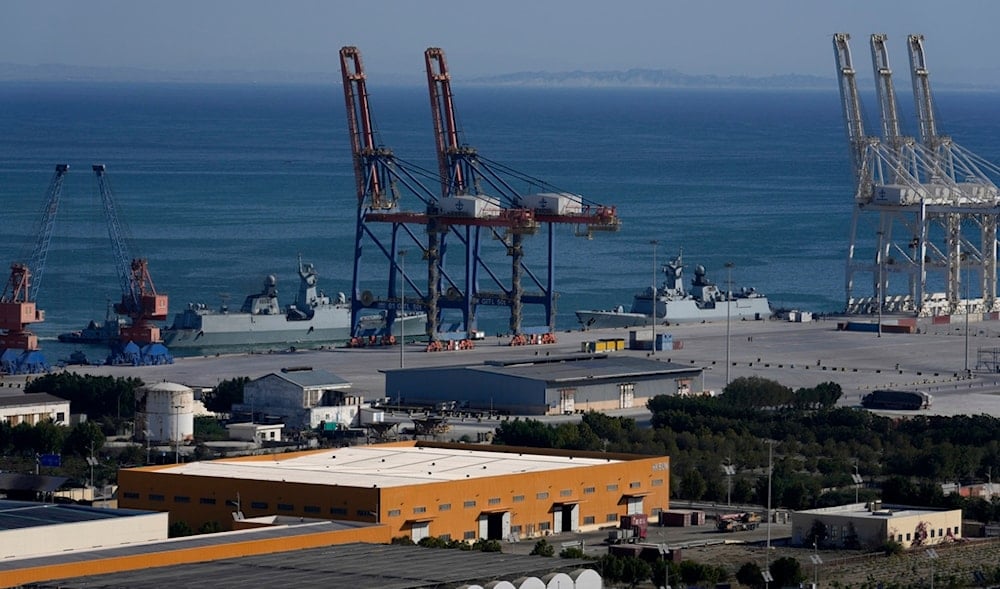
Pakistan Navy ships berth at Gwadar port in the coastal city of Gwadar, in the southwest Pakistani province of Balochistan, Jan. 15, 2025 (AP)
A newly activated Iran–Pakistan land corridor linked to China’s $60 billion China–Pakistan Economic Corridor (CPEC) is reshaping regional trade flows by bypassing the United Arab Emirates’ long-standing dominance over West Asian maritime transit routes and reducing reliance on shipping through the Strait of Hormuz, Fars News Agency reported.
The corridor is based on a 2008 road transport agreement between Tehran and Islamabad and connects six overland routes from Pakistan’s key ports, Gwadar, Karachi, and Port Qasim, to Iranian border crossings at Taftan and Gabd, according to Fars.
The objective is to shift cargo movement overland between South Asia, Iran, and Central Asia while reducing exposure to maritime chokepoints and naval restrictions in the Gulf.
The development is widely seen as introducing competition to the United Arab Emirates’ established role as a regional maritime re-export and logistics hub, particularly through Dubai and Abu Dhabi, which have historically served as central transit points for goods moving toward Iran and Central Asia.
While maritime trade remains dominant globally, the emergence of overland alternatives introduces new logistical competition to UAE-controlled shipping networks and Gulf-based distribution routes.
First shipments reach Central Asia
A report cited by the Russian International Affairs Council confirmed that the first commercial shipment via the corridor has already reached Tashkent, marking an early operational milestone.
The corridor’s strategic importance is strengthened by its integration with CPEC, a $60 billion infrastructure network linking western China to the Arabian Sea and forming a key artery of Eurasian trade connectivity.
Through this linkage, Iran gains access to an expanding overland system connecting China, Pakistan, and Central Asia, reducing reliance on maritime routes long dominated by Gulf shipping hubs.
According to analysts, the corridor extends CPEC westward into Iran, creating a continuous overland route linking Chinese, South Asian, and Central Asian markets.
Pakistan is also using the corridor to reduce dependence on the unstable Afghan transit route, which has faced recurring security and border tensions. The new pathway provides Islamabad with more direct access to Uzbekistan, Tajikistan, and Kyrgyzstan through Iranian territory.
Iran advances parallel north–south corridor
At the same time, Iran is developing the Chabahar–Zahedan railway project, which is more than 90% complete and expected to become operational by spring 2026. The railway is part of the International North–South Transport Corridor, connecting southern Iranian ports to Russia and Central Asia.
Together, these east–west and north–south routes position Iran as a central transit hub within overlapping Eurasian logistics networks.
The integration of Iran–Pakistan transport routes with CPEC reflects a broader shift toward diversified Eurasian trade corridors, where overland systems increasingly complement maritime shipping lanes.
As these networks expand, they are expected to reshape regional logistics patterns and reduce dependence on traditional Gulf maritime chokepoints, including those centered on UAE-controlled trade flows.
Read more: UAE fast-tracks new pipeline to double Fujairah export capacity


