
Morgan Stanley: Oil in 'race against time' on Hormuz closure
 4 Min Read
Morgan Stanley warns that the oil market faces a "race against time" because temporary buffers preventing a price spike may vanish if the Strait of Hormuz remains closed into June.
-
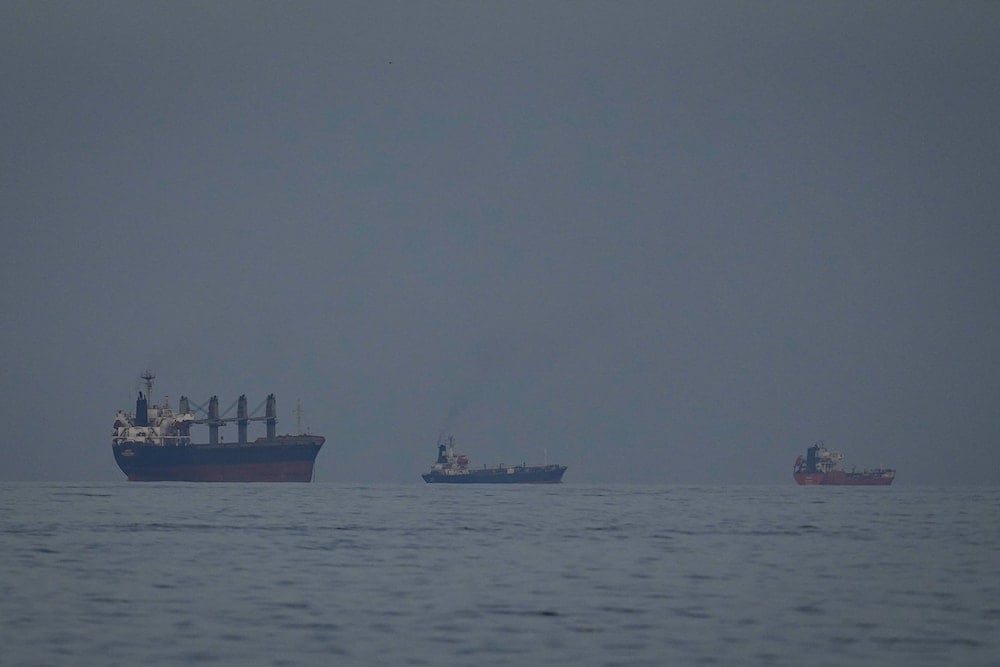
Oil tankers and ships line up in the Strait of Hormuz as seen from Khor Fakkan, United Arab Emirates, Wednesday, March 11, 2026 (AP)
Investment bank Morgan Stanley has warned that global oil markets are entering a "race against time" because the factors that have so far prevented prices from spiking even higher may no longer hold if the Strait of Hormuz remains closed into June, despite nearly one billion barrels of supply having already been lost since the US-Israeli war on Iran began.
In a research note, analysts, including Martijn Rats, observed that crude futures have not yet surpassed the levels seen after the war in Ukraine, even though the war has shut the Strait of Hormuz to almost all traffic. They attributed this relative stability to several temporary buffers: the market entered the crisis with existing stockpiles, investors consistently bet on a quick reopening of the strait, higher crude exports from the United States offset some of the shortfall, and Chinese import demand slowed.
According to the bank, these mitigating factors may soon run out. A closure that extends beyond what China and the United States can sustain "could cause renewed tightness." While China appears well-positioned for now, the ability of the United States to maintain its elevated export levels "is hard to gauge but appears under more pressure."
Morgan Stanley's base case expects reopening before buffers evaporate
The analysts said their baseline expectation is that the Strait of Hormuz will reopen before US exports need to be curtailed and before China's declining import trend halts. However, they cautioned that if the interruption persists, significantly higher oil prices are likely.
"The path matters: a reopening in June with US and Chinese buffers still partly intact is the base case; a closure that runs into late June or even July is the regime in which Brent flat price has to do work it has so far been able to avoid," they wrote, referring to the global crude benchmark.
For the current quarter, Morgan Stanley forecasts Dated Brent at $110 per barrel, followed by $100 in the next three months and $90 between October and December. Those forecasts remain unchanged. In a bull case scenario based on a prolonged closure, prices would reach between $130 and $150 per barrel.
US exports and Chinese imports have shielded markets from full shock
The analysts highlighted that a 3.8 million barrel‑per‑day increase in US exports, combined with a 5.5 million barrel‑per‑day reduction in Chinese imports, has shielded the rest of the world from 9.3 million barrels per day of supply tightness. They described that as "a very significant amount" in a section of the note titled "A race against time."
Washington has escalated its economic campaign against Tehran by expanding sanctions, while simultaneously targeting Chinese entities involved in oil trade with Iran. In late April, the US sanctioned Hengli Petrochemical Refinery, identified as a major buyer of Iranian crude linked to Iran’s Revolutionary Guard.
The move forms part of a broader strategy aimed at tightening economic pressure on Iran while attempting to stabilize global energy markets, as oil prices surge amid ongoing tensions in the Strait of Hormuz.
China has rejected US measures, instructing its companies not to comply with sanctions and invoking legal mechanisms to shield domestic firms from foreign restrictions. The response signals growing friction between the world’s two largest economies, as the Iran war adds a new dimension to their rivalry.
Read More: US pressures China over Iran oil, urges role in reopening Hormuz


