
Putin: Russia remains a leading player in global gas market
 6 Min Read
Putin says Russia remains a leading player in the global gas market as GECF members discuss supply disruptions, prices, LNG and rising demand.
-
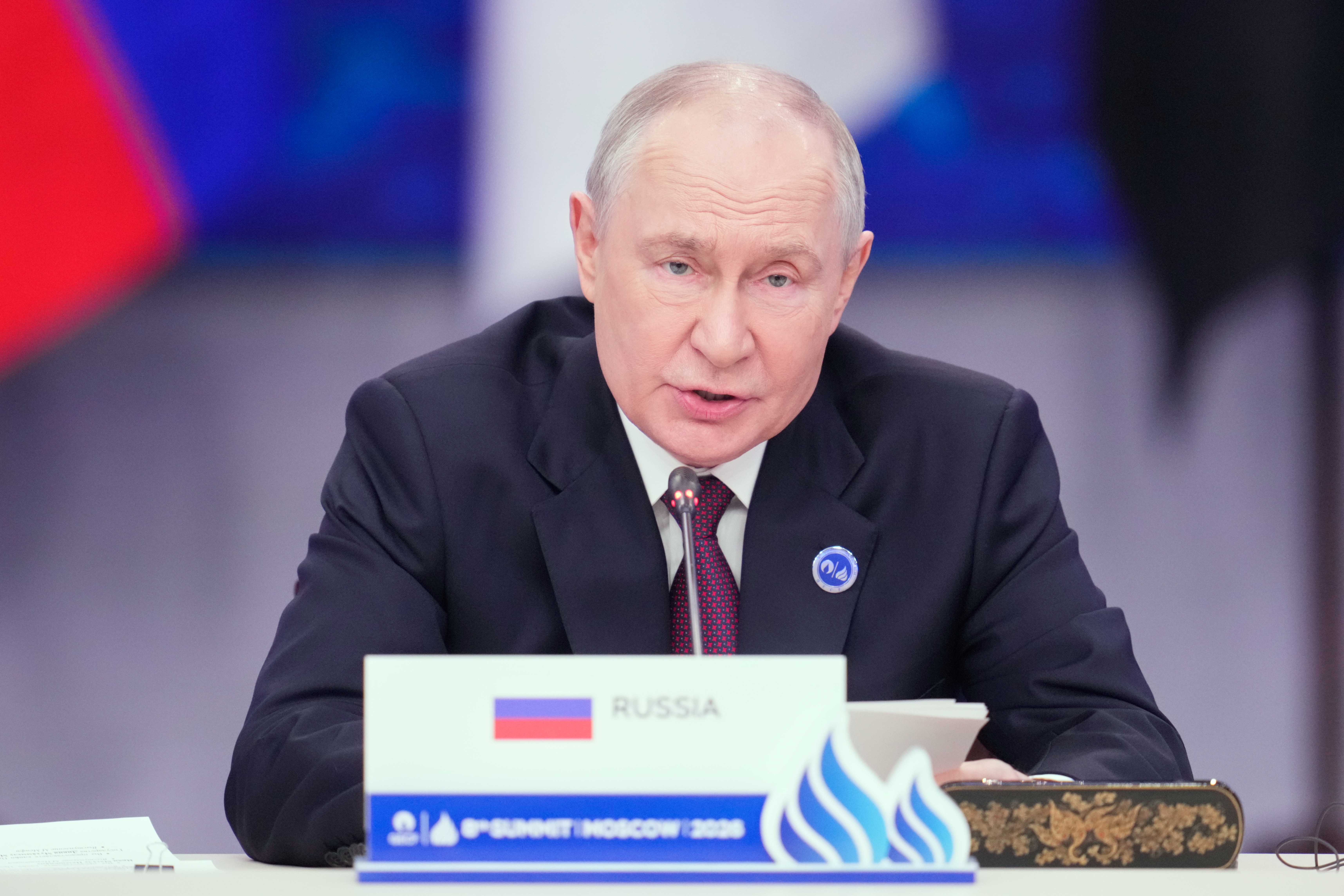
Russian President Vladimir Putin speaks during the plenary session of the Summit of Heads of State and Government of the Gas Exporting Countries Forum in Moscow, Oct. 27, 2026 (AP)
Russia remains one of the leading players in the global gas market, Russian President Vladimir Putin said Tuesday, warning that efforts to exclude the country from international gas trade could raise costs for other countries.
Speaking at the Gas Exporting Countries Forum (GECF) summit in Moscow, Putin said Russia ranks first globally in natural gas reserves and second in production, adding that the country has developed a production base allowing it to diversify gas supplies while expanding gas processing and gas chemistry.
"We have created a unique production complex that allows us to diversify gas supplies, develop its processing and gas chemistry. We use this powerful resource, scientific, and industrial base to grow the national economy and at the same time act as a responsible supplier of gas abroad, a reliable, predictable partner," Putin said.
Putin said Europe is harming its own industrial and social sectors by moving away from Russian gas. He also called for greater cooperation among gas-exporting countries and the use of sovereign technologies.
"To address the challenges facing the global gas industry, we must not erect barriers; on the contrary, we need to strengthen cooperation, first and foremost among gas-exporting nations. This should be done by leveraging our own capabilities and sovereign technologies, while fostering open, trust-based collaboration rooted in the principles of mutual benefit and respect for each other's interests," Putin said.
Supply disruptions and rising gas prices
Putin identified disruptions to supply as the main problem facing the global gas market, saying large volumes of gas had been removed from international markets. He called for efforts to optimize transportation routes while taking into account the geographic locations of GECF members.
"It is necessary to work on optimizing transport routes, taking into account the geographical location of the forum's member countries," Putin said.
Turning to prices, Putin noted that "Prices have risen sharply, but we understand that they could just as sharply fall back, returning to their previous levels."
GECF members collectively hold 70% of the world's natural gas reserves and account for about 40% of global gas exports, according to Putin.
He said dialogue within the forum was developing without behind-the-scenes maneuvering or attempts to manipulate the market, adding that GECF members make a significant contribution to global energy security.
"Each country determines for itself which type of generation to develop: hydrocarbon, nuclear, hydropower or renewable energy sources. However, today a quarter of the energy balance of the planet is accounted for by gas," Putin said.
Gas demand expected to rise
Putin said natural gas would continue to play a major role in international energy trade, with global demand expected to reach 5.5 trillion cubic meters annually by the middle of the century.
"It is expected that such trends will continue, and by the middle of this century, global gas demand will increase to 5.5 trillion cubic meters per year. International supplies will increase by about 1.5 times and amount to 1.7 trillion cubic meters," Putin said.
He added that liquefied natural gas (LNG) now accounts for about half of global gas trade.
"LNG now accounts for about half of the global gas trade," Putin said.
Putin also pointed to OPEC+ as an example of multilateral coordination in another major hydrocarbon market.
"There is a successful multilateral experience in balancing another key hydrocarbon market — oil, where joint actions in the OPEC+ format have ensured market predictability and stable supply volumes," Putin said.
Putin calls for long-term gas investment
Putin said investment in the gas industry should be based on long-term arrangements rather than relying on periods of high prices.
"Clearly, we are talking about large-scale, long-term investments, and one cannot rely solely on the current high-price environment. Such investments should, first and foremost, be based on long-term contracts, arrangements where a gas buyer plans energy supplies for the economy, the social sector, and development of the territory, etc. over the long term, while the gas supplier gains certainty regarding sales, allowing them to invest in new projects with a guaranteed return," Putin said.
He proposed expanding consultations within the GECF on crises affecting the global gas market, including risks to infrastructure and approaches to maintaining supplies.
"In the gas sector, it is necessary to build our own effective mechanisms of interaction. In this regard, we propose to expand consultations within our forum on crisis situations in the gas market in order to timely assess risks, including physical threats to the gas infrastructure, and coordinate supply approaches," Putin said.
Putin said gas demand would continue to increase and that supply would need to expand accordingly, adding that GECF members and observers had the resources to address challenges facing the gas and broader global energy sectors.
"The Gas Exporting Countries Forum, its participants and observers, have the resources and capabilities to solve the most difficult tasks in the gas industry and in the entire global energy sector," Putin said.
Iran offers investment opportunities in gas sector, Pezeshkian says
Iran is ready to expand its involvement in multilateral cooperation and investment in gas infrastructure through the Gas Exporting Countries Forum (GECF), Iranian President Masoud Pezeshkian said Tuesday at the forum’s summit in Moscow.
"As a founding member of the Gas Exporting Countries Forum and the holder of the world's second-largest proven natural gas reserves, Iran reaffirms its readiness to play an even more active role in promoting multilateral diplomacy, sharing expert knowledge, and implementing investment initiatives in gas infrastructure, all under the auspices of this forum," Pezeshkian said.
He added that Iran would provide foreign investors with comprehensive support, incentives, and preferential terms for investments in its oil, gas, and petrochemical industries.
Pezeshkian also accused the United States of destabilizing energy markets through its actions against Iran, arguing that Washington's measures were contributing to price volatility.
"Economic terrorism in the form of the US naval and air blockade against Iran, as well as Washington's pressure on other countries to comply with this blockade, are illegal actions that seriously destabilize energy markets... Today, US military interventions in the Persian Gulf region are destabilizing not only the regional situation, but also provoking dangerous workshop shocks," Pezeshkian said.


