
Rapid Iran war drawdown raises concerns over US strategic oil reserve
 6 Min Read
The rapid US drawdown of its Strategic Petroleum Reserve during the Iran war is pushing inventories to four-decade lows.
-
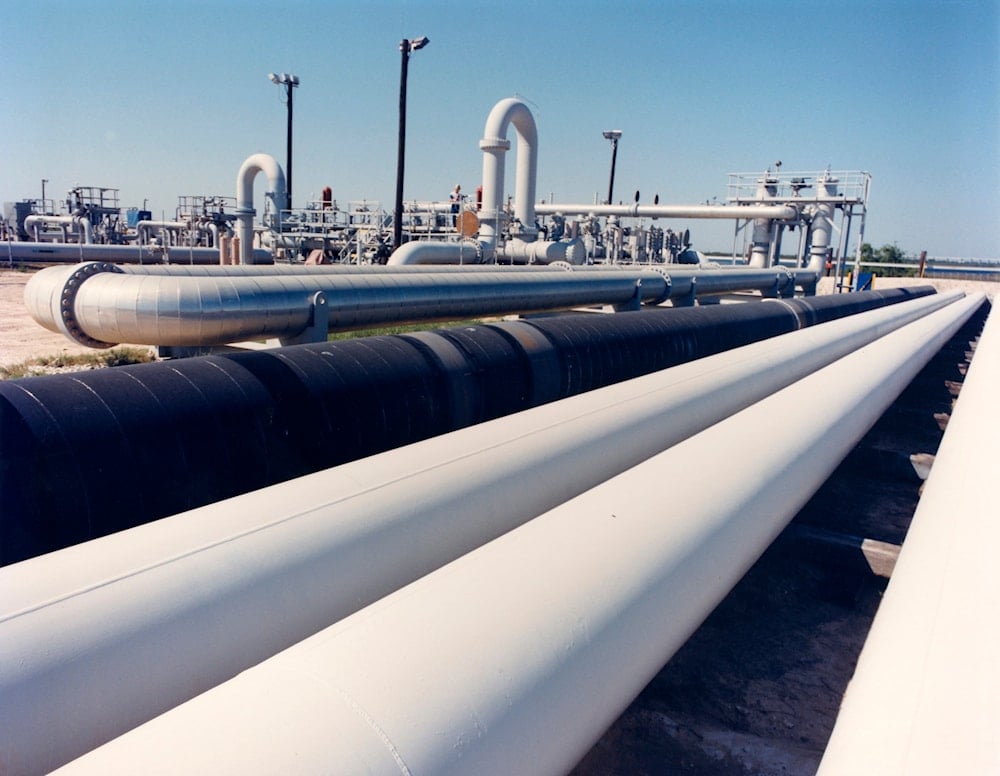
An undated photo provided by the Department of Energy shows crude oil pipes at the Bryan Mound site near Freeport, Texas (AP)
The United States' large-scale release of crude from its Strategic Petroleum Reserve (SPR) in response to disruptions linked to the war on Iran is raising concerns that repeated withdrawals could undermine the long-term integrity and operating capacity of the underground caverns used to store the country's emergency oil supplies, CNBC reported.
US inventories have fallen below 300 million barrels for the first time since the reserve was filled in the early 1980s, according to Department of Energy data released on Monday. Washington is in the process of releasing 172 million barrels amid energy supply disruptions caused by the war, a drawdown expected to leave the reserve at roughly 243 million barrels.
Experts dispute safe limits for US oil reserve
The SPR holds crude in around 60 underground salt caverns at four sites along the Gulf Coast in Texas and Louisiana. Unlike conventional storage tanks, the caverns depend on carefully managed pressure and water injection to move oil to the surface, making their physical condition critical to the reserve's ability to respond to future emergencies.
The Energy Department maintains that at least 70 million barrels must remain in the reserve for the caverns to continue operating safely. Former senior Biden administration energy advisor Amos Hochstein has sharply challenged that assessment.
“Don’t believe the people out of the government that are saying the SPR can go to 70 million barrels. It’s nonsense,” Hochstein told CNBC’s Squawk Box Thursday.
At such levels, he said, the reserve would be depleted to “the point of never resurrecting it.”
Hochstein had previously warned that allowing inventories to fall below 300 million barrels could place the storage system itself at risk.
“I don’t know anyone who believes we can go below 300,” Hochstein told CNBC’s Brian Sullivan at an Atlantic Council event in June. “I know plenty of people who think we can’t get near 300 because physically you will damage the caverns where the oil is stored.”
The Trump administration has rejected claims that the drawdown threatens the structural stability of the caverns.
“The caverns are always full. All that changes is the ratio of oil and water that is filling them,” Energy Department spokesman Ben Dietderich told CNBC in a statement.
Dietderich said the administration is “responsibly managing the SPR as the critical national security asset it was designed to be.”
Experts warn operational limits may be much higher
Technical concerns center on the method used to extract crude from the reserve. Water is pumped into the bottom of the salt caverns, forcing oil upward through wells and into pipelines.
Siddharth Misra, a petroleum engineering professor at Texas A&M University, said around 70 million barrels represents only the strict physical minimum required to keep extraction pipes submerged in crude rather than water.
But he argued that the actual operational threshold is significantly higher.
“The practical operational floor for the crude inventory is between 250 million and 300 million barrels,” Misra said in an email to CNBC.
At current levels, he added, “cavern integrity and overall operational capability are at an elevated risk.”
Dropping 300 million barrels below could also limit how quickly the United States can release oil during another crisis, Misra said. As the layer of crude becomes thinner, sludge at the bottom of the storage system can move closer to extraction equipment, potentially damaging pumps and pipes.
Repeated drawdowns threaten cavern integrity
Rapid withdrawals can further accelerate wear on the caverns because fresh water injected during a drawdown dissolves portions of the salt walls.
This process, Misra said, “creates flatter, less stable roof and severely thins the critical salt pillars that separate adjacent caverns, greatly increasing the geological risk of a structural cave-in.”
The reserve was initially designed to withstand roughly five complete drawdowns, according to Misra, but has instead experienced dozens of releases of varying sizes over the past four decades.
“Because the system was not designed for this many cycles, the repeated injection of water and extraction of oil have caused severe cavern deformation, accelerated the rate of massive salt falls from the ceilings, and significantly weakened the overall structural integrity of the aging reserve,” he said.
GAO highlights long-term deterioration risks
Concerns over the condition of the SPR predate the current war.
Republican lawmakers raised similar warnings after the Biden administration released a record 180 million barrels following the outbreak of the Ukraine war in 2022. The reserve subsequently fell below 350 million barrels in 2023 before being rebuilt to around 415 million barrels ahead of the war on Iran.
A Government Accountability Office report published in May found that repeated withdrawals and refilling can gradually alter cavern structures.
“Repeated partial drawdowns followed by refill can leach a single part of a cavern repeatedly, leading to undesirable shapes,” the GAO said.
While most SPR caverns were assessed to be in “very good condition” following the 2022 drawdown, the watchdog warned that repeated use carries cumulative consequences.
“However, every drawdown cycle expands cavern volume and reduces the spacing between caverns within the salt dome, which ultimately reduces their long-term viability,” it said.
Aging infrastructure adds to SPR constraints
The GAO also reported that Energy Department officials described efforts to maintain aging SPR infrastructure in stark terms, saying they were “holding the SPR infrastructure together with ‘Band-Aids,’ and that it is uncertain how long they will hold.”
More than one-quarter of the reserve's crude was unavailable for withdrawal as of December 2025 because of construction work and cavern outages, according to the report.
Analysts at Rapidan Energy have offered a lower estimate for the reserve's minimum sustainable level, placing what they described as a “soft-ish floor” at approximately 170 million barrels. Below that point, they said, limitations related to cavern integrity and pumping infrastructure would increasingly constrain additional withdrawals.
With the Iran-war drawdown expected to push inventories to around 243 million barrels, the debate is increasingly focused not only on how much emergency crude Washington has left, but also on how much more can be released without weakening the infrastructure needed to access it in the future.
Read more: US SPR hits new record low, falls below 300mln barrels amid Iran war


