
US drains oil reserve to 1983 low after war on Iran
 5 Min Read
US emergency oil reserves have fallen to their lowest level since 1983 as Washington releases crude to offset Iran war disruptions, while oil prices slide on hopes of de-escalation.
-
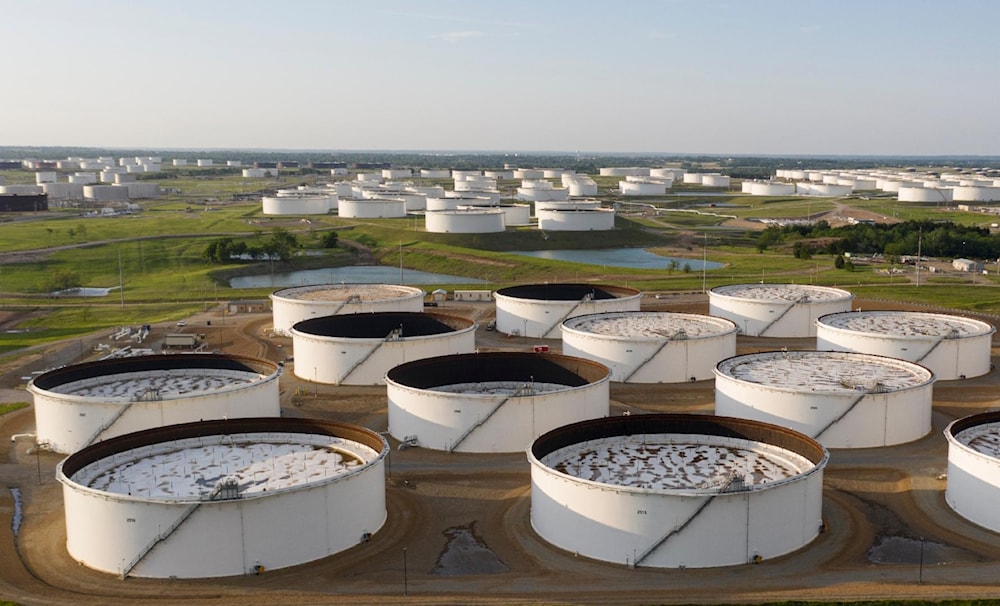
An aerial view of a crude oil storage facility is seen on May 4, 2020, in Cushing, Oklahoma (AFP)
Oil prices were heading toward their steepest quarterly decline since the early months of the COVID-19 pandemic, Reuters reported on Tuesday.
The market decline came as traders assessed signs of possible de-escalation between Tehran and Washington, while uncertainty persisted around the fragile ceasefire that paused the four-month confrontation.
Data from the US Department of Energy showed that the Strategic Petroleum Reserve fell by 5.5 million barrels to 325.7 million barrels, its lowest level since May 1983.
The drawdown is part of a US agreement to release 172 million barrels from the reserve to compensate for shortages in global supply following the war and to ease pressure on fuel prices. US crude inventories have also declined sharply in recent weeks, driven by strong refining activity and export demand for American oil.
Since the war began at the end of February, total US oil inventories, including both commercial stockpiles and the SPR, have dropped by 111.4 million barrels to 743.3 million barrels as of June 19, the lowest level since 1984.
US drains reserves, markets price in de-escalation
Brent crude futures for August, which expire Tuesday, fell 30 cents, or 0.41%, to $72.85 a barrel by 0824 GMT. The contract was heading for a third consecutive monthly decline and had fallen around 21% so far in June. The more active September Brent contract slipped 7 cents, or 0.1%, to $73.84 a barrel.
US West Texas Intermediate crude for August also moved lower, dropping 13 cents, or 0.2%, to $70.62 a barrel. WTI was on course for a second straight monthly loss and had declined by roughly 20% in June.
Both benchmarks are now trading close to pre-war levels, a sign that markets are pricing in the possibility that Washington may avoid renewed aggression and move toward de-escalation channels.
"The recent de-escalation between the United States and Iran is undoubtedly a positive development for global financial markets, but it should not be interpreted as the end of uncertainty surrounding the energy sector," Rania Gule, senior market analyst at XS.com, said.
Iran denies direct talks with US
Markets were also monitoring reports of possible Iranian-US contacts in Doha this week. Tehran, however, said Monday that no meeting with the American side had been scheduled, after weekend missile fire tested the interim ceasefire reached on June 17.
Iranian Deputy Foreign Minister Kazem Gharibabadi said Iranian and Omani experts would begin talks in the coming days on redefining transit routes through the Strait of Hormuz. He added that Iran would seek to obstruct vessels operating outside the defined paths.
Iranian Foreign Ministry spokesperson Esmaeil Baghaei later said there would be no negotiations with the American side at any level in the coming days.
The conflicting signals highlighted the fragility of the ceasefire and the continued weight of Iran’s position in the region’s energy equation. The war disrupted flows through the Strait of Hormuz, one of the world’s most important oil transit routes, and created a political challenge for US President Donald Trump ahead of November’s congressional elections.
For Tehran, the depletion of US emergency reserves reinforces the argument that Washington could not pursue escalation without absorbing high economic costs at home.
Morgan Stanley lowers Brent outlook
Morgan Stanley cut its 2027 forecast for Dated Brent by $5 a barrel, projecting prices at $75 a barrel in the first half of the year and $70 in the second half.
The bank cited expectations of a build-up in commercial oil inventories across OECD countries, saying it now expects the global oil market to show an implied surplus of 4.8 million barrels per day in 2027.
Despite renewed attacks on ships in the Strait of Hormuz and fresh strikes between the US and Iran in recent days, Middle Eastern producers have continued loading oil and liquefied natural gas, according to shipping data.
Traffic through the region reached its highest level last week since the war began in late February, suggesting that regional energy exports continued despite instability.
Still, the broader picture remains clear: while crude prices have fallen on expectations of de-escalation, the United States has been forced to draw down emergency reserves to levels unseen since 1983, underscoring the pressure the war placed on Washington’s energy security and political calculations.
Read more: Trump threatens gas stations over high pump prices as crude falls


