
India talks with ‘Cockroach’ movement end without breakthrough
 5 Min Read
Talks between India’s government and the youth-led ‘Cockroach’ movement end without a breakthrough as protesters demand the education minister’s removal.
-
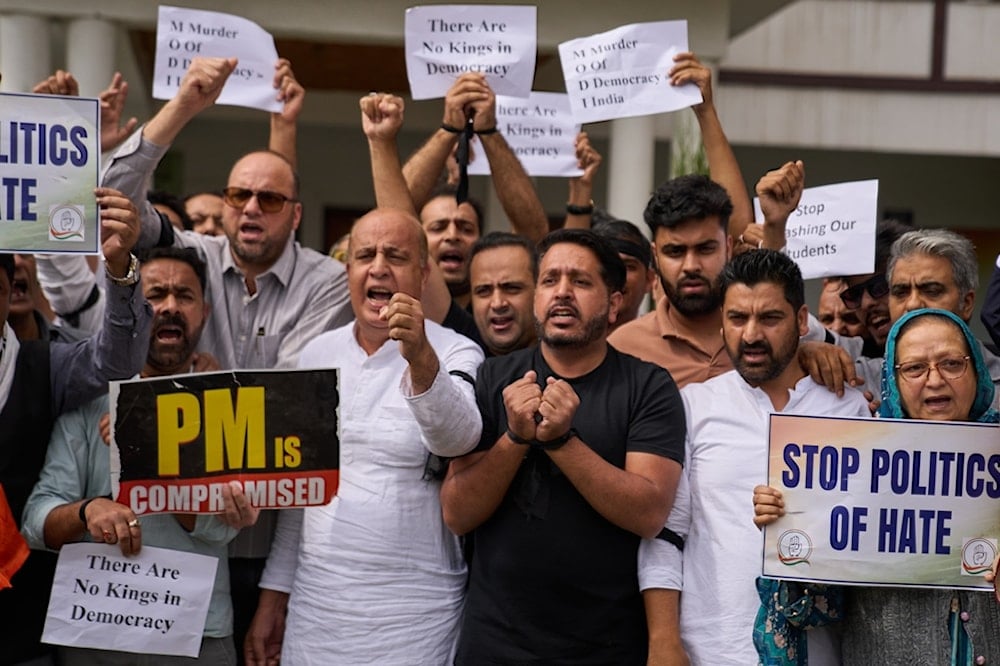
Members of India's Congress party shout slogans during a protest inside the party HQs in Srinagar in support of the Cockroach Janta Party's ongoing movement demanding educational reforms, in Srinagar, Kashmir, Friday, July 24, 2026 (AP/Dar Yasin)
Talks between the Indian government and the youth-led "Cockroach" movement failed to produce a breakthrough on Friday, with protesters maintaining their demand for the resignation or removal of Education Minister Dharmendra Pradhan.
"We conveyed in very clear terms that nothing short of Dharmendra Pradhan's resignation or his removal from the Union Cabinet would be acceptable," Ashutosh Ranka, spokesman for the Cockroach Janta Party protest group, told reporters.
Senior government minister JP Nadda said talks between the two sides would resume on Saturday.
The negotiations come amid weeks of growing protests led by the Cockroach Janta Party (CJP), which has mobilized thousands of students and young people in New Delhi over alleged irregularities in India's education system, as well as broader concerns over unemployment and economic pressures.
What is the 'Cockroach' movement?
The youth-led "Cockroach" movement began more than two months ago as a satirical online campaign but quickly developed into a broader political movement, drawing thousands of protesters into the streets of New Delhi.
The movement's immediate focus has been the cancellation of the May 3 NEET exam, India's highly competitive entrance test for undergraduate medical programs, after an investigation found that questions had been leaked. More than two million students were subsequently forced to retake the exam, fueling anger and demands for systemic reforms.
The movement also draws on wider frustrations among young people over high unemployment and economic pressures. Its name originated from a comment by India's Chief Justice during an unrelated hearing, in which she compared young unemployed people to "cockroaches" and "parasites."
"What if all cockroaches came together?" Abhijeet Dipke, the movement's founder, wrote on social media in response.
Dipke, who was then living in the US after graduating from Boston University, went on to establish social media accounts and a website for the Cockroach Janta Party. The name references both the justice's remark and India's ruling Bharatiya Janata Party.
The movement rapidly gained a following, with more than 20 million people reportedly following Dipke's accounts within weeks. The Modi government temporarily blocked the CJP's X account in India as the campaign gathered momentum.
What is the movement demanding?
The CJP has called for Pradhan's resignation over the examination crisis, with protesters maintaining a sit-in at Jantar Mantar in central New Delhi for more than four weeks.
The movement's broader manifesto contains five demands, including restrictions on retired chief justices entering Parliament, action against election officials accused of erasing citizens' votes, greater representation for women in government, a more independent media, and a 20-year ban on lawmakers who switch political parties from holding government positions.
The CJP has also published a separate charter focused on India's examination system. Its demands include creating a new Public Examinations Act to increase transparency and accountability, reforming examination bodies, establishing a students' rights charter, creating a welfare fund for students and their families, and ensuring consistent parliamentary oversight of examination authorities.
Protests escalate in New Delhi
The movement gained national attention following a mass demonstration in New Delhi on Monday, when an estimated 20,000 people, mostly students and young people, took to the streets.
The protest later escalated into clashes with police as demonstrators marched toward Parliament. Delhi Police said around 180 people were injured, including 118 security personnel and 60 protesters, while CJP founder Dipke said 150 protesters were receiving treatment in hospitals.
The movement subsequently called off another march on Parliament planned for Tuesday over safety concerns, but protesters continued their sit-in at Jantar Mantar.
"We will not march again because the police will hurt the youth again," Dipke said at a press conference on Tuesday.
A separate protest was also held outside the residence of Prime Minister Narendra Modi, where opposition leader Rahul Gandhi was detained along with other opposition figures.
On Wednesday, members of the Indian National Congress demonstrated inside and outside Parliament in support of the protesters and called for the government to address the police response to Monday's clashes.
Government faces pressure over exam leak
The protests have placed renewed pressure on the Indian government over the NEET examination leak and its handling of the broader education crisis.
Modi recently addressed the issue publicly for the first time since May, defending the government's response to the leak and vowing to punish those responsible, according to a cabinet minister.
Pradhan also condemned the protest outside Modi's residence, saying the government "remains 100% committed" to discussing the exam leak and "addressing every genuine concern of our youth on the floor of the House."
“We owe our students more than outrage. We owe them answers, reforms and accountability,” he wrote. “That is exactly what our government remains committed to delivering.”
With negotiations set to resume Saturday, the CJP continues to demand Pradhan's resignation or removal from the Union Cabinet, while the government faces mounting pressure to address the examination crisis and the wider concerns driving the youth-led protests.


