
India battles rupee crisis as oil shock deepens economic strain
 5 Min Read
India moves to stabilize the rupee amid soaring oil prices, capital flight, and widening deficits triggered by the war on Iran.
-
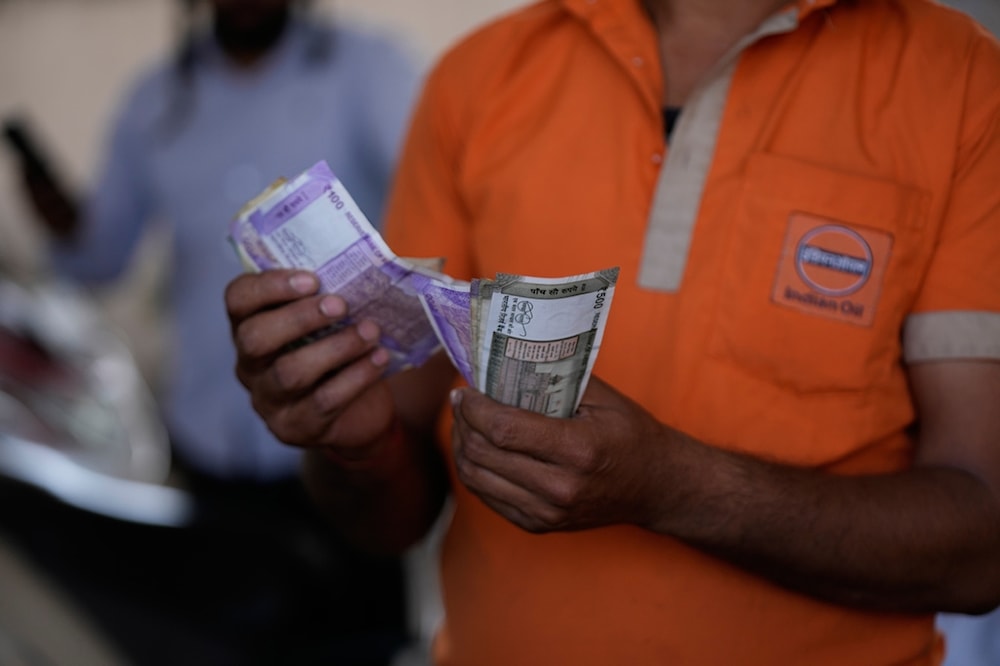
An employee counts Indian rupees while refueling a motorbike at a filling station in Jammu, India, Friday, May 15, 2026.(AP Photo/Channi Anand)
India is scrambling to contain a rapidly weakening rupee as soaring oil prices linked to the US-led war on Iran place mounting pressure on the country’s economy.
The Indian currency has fallen more than five percent since the war on Iran began on February 28, extending losses accumulated throughout 2025 and making the rupee Asia’s worst-performing major currency so far this year.
On Friday, the rupee fell to a record low of more than 96 against the US dollar, intensifying concerns within financial markets and prompting Indian authorities to prioritize efforts to halt further depreciation.
The Reserve Bank of India has already spent billions of dollars from its foreign exchange reserves to stabilize the currency. Officials have also imposed measures to limit speculative trading and introduced special credit support for oil importers to reduce immediate demand for dollars.
Indian Prime Minister Narendra Modi has meanwhile called for voluntary austerity measures, urging reductions in non-essential imports, including gold purchases and overseas travel.
War on West Asia drives economic pressure
India’s economic vulnerability has been magnified by its heavy dependence on imported energy, particularly crude oil shipped through the Strait of Hormuz, which has been crippled following the US-Israeli war on Iran.
Iran initially closed the passage for hostile forces through the Strait as a retaliatory measure against the US-Israeli aggression against the country. The US would later impose its own blockade against Iran's geographic leverage.
Rising oil prices have sharply increased the country’s import bill, widening the current account deficit and placing sustained pressure on the rupee.
According to estimates from Bank of America Securities, India’s current account gap could exceed two percent of GDP during the current fiscal year, more than double the previous year’s level and potentially the widest deficit since 2012–13.
Analysts warn that prolonged instability in West Asia due to US-led aggression could deepen the strain further, especially if energy markets remain volatile and shipping disruptions intensify.
Capital flight and investor retreat intensify strain
At the same time, India has experienced a major outflow of foreign capital since the beginning of the conflict.
Foreign investors have reportedly withdrawn more than $20 billion from Indian equity markets, marking the fastest pace of capital flight on record. Slowing dollar inflows have also increased fears of a widening balance-of-payments gap that could reach between $67 billion and $88 billion.
Economist Dhiraj Nim of ANZ Research stated that the 2027 fiscal year could become India’s third consecutive year facing a balance-of-payments deficit, a situation he described as highly unusual.
The pressure has forced the central bank to rely increasingly on foreign exchange reserves, which have fallen from more than $720 billion before the war to around $697 billion.
While reserves still cover roughly 11 months of imports, the decline reflects the growing cost of defending the currency amid sustained external pressure.
Domestic industries feel currency impact
The weakening rupee is spreading economic pressure across multiple sectors of the domestic economy.
Manufacturers and food processors reliant on imported raw materials priced in dollars are facing rapidly rising costs, while smaller businesses often lack the financial tools necessary to hedge against currency volatility.
The crisis has been especially severe in Kerala’s cashew industry, which depends heavily on imported nuts from Africa. Import costs have risen sharply due to the rupee’s decline, reducing purchasing capacity across the sector.
One industry executive stated that buyers can now afford roughly 90 percent of the import volumes they managed a year earlier. He also estimated that more than 80 percent of processing units have shut down in recent years, with currency instability contributing to the collapse.
Indian households face rising costs
The currency crisis is also affecting ordinary households, particularly families funding education abroad.
Education consultants report that studying in the United States now costs more than one million rupees extra compared to the previous year due to the depreciation of the rupee against the dollar.
Students preparing to study overseas increasingly find themselves monitoring exchange-rate fluctuations alongside tuition and living costs.
At the same time, inflation fears are growing as rising import prices threaten to increase fuel costs, consumer prices, and broader living expenses throughout the economy.
Read more: Inside Iran's bid for Strait of Hormuz insurance-based framework: Fars
Government and RBI consider tougher measures
Economists warn that Indian authorities may soon resort to more aggressive intervention measures if pressure on the rupee continues.
Analysts at Nomura have suggested that the government could consider fuel price increases, tighter restrictions on overseas remittances, and efforts to attract more dollar deposits from non-resident Indians, a strategy previously used during earlier financial crises.
Some economists also believe an interest rate hike remains possible as policymakers attempt to contain future inflationary pressures.
However, analysts caution that currency intervention alone cannot reverse the structural factors driving the rupee’s decline, particularly high energy dependence, capital outflows, and geopolitical instability.


