
India, UAE, sign pacts on security, energy, as part of PM Modi's tour
 5 Min Read
India and the UAE signed pacts on multiple facets including security cooperation and energy, as part of Indian PM Narenda Modi's ongoing multi-nation tour.
-
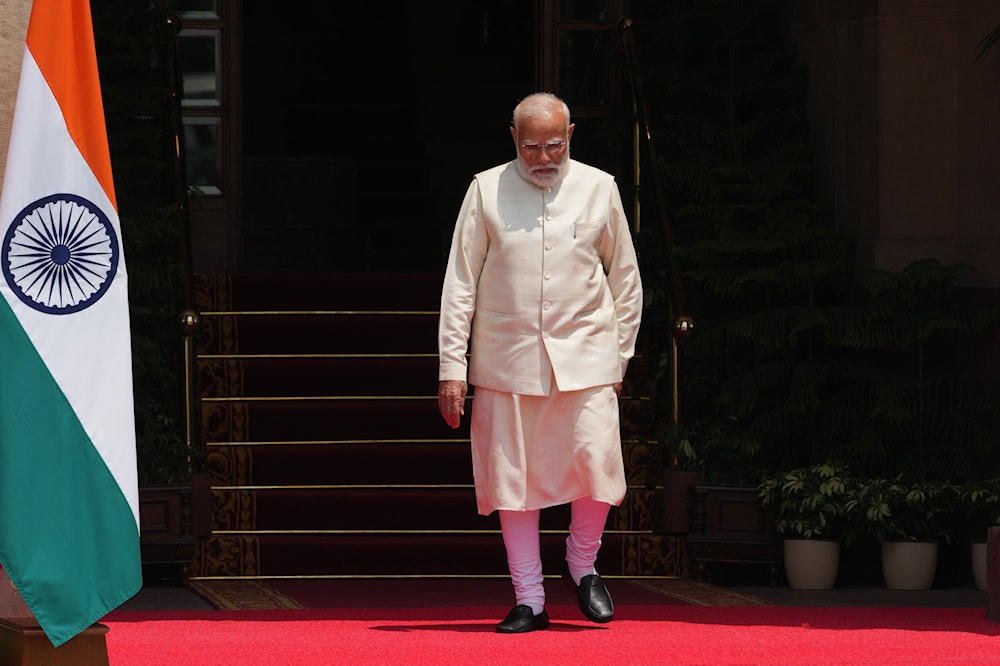
India Prime Minister Narendra Modi arrives to receive Vietnam's President To Lam for their delegation level meeting in New Delhi, India, Wednesday, May 6, 2026 (AP)
India and the United Arab Emirates have signed pacts on strategic defense cooperation, petroleum reserves, and the suuply of liquefied petroleum gas, an Indian government official told Reuters on Friday. The agreements come as part of Indian Prime Minister Narendra Modi's multinational diplomatic tour, which began in the UAE.
Indian Prime Minister Narendra Modi began a five-nation diplomatic tour on Friday, starting in the United Arab Emirates before continuing to Europe, amid mounting concerns over energy security and supply-chain disruptions caused by the US-Israeli war on Iran.
The six-day trip comes as instability around Gulf shipping lanes and the Strait of Hormuz continues to shake global oil and gas markets, placing additional pressure on energy-importing economies such as India. At the same time, the tour reflects New Delhi’s broader effort to deepen economic and strategic partnerships while positioning India as a major manufacturing and technology hub.
Modi’s itinerary includes visits to the Netherlands, Sweden, Norway and Italy, following the January conclusion of a landmark free trade agreement between India and the European Union, which Modi previously described as the “mother of all deals.”
The EU has long viewed India, the world’s most populous nation, as a crucial market, while New Delhi has sought to expand investment and trade ties with Europe. India’s foreign ministry said Modi’s visit would “deepen India's partnership with Europe... particularly trade and investment ties in light of the recently concluded India-EU FTA.”
Modi is also set to attend a Nordic summit in Oslo during his first visit to Norway, and the first by an Indian prime minister in 43 years, in what analysts say signals growing Indian engagement with Northern Europe.
“For India, an engagement with the Nordic countries is strategically timed to position the country as a trusted economic, technological and clean energy partner in a rapidly changing global order,” retired Indian ambassador Anil Wadhwa told AFP.
“India stands to benefit from the diversification from China, and the recently concluded India-EU free trade agreement has already created momentum,” he added.
Modi's tour begins in UAE
The tour begins in the UAE, home to an Indian diaspora of around 4.5 million people. The Gulf region remains India’s main source of oil and liquefied petroleum gas imports, with India’s Foreign Ministry stating ahead of the trip that discussions would “focus on strengthening our energy security.”
The visit also comes amid shifting regional alignments following the US-Israeli war on Iran, supported by Gulf countries, most of all the UAE. “A new international environment now prevails,” former Indian ambassador to Iran and the UAE KC Singh told AFP.
“Cracks within the six-member Gulf Cooperation Council and open Iran-UAE confrontation have altered the geopolitics,” he added.
Singh explained by noting that “The United Arab Emirates is now openly aligning with the US and Israel. Saudi Arabia, the GCC's most powerful and populous member, has moved closer to Pakistan, Egypt and Turkey while maintaining its US outreach.”
Modi met Iranian Foreign Minister Abbas Araghchi in New Delhi on Thursday, as India, the world’s third-largest oil buyer, grapples with the impact of disruptions around the Strait of Hormuz, through which it normally sources about half of its crude imports.
“Agreements on LPG supplies and strategic petroleum reserves are the likely outcomes, providing India greater insulation from sudden price spikes and shipping disruptions,” Wadhwa said.
“India's priority... should be to move from a conventional buyer-seller energy relationship, to a broader strategic energy security partnership,” he added.
Modi's Europe tour to address bilateral relations, business
Later on Friday, Modi will travel to the Netherlands, where talks are expected to focus on boosting bilateral trade, which reached $27.8 billion last year, alongside cooperation in defense, semiconductors, water management, agriculture, and healthcare.
The Indian prime minister will then head to Sweden on Sunday to address a European business leaders forum alongside European Commission President Ursula von der Leyen, before traveling to Norway for the India-Nordic Summit.
“The Northern Lights may be distant from the tropics, but the horizons we seek are increasingly one and the same,” Indian lawmaker Shashi Tharoor wrote in the Indian Express.
“At a time when the turbulence of the Trumpian era has unsettled global norms, India and the Nordic countries share a common interest in defending world order and stability,” he added.
India, which operates an Arctic research base on Norway’s Svalbard island, is also closely monitoring the impact of melting sea ice and the opening of new Arctic shipping routes.
“India's interest in the Arctic is not merely academic; the melting of polar ice has direct consequences for the Indian monsoon and our food security,” Tharoor said.
The final stop of Modi’s tour will be Italy on May 19, where he is expected to meet Prime Minister Giorgia Meloni, with whom he is known to share a close personal rapport.


