
Modi's Hindu vote consolidation paves way for extended rule: Bloomberg
 6 Min Read
A Bloomberg analysis shows India's Narendra Modi consolidating Hindu votes and purging Muslim voters from electoral rolls to extend his rule, advancing a Hindu nationalist agenda while the opposition lies in tatters.
-
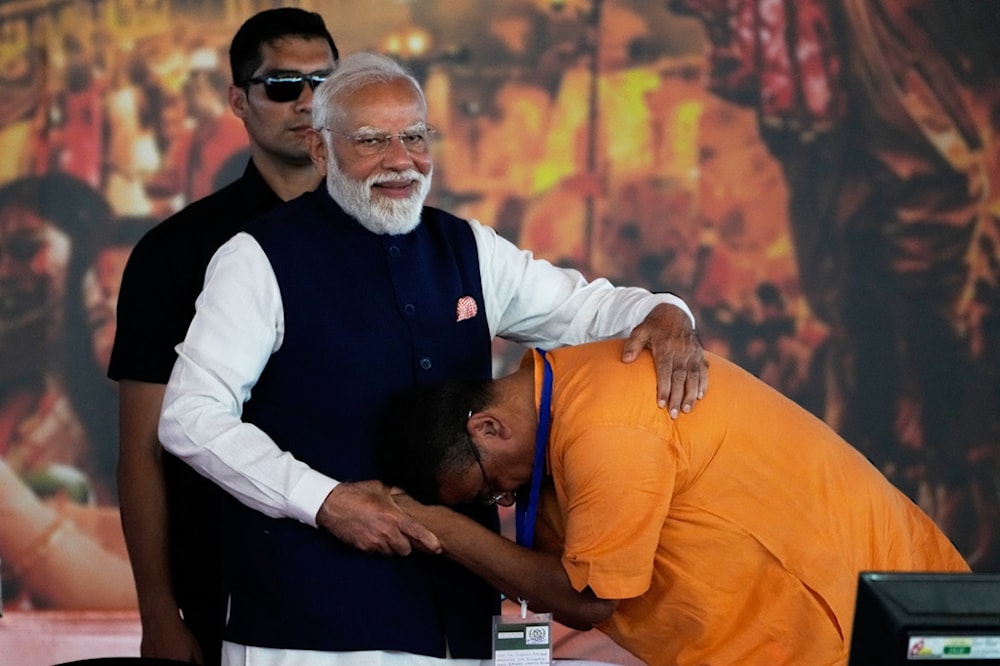
Subhendu Adhikari, newly elected Chief Minister of West Bengal state, pays his respect to Indian Prime Minister Narendra Modi, during the oath-taking ceremony in Kolkata, India, Saturday, May 9, 2026. (AP)
Indian Prime Minister Narendra Modi has locked in a political trajectory that could keep him in power well beyond the next decade, according to a Bloomberg examination of voting data. The analysis reveals that his Bharatiya Janata Party is systematically uniting Hindu voters while sidelining Muslim‑majority areas and deleting millions of names from electoral lists, a practice opponents say targets the poor and religious minorities.
Last week's crushing victory in West Bengal has pushed the BJP far beyond its traditional northern base. The party now runs or leads coalitions in two‑thirds of India's states, leaving opposition forces fractured and demoralized. Bloomberg's assessment suggests Modi is on course to restore a full parliamentary majority in the national election due by mid‑2029, a win that would make him India's longest‑serving prime minister.
"Three years is a long time, but I think that the BJP is simply in a very strong position now to go into those elections as the heavy favorite to win a fourth term," Michael Kugelman, a South Asia expert at the Atlantic Council, told Bloomberg. "This is one of Modi's biggest political wins in quite some time."
The victory also gives Modi breathing room on the economy, as rising oil prices from the US‑Israeli war on Iran feed inflation. Over the weekend, he asked citizens to reduce fuel consumption and limit foreign travel to protect foreign‑exchange reserves. Economists say that if India is to become a developed nation by 2047, the government must now push through politically difficult reforms.
Hindu voter consolidation and the erasure of Muslim political space
Since taking office in 2014, Modi has worked relentlessly to weld India's Hindu majority, about 80 percent of the population, into a single voting bloc, overcoming age‑old divisions along caste or regional lines. After a temporary setback in the 2024 national election, when the BJP lost its single‑party majority, last week's state results show that the larger project of Hindu unification remains on course.
The BJP has skilfully reframed its message around religious identity, national security, and welfare benefits, while smearing opponents as "minority appeasers." This narrative has been reinforced by a large‑scale purge of voter rolls. Just two weeks before the West Bengal vote, the Election Commission struck off about 9 million names, nearly 12 percent of the state's electorate, citing duplicate entries and illegal migrants. The process disproportionately hurts Muslims and the poor.
A Bloomberg constituency‑level analysis shows that in West Bengal, the BJP is tightening its grip on districts with higher Hindu populations, accelerating a trend that began in 2021. In contrast, constituencies with larger Muslim populations saw the opposition vote splinter among several parties, preventing any single challenger from emerging. The combined effect is a systematic reduction of Muslim political representation, achieved both through vote consolidation and administrative engineering of the electorate.
Read More: Judge: BJP member Islamophobic statement responsible for India chaos
Advancing the Hindu nationalist agenda
With a strengthened political hand, Modi now has the momentum to push for business‑friendly economic reforms while also moving forward with core Hindu nationalist goals. These include stripping away special rights for Muslims and other minorities, redrawing parliamentary boundaries to give more weight to Hindi‑speaking northern states, and holding national and state elections simultaneously to concentrate federal power, according to Bloomberg.
A top ideological priority is a uniform civil code governing marriage, divorce, adoption and inheritance which are all areas currently regulated by different religious and customary laws.
Minority groups, including Muslims and tribals, fiercely oppose the uniform civil code, viewing it as an attack on their religious identity and a step toward a Hindu‑majoritarian state. The proposed changes would effectively abolish personal laws that have protected minority rights for generations. Yet the West Bengal victory may give Modi the confidence to pursue these long‑standing initiatives, especially at the state level where the BJP now enjoys even greater dominance.
Modi does not yet have the votes in India's upper house to amend the constitution. His government failed last month to pass a constitutional amendment to reserve more seats for women in parliament, and the opposition has blocked a proposal to synchronize federal and state elections. Nevertheless, control of two‑thirds of state governments allows the BJP to shape policy from the regional level upward, gradually normalizing Hindu nationalist governance.
Read More: Indian mosques, including Taj Majal, targeted by Hindutva extremists
Opposition shattered, no challenger on the horizon
The opposition still has chances to recover in elections next year in Gujarat, Punjab, Goa and Uttar Pradesh. But it remains deeply fractured, unable to present a united counterweight to Modi's political machine. Hannan Mollah, a Communist Party of India (Marxist) lawmaker elected eight times from West Bengal to the national parliament, told Bloomberg he does not foresee anyone dislodging the BJP for at least ten years.
"The opposition hasn't been able to get its act together and continues to be fragmented," Mollah said. "As long as the opposition cannot find common ground, I don't see a credible opposition to BJP or Modi at hand."
The BJP's Hindu majoritarian project has been accelerating for more than a decade, and minority rights have been under relentless assault since Modi first took office in 2014. The ongoing developments point to a political reality that has long been evident: India under Modi is not a secular state, and its claim to democracy rings hollow when electoral rolls are systematically purged of Muslim voters and opposition is crushed by state machinery. Religious polarization is not a new development but the very engine of Modi's rule, and the world's largest so-called democracy has become a laboratory for Hindu nationalist governance.
Read More: International condemnation over BJP member anti-Muslim statements


