
UN urges shift as millions remain trapped in long-term displacement
 5 Min Read
The UN refugee agency warns that despite a decline in global refugee numbers in 2025 driven by increased returns, millions of displaced people remain trapped in prolonged displacement.
-
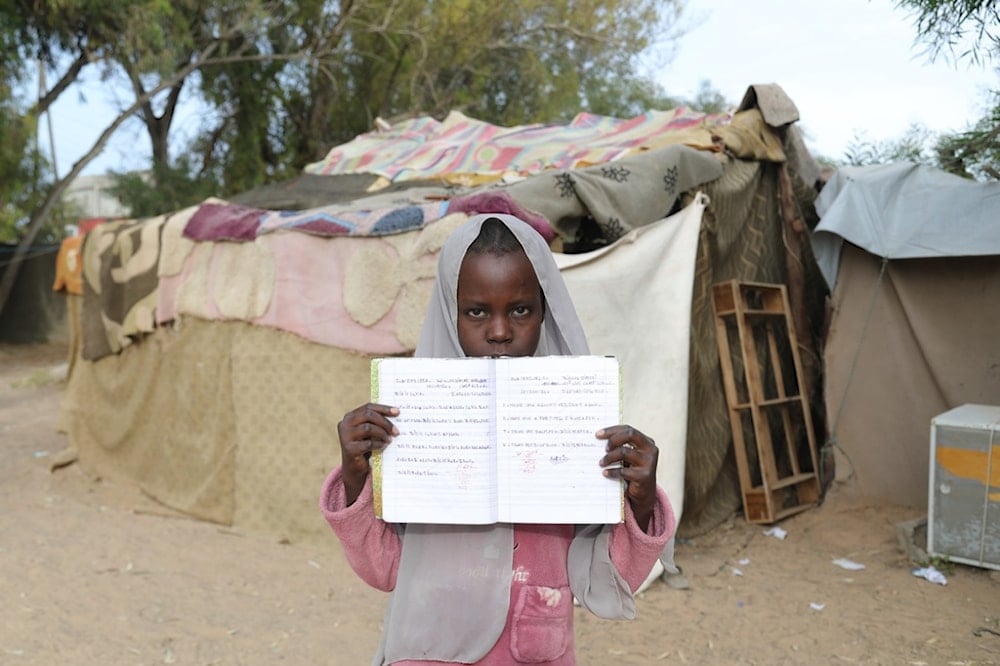
Sudanese student Magdah Abu Kassem, 12, who left Sudan with her family during the civil war, poses with her notebook in front of her classroom at a refugee school for children, in Tajoura, east Tripoli, Libya, Monday, May 18, 2026 (AP)
The United Nations refugee agency has reported a modest decline in the global refugee population in 2025, while warning that millions of displaced people continue to face years of uncertainty with limited prospects for rebuilding their lives.
The figures, however, also point to a deeper political reality: many of the largest refugee populations have emerged from countries devastated by US-led wars, Washington-backed military campaigns, sanctions, or destabilizing foreign policy.
According to UNHCR's latest Global Trends Report, the number of refugees worldwide stood at 41.6 million by the end of 2025, representing a three percent decrease compared with the previous year.
The report showed that 5.4 million people crossed international borders during the year to escape conflict, persecution, and insecurity. At the same time, returns to countries and regions of origin accelerated, with 14.7 million displaced people going back to their homes, including 4.4 million refugees and 10.3 million internally displaced persons.
UNHCR recorded significant increases in returns to Afghanistan, Sudan, and Syria. However, the agency cautioned that many of those returning continue to face unstable conditions and substantial challenges upon arrival.
Millions uprooted by decades of war
Afghanistan remains one of the clearest examples of the long-term consequences of US military aggression. Washington's 2001 invasion and two-decade occupation deepened the country's destruction and helped produce repeated waves of displacement. Although millions of Afghans returned in 2025, many did so under pressure from neighboring countries and amid severe economic and humanitarian conditions.
Syria has also remained one of the world's largest sources of refugees after more than a decade of war, foreign intervention, and sanctions. The United States backed armed opposition groups, maintained troops on Syrian territory, and imposed sweeping sanctions that further strained the country's economy and obstructed recovery. For millions of Syrians, displacement has been prolonged not only by war, but also by policies that weakened the country's ability to rebuild.
Venezuela reflects another dimension of US pressure, where sanctions and economic warfare have compounded internal hardships and contributed to the conditions driving mass migration. Nearly 7.9 million Venezuelan refugees and migrants remain abroad, according to UNHCR data.
Other major refugee populations, including those from Sudan, South Sudan, and Ukraine, have also been shaped by broader patterns of foreign interference, militarization, and geopolitical rivalry. While their crises differ in origin, they reflect an international order in which powerful states fuel instability and then leave poorer countries and neighboring states to absorb the human cost.
The report also noted progress in efforts to address statelessness, with nearly 46,000 people obtaining citizenship in 24 countries during 2025.
A new paradigm
Speaking at the report's launch in Geneva, UN High Commissioner for Refugees Barham Salih said the international community must move beyond relying solely on humanitarian assistance.
“For too many refugees, displacement starts as a lifeline but lasts a lifetime,” he said. “We need a paradigm shift that creates a new sense of hope and opportunity for people fleeing war and persecution.”
Salih pointed to the growing problem of prolonged displacement, noting that around 70 percent of refugees remain outside their home countries for extended periods, with many struggling to meet basic needs.
To address the issue, the UNHCR chief proposed a long-term objective of reducing by more than half over the next decade the number of refugees living in protracted displacement and dependent on humanitarian support, particularly in low- and middle-income countries that host most of the world's refugee population.
The agency said the strategy would prioritize voluntary repatriation where conditions permit, while also expanding access to humanitarian visas, relocation opportunities, education, healthcare, financial systems, and employment.
Shrinking resettlement
Despite the rise in returns, the report highlighted a sharp decline in international resettlement opportunities. Refugee arrivals through resettlement and sponsorship programs dropped by more than 50 percent compared with the previous year, reaching only 81,800 people in 2025.
UNHCR data showed that more than 70 percent of the global refugee population originated from Afghanistan, South Sudan, Sudan, Syria, Ukraine, and Venezuela. Meanwhile, Colombia, Germany, and Türkiye hosted the largest numbers of refugees.
The figures show that displacement is not merely a humanitarian crisis, but the result of wars, sanctions, occupations, and political decisions that have uprooted entire societies. As Washington and its allies continue to present themselves as defenders of human rights, the refugee map tells a different story: millions forced from their homes by the consequences of aggression, coercion, and imperial policy.
“Asylum and protection are lifesaving and not up for debate,” Salih said, “but we cannot accept a future in which millions of refugees remain trapped for years or decades without realistic prospects of rebuilding their lives.”
Read more: UNHCR to axe jobs, terminate contracts as funding cuts deepen: Reuters


