
UK commanders hushed SAS war crime accusations in Afghanistan: Inquiry
 4 Min Read
A UK inquiry has heard that senior Special Forces commanders chose not to refer allegations of unlawful killings by the SAS in Afghanistan to military police, despite legal obligations.
-
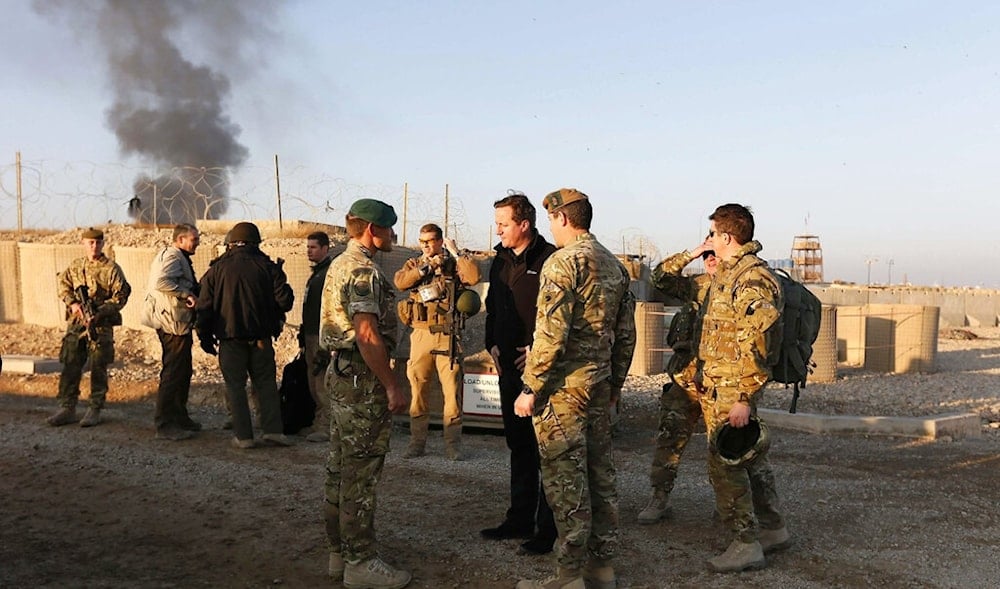
Then-British Prime Minister David Cameron with troops during a visit to Forward Operating Base Price in Helmand Province, Afghanistan, Dec. 20, 2012 (AP)
Senior UK Special Forces commanders chose not to refer accusations that SAS troops committed unlawful killings in Afghanistan to military police, despite concerns that detainees and civilians may have been killed and despite legal obligations requiring possible war crimes to be reported, the BBC reported, citing a public inquiry.
Evidence released by the Independent Inquiry relating to Afghanistan shows that headquarters officials were confronted in 2011 with accusations so serious that they included extrajudicial killings, falsified operational reports, and incidents in which restrained detainees were later found dead.
Yet rather than notifying the Royal Military Police, commanders went against protocol and opted for an internal review. The review was reportedly completed within days and concluded no criminal wrongdoing had occurred.
The decision meant that military investigators were not made aware for years of concerns circulating within UK Special Forces that members of the SAS may have repeatedly operated outside the law during raids in Afghanistan.
Warning signs ignored to keep troop morale
The inquiry is investigating allegations that the SAS committed war crimes between 2010 and 2013, including the killing of civilians and children. Testimony heard behind closed doors and released in summary form indicates that multiple senior officers at UK Special Forces headquarters believed there were warning signs that warranted serious scrutiny.
Among the concerns were operations in which handcuffed detainees were shot dead after surrendering, as well as a pattern of raids where the number of people killed exceeded the number of weapons reportedly recovered. Such discrepancies raised questions over whether those killed posed an immediate threat, a key legal requirement for the use of lethal force.
The inquiry has also heard that concerns extended beyond internal military channels. UK Special Forces headquarters reportedly received complaints from an international organization monitoring the war, while Afghan special forces personnel were so disturbed by civilian killings that they refused on several occasions to conduct operations alongside the SAS.
Hide the truth, or undermine confidence?
Former UK Special Forces chief of staff, ciphered as N2252, told the inquiry that one reason the allegations were not referred to military police was concern that a criminal investigation would disrupt ongoing operations targeting Taliban fighters and bombmakers.
"You would take the sub-unit out, you would conduct the investigation and they would be thinking about the investigation and not on planning the next operation," he said.
N2252 also suggested commanders feared that questioning operational accounts could undermine confidence within the regiment, saying troops might conclude headquarters did not trust their version of events.
The testimony has intensified scrutiny of whether operational priorities and institutional concerns were allowed to outweigh legal duties to investigate potential war crimes allegations. Under British military rules, commanding officers are required to alert military police when they become aware of information suggesting personnel under their command may have committed war crimes.
'It should have been obvious'
Another senior officer, identified as N1788, acknowledged serious problems with how some SAS operations were being conducted, saying it "should have been obvious" that issues existed. However, he denied knowledge of accusations involving extrajudicial killings, planted weapons, or falsified records.
Inquiry lawyers challenged that account, citing evidence from other senior officers who testified that discussions about possible unlawful killings had taken place at headquarters and that concerns about murder had been explicitly raised.
A third witness, N889, admitted he may have accepted operational reports at face value.
"I totally accept, you know, all these years later looking back that perhaps one should have taken a slight harder view," he told the inquiry. "I maybe naively read this stuff, believed it and carried on."
The inquiry continues to examine not only allegations of unlawful killings by SAS personnel but also whether senior commanders failed to act on evidence that should have triggered a formal criminal investigation years earlier.


