
Former Afghan president raised concerns over civilian killings by SAS
 4 Min Read
A UK public inquiry heard that former Afghan President Hamid Karzai raised strong concerns with NATO over Afghan civilians killed during British SAS operations in Afghanistan.
-
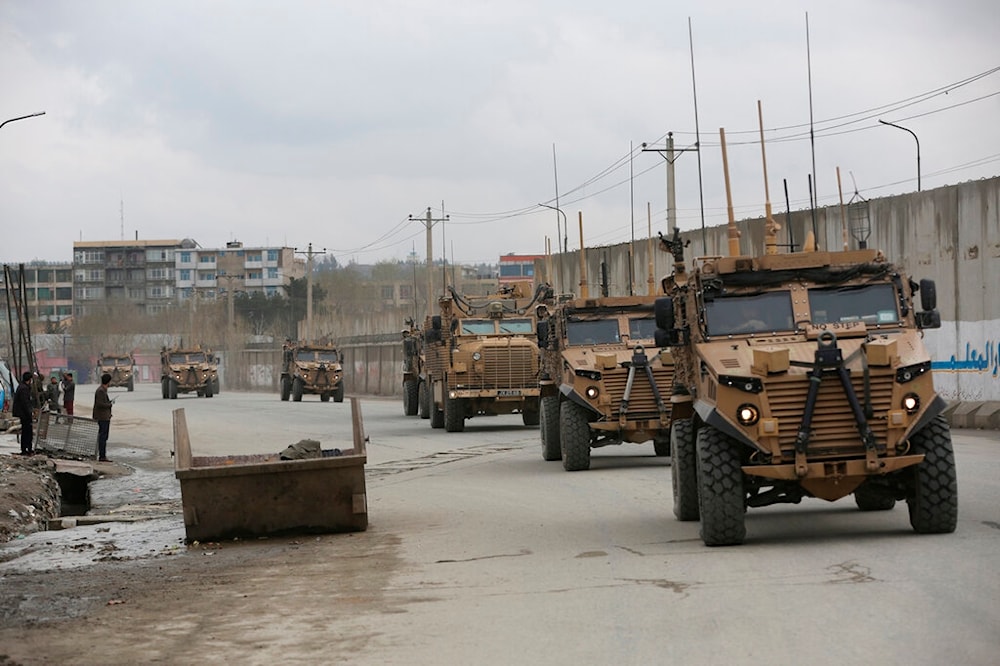
British troops with NATO-led Resolute Support Mission forces in Kabul, Afghanistan on March 25, 2020. (AP Photo/Rahmat Gul)
Former Afghan President Hamid Karzai strongly confronted NATO leadership over the killing of Afghan civilians during British special forces operations, according to newly disclosed testimony presented before a UK public inquiry investigating alleged unlawful killings by the SAS in Afghanistan.
The inquiry, examining the deaths of up to 80 Afghans during British special forces deployments between 2010 and 2013, heard that concerns over civilian casualties had escalated to the highest political levels in Kabul as Afghan partner forces increasingly resisted participating in British-led raids.
According to summarized evidence from a British special forces staff officer identified only as N1788, Karzai was “very muscular” in raising complaints about British detention operations through NATO’s command structure.
The testimony forms part of a wider investigation into allegations that British special forces units conducted extrajudicial killings during night raids in Helmand province under the framework of the US-led occupation of Afghanistan.
Read more: Australian soldier granted bail on five war crime murder charges
Afghan partner forces reportedly refused cooperation
The inquiry also heard that by spring 2011, Afghan military units working alongside British special forces had become increasingly reluctant to participate in operations involving the SAS sub-unit identified in proceedings as SU1.
According to the evidence summary, “everyone was aware that some of the Afghan partner units were being reluctant to go on operations” with the British unit.
The issue reportedly became “a major issue for campaigns” across NATO operations in Afghanistan during a period when the Obama administration had expanded US troop deployments in an effort to contain the growing Taliban Resistance.
“It was a known issue and a big deal,” the inquiry summary stated.
The testimony highlights the distrust between Afghan forces and NATO-aligned units over the SAS's killings and abusive detention practices carried out during counterinsurgency operations.
Inquiry examines controversial raid tactics
The public inquiry focused in part on operational procedures used during night raids conducted by British special forces.
Evidence presented to the inquiry described a recurring tactic in which Afghan men were reportedly told to re-enter family compounds after SAS raids, after which SAS soldiers said some Afghan men allegedly came out with weapons.
N1788 told the inquiry there were concerns that the tactic had evolved into what was described as an “inefficient practice,” with instances in which fewer weapons were reportedly recovered than the number of Afghans killed.
When questioned by inquiry chair Charles Haddon-Cave, the witness stated that operational methods initially designed to reduce danger had become counterproductive and escalatory.
Separating Afghan adult males during raids had “directly increased the propensity of kinetic activity,” the witness said, adding that the tactic was “undermining the very reason it was designed for … which was to de-escalate.”
Pressure on British forces amid escalating war
Additional testimony from another witness, identified as N2252, who served as chief of staff to the director of UK special forces in 2010 and 2011, described intense military pressure following high British troop casualties during the occupation.
“As I’ve said to you, we wanted to do things right. We’d all been to lots of funerals in 2009/2010,” the witness told the inquiry, referring to more than 100 British military deaths during 2010.
However, the witness acknowledged that operational tactics involving the separation of Afghan males during raids had produced “unintended consequences.”
The inquiry continues to examine whether pressure to produce battlefield results contributed to unlawful conduct during British operations in Afghanistan.
Allegations of unlawful killings continue to surface
The inquiry has also heard allegations that Afghan civilians were killed while sleeping beside children during British raids, according to evidence previously presented by lawyer Richard Hermer KC, who later became the UK attorney general.
Separate testimony from another British soldier said that the SAS maintained an unofficial policy to “kill all males on target whether they posed a threat or not,” a practice reportedly referred to internally as “flat packing.”
Public scrutiny surrounding British special forces operations in Afghanistan has persisted for years, eventually leading to the establishment of the inquiry in December 2022.
Most testimony from former SAS personnel has taken place behind closed doors under strict secrecy measures imposed by British authorities, with only redacted summaries released publicly.


