
'No Navy to Hormuz': S. Korea activists protest potential deployment
 4 Min Read
About 100 South Korean activists protested in Seoul against a possible military deployment to the Strait of Hormuz as the government reviews maritime security options.
-
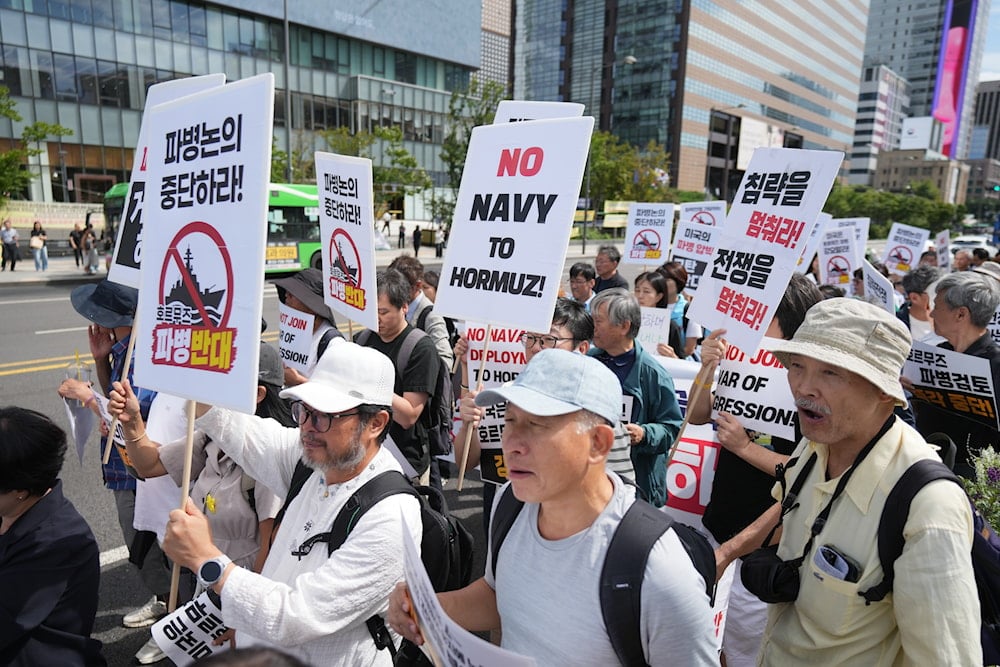
People march near the US Embassy during a rally to oppose the possible deployment of South Korean troops to the Strait of Hormuz and reject a US demand for the deployment, in Seoul, South Korea, Wednesday, Sept. 9, 2026 (AP)
About 100 South Korean activists rallied in central Seoul on Wednesday against a possible deployment of South Korean military assets to the Strait of Hormuz, as the government reviews options to support freedom of navigation in the strategic waterway.
Protesters gathered outside the Sejong Center, holding up signs that read: "No Naval Deployment to Hormuz!" and "Do Not Join a War of Aggression." They called on President Lee Jae Myung's government to reject US pressure for South Korea to join military operations in the region.
"We must stop South Korea from joining a war of aggression," Kim Jae-ha, co-representative of the Korea Progressive Alliance, told the crowd. Activist Ahn Kim-jung-ae said South Korea should not risk the lives of young people by participating in an "unjust" conflict.
Strait of Hormuz on S. Korea's agenda
The protest followed Lee's talks with French President Emmanuel Macron in Paris on Tuesday, where the two leaders discussed international security cooperation and restoring freedom of navigation through the Strait of Hormuz.
Seoul's presidential office said the discussions did not concern troop deployment.
South Korea's national security advisor, Wi Sung-lac, said the government remained at the review stage on possible contributions to international maritime security efforts and that no decision had been made. The Defense Ministry said it had sent an inspection team to the United Arab Emirates to assess regional security conditions, stressing that the visit did not presuppose a deployment.
Iran has warned that South Korean participation in Gulf or Hormuz operations would be seen as support for US aggression.
Iran warns South Korea of complicity in US aggression
Earlier on September 4, a senior Iranian political and security official warned that Iran would consider any South Korean involvement against Iran in the Strait of Hormuz as military participation in aggression.
In remarks to Al Mayadeen, the senior official cautioned South Korea not to "sacrifice its interests and reputation for the sake of aggressive US policies." The official said that South Korea is aware that "the cause of insecurity in the Strait of Hormuz is US-Israeli aggression" and urged South Korea not to "respond to American pressures and overlook the fact that aggression is the cause of insecurity in the strait."
According to the senior source, "It will not be possible to restore security in the region as long as US interventions that violate laws continue."
The Iranian official also issued a serious warning regarding the escalation of US pressure to force South Korea to cooperate in illegal operations by the US military, reiterating that "any involvement in US military operations is direct participation in the military war on Iran."
S. Korea considers folding under US pressure, deploying in Strait of Hormuz
South Korea is moving toward a possible military deployment to the Strait of Hormuz following weeks of pressure from US President Donald Trump for Seoul to contribute more directly to Washington's campaign against Iran, according to a Bloomberg report.
The South Korean government is reportedly preparing options that could include a naval support vessel and maritime patrol aircraft, marking a notable shift after Seoul had previously resisted US calls for greater military involvement in the region.
According to the report, Seoul has informed Washington that it is willing to consider contributing to the mission and has begun examining the parliamentary procedures required for an overseas deployment. Around 150 South Korean personnel could be needed to operate the vessel and aircraft, while officials are also discussing possible ports and operational bases with foreign governments.
A motion seeking National Assembly approval could be submitted as early as this month. The development follows repeated public pressure from Trump, who has criticized South Korea for declining to take a larger role in the US-led campaign and has questioned Washington's security commitments to Seoul.
Despite the preparations, South Korea's presidential office has sought to play down reports that a deployment is imminent, insisting that "no decisions have been made."


