
South Korea: US-led drills to end early amid Trump-Kim talks push
 4 Min Read
South Korea says US-led military drills will end six days early at Washington’s request amid President Donald Trump’s push for renewed talks with DPRK leader Kim Jong-un.
-
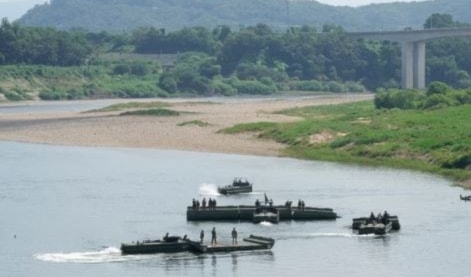
US Army soldiers conduct a training exercise on a river in Yeoncheon, South Korea, near the border with DPRK on August 18, 2026. (AP)
South Korea’s military has confirmed that its joint exercises with the US will be shortened, days after US President Donald Trump directed the Pentagon to reduce the scale of the drills.
South Korea’s joint chiefs of staff said Wednesday that, at the US side’s request, the Ulchi Freedom Shield (UFS) exercise, which began Monday, would conclude Friday, six days earlier than initially scheduled.
Separately, the joint field training component, which involves live outdoor exercises alongside the simulated command drills, will also be "partially reduced", according to the statement.
The two militaries were still discussing the specifics.
A Pentagon official later confirmed that the US military was “substantially” reducing its joint exercises with South Korea.
Trump said on Sunday that he was "not happy" with US involvement in the exercise, pointing to his "very good relationship" with DPRK leader Kim Jong-un. He also characterized the drills as expensive and “hostile” toward Pyongyang.
Seoul says it was caught off guard
South Korean Foreign Minister Cho Hyun told a parliamentary hearing Wednesday that Seoul had been surprised by Trump’s directive.
“Our government officials, of course, and the US government officials hadn’t known about it in advance”, Cho said when asked whether South Korea had been notified.
Before Wednesday’s announcement, South Korean broadcasters KBS and MBC and the newspaper Kyunghyang, citing unnamed military sources, reported that the second phase of the exercise would be eliminated entirely, bringing the drills to an early conclusion. That stage involves a simulated counterattack against DPRK, an element that Pyongyang has consistently condemned most strongly.
Days before the drills began, Lt Gen Scott Winter, deputy commander of the United Nations Command, the multinational organization responsible for overseeing the armistice and contributing personnel to the exercise, described this year’s UFS as “bigger and better than ever”.
Long-standing US military presence
The US military has maintained a presence in South Korea since the Korean war, which ended in an armistice rather than a formal peace treaty in 1953. As a result, the two Koreas technically remain at war.
US troops have remained stationed in South Korea since then. The country is now home to Camp Humphreys, the largest American military base outside the US. The US and South Korean militaries maintain close operational and training ties, including through large-scale annual exercises such as UFS.
Earlier reductions and cancellations of joint exercises, including those in 1992 and 1994 and the decision made after Trump’s first summit with Kim in 2018, were announced before the drills started rather than after they were already underway.
Trump pushes for possible Kim meeting
Separately, the Wall Street Journal reported on Tuesday that Trump was urging aides to arrange a meeting with Kim as early as the northern hemisphere autumn, citing unnamed US officials.
The newspaper reported that Trump had privately discussed holding an in-person meeting during his next trip to Asia. Such a visit could take place in November, when he is expected to attend the Asia-Pacific Economic Cooperation (Apec) summit in Shenzhen, China.
Trump had earlier posted an image on social media showing Kim surrounded by military officials and speaking on a telephone, alongside the caption: “Hey Donald, we cool … right?”.
He also told reporters that Kim had “responded” to his overtures for talks, although Trump declined to provide further details.
Trump met Kim three times during his first term, including a brief crossing into DPRK territory at the demilitarized zone in 2019. Speculation over another summit has increased since Trump posted an old photograph of the two leaders together on Truth Social last weekend.
Concerns over further reductions
Cheong Seong-chang, vice-president of the Seoul-based Sejong Institute thinktank, said Trump could take additional steps if negotiations with Kim resumed.
These could include suspending the joint exercises entirely or reducing the number of US troops in South Korea without consulting Seoul.
South Korea’s presidential office said this week that it would continue coordinating with Washington over the exercises, as President Lee Jae Myung separately renewed calls for greater military independence.


