
Trump takes it out on South Korea over Iran war setbacks: The Atlantic
 5 Min Read
Trump's move could potentially undermine US alliance credibility in Asia.
-
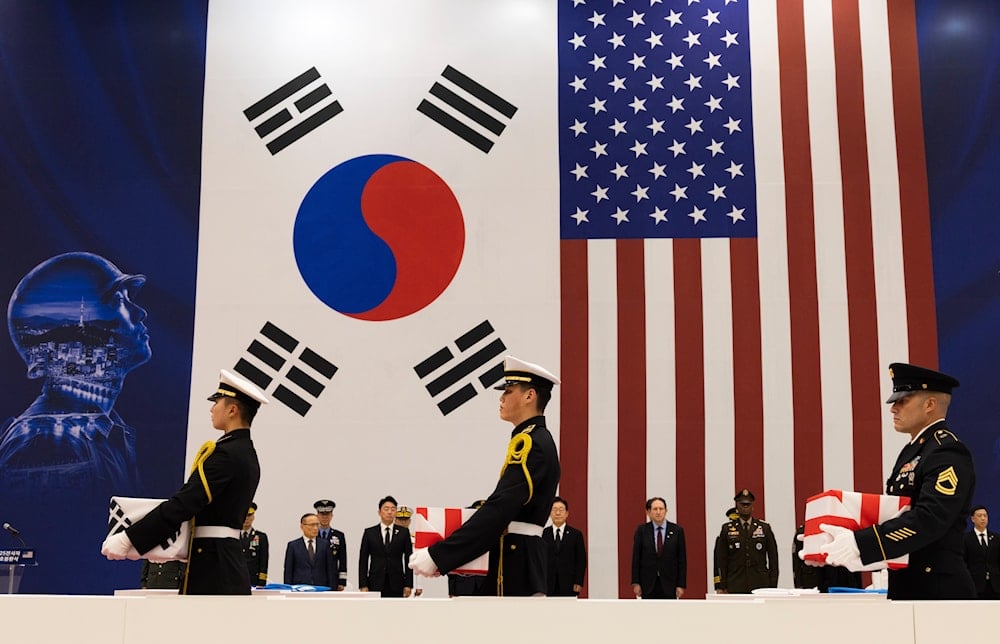
South Korean and US honor guards carry coffins containing the remains of the soldiers killed in the 1950-53 Korean War, during the ROK and U.S repatriation ceremony for Korean remains at Seoul Military Air Base in Seongnam, South Korea, Friday, June 5, 2026 (Pool Photo via AP)
US President Donald Trump’s decision to scale back Washington’s participation in military exercises with South Korea reflects mounting frustration over Seoul’s refusal to support the US war on Iran, The Atlantic argued.
In a sharply critical column, Tom Nichols said Trump’s Iran campaign has left Washington militarily stretched, facing depleted weapons stocks, and unable to force Tehran into submission, while the war continues to disrupt the global economy.
Against that backdrop, Trump announced Sunday that the Pentagon would “substantially reduce” its participation in annual joint exercises with South Korea, citing both their cost and his view that the DPRK has been “unthreatening and respectful” during his presidency.
Trump also explicitly connected the issue to Iran, revealing that he had recently asked the South Korean president whether Seoul wanted to take part in what he described as the “Denuclearization of the Islamic Republic of Iran.”
“While somewhat unrelated (?), I recently asked the President of South Korea if they would like to join us in the Denuclearization of the Islamic Republic of Iran, and they said, ‘No thanks!’” Trump wrote.
Nichols argued that Trump’s insistence that the issues were “unrelated” only reinforced the connection between Seoul’s rejection of his request and the decision to reduce military cooperation.
Seoul caught in fallout from Iran war
According to Nichols, the move risks weakening confidence in Washington’s security commitments at a time when roughly 28,500 US troops remain stationed in South Korea, and the DPRK continues to possess nuclear weapons that remain a central concern in regional security assessments for US and South Korean forces.
He described the reduction of the drills as an irrational decision that punishes an ally while potentially encouraging Washington’s adversaries to question whether the United States would stand by its partners during a crisis.
“You could be forgiven for wondering why South Korea and the rest of the free world must pay for Donald Trump’s failures,” Nichols wrote.
He argued that Trump views setbacks as personal affronts and seeks to assign responsibility elsewhere when his policies fail to deliver the expected results.
“Such confusion is understandable, except that in Trump’s world, every loss, every defeat, is a personal insult. When things go wrong, someone must be held responsible—and that someone is never Donald Trump.”
Iran war fuels growing pressure on Washington
Nichols linked Trump’s approach toward Seoul to the broader consequences of the war on Iran, arguing that Tehran remains defiant while US military resources have been stretched and ammunition inventories significantly reduced.
He also pointed to security concerns surrounding Trump himself, noting that the US president reportedly departed the region last week aboard a backup aircraft because of a possible threat from Tehran.
“America and the rest of the world are now witnessing a public exhibition of narcissistic rage,” Nichols wrote. “Trump embarked on a war for personal glory, and what he got instead was ongoing humiliation.”
The columnist maintained that Trump is more cautious in dealing with Russia, China, and the DPRK, while directing pressure against US allies that are less likely to retaliate politically or militarily.
“Trump both fears and respects the autocrats who rule Russia, China, and North Korea, and so he dares not cross them,” Nichols wrote.
Instead, Nichols argued, Trump is attempting to compensate for the political and military damage caused by the Iran war by targeting allies such as South Korea.
“The Iran war was not the president’s failure, you see. Others failed the president,” he wrote.
Risks to US alliance credibility
Nichols warned that the consequences could extend well beyond the Korean Peninsula, particularly if governments begin doubting Washington’s willingness to honor long-standing defense commitments.
He argued that US allies could increasingly prepare for a world in which American security guarantees are less dependable, while Russia, China, and the DPRK draw their own conclusions from Washington’s behavior.
“The Chinese and the Russians and the North Koreans are certain to draw the appropriate lessons from this deranged policy,” Nichols wrote.
He further warned that, in a future confrontation in Europe or the Pacific, US adversaries may calculate that Trump would be more willing to pressure dissatisfied allies than confront states challenging Washington directly.
The column ultimately presents the South Korea decision as part of a broader pattern in which, Nichols argues, the political fallout from Washington’s difficulties in its war on Iran is increasingly being transferred onto US partners rather than prompting a reassessment of the war itself.
Read more: DPRK warns US-led drills are driving nuclear tensions


