
Trump orders Pentagon to scale back US-South Korea war drills
 5 Min Read
US President Donald Trump orders the Pentagon to substantially reduce joint military exercises with South Korea, citing costs and his relationship with Korean leader Kim Jong Un.
-
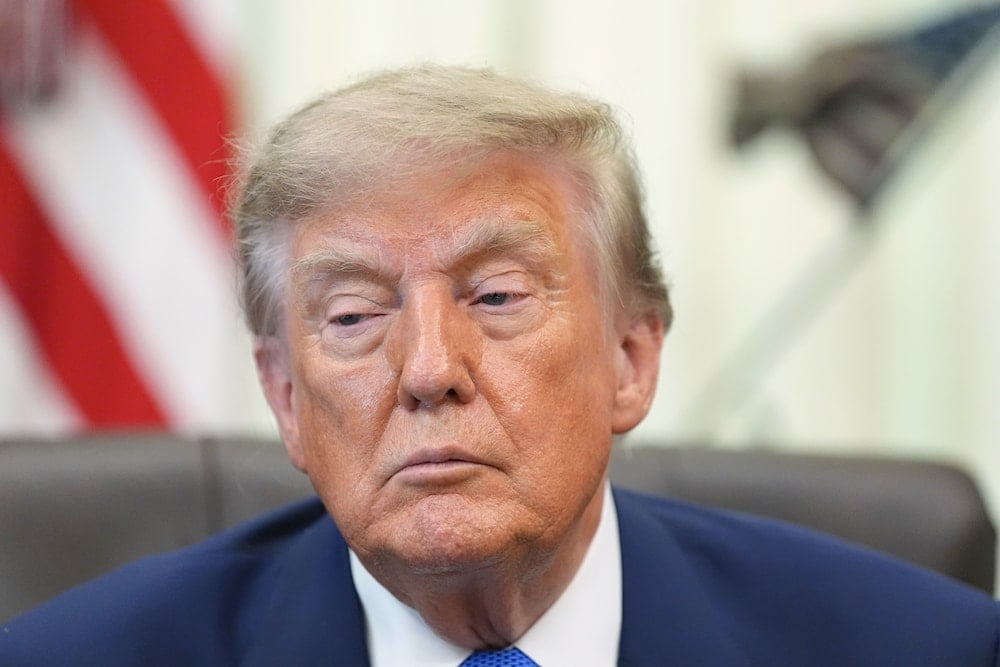
United States President Donald Trump is pictured during a meeting to sign an executive order about vaccines, on August 10, 2026, in the Oval Office of the White House in Washington. (AP)
United States President Donald Trump has ordered War Secretary Pete Hegseth to “substantially reduce” the United States’ joint military exercises with South Korea, arguing that the drills are costly and send an “inappropriate and hostile” signal to the Democratic People's Republic of Korea (DPRK).
Trump made the announcement in a Truth Social post on Sunday, August 16, just hours before the annual Ulchi Freedom Shield exercises were scheduled to begin.
“Based on my very good relationship with Kim Jong Un, of North Korea, I am not happy with the fact that the United States has, long ago, agreed to participate in Joint Military Exercises with South Korea,” Trump wrote.
He said the exercises were costly, with much of the expense covered by the United States, and argued that they were inappropriate toward a DPRK that he described as having been “unthreatening and respectful” toward Washington during his presidency.
Trump said it was too late to cancel the drills entirely but that he had instructed Hegseth to substantially reduce them.
US-South Korea drills begin despite Trump order
The Ulchi Freedom Shield exercises began Monday as scheduled, according to South Korea’s Joint Chiefs of Staff, despite Trump’s order.
The annual drills are scheduled to run from August 17 to 27 and involve around 18,000 South Korean military personnel. The exercises focus heavily on simulated scenarios involving DPRK attacks, including drone warfare, cyberattacks, GPS disruption, missile threats, and other forms of asymmetric warfare.
South Korea's Joint Chiefs of Staff confirmed that the exercises had begun but declined to comment directly on Trump's remarks, saying that the presidential Blue House was reviewing Trump's comments.
"The government is closely following President Trump's social media message today," read a statement given to the AFP news agency.
It added a hope that Trump's apparently "friendly relationship" with Kim Jong Un would lead to "meaningful dialogue between the two countries, opening discussions aimed at advancing peace and stability on the Korean Peninsula."
The Pentagon referred questions concerning the implementation of Trump's order to the White House.
It remains unclear how Washington intends to reduce the exercises after they have already begun or which components will be affected.
Trump links drills to relationship with Kim
Trump's decision marks another shift in his longstanding approach to US military exercises on the Korean Peninsula.
During his first presidency, Trump suspended major US-South Korean military exercises in 2018 as diplomatic engagement with Kim Jong Un intensified. He repeatedly criticized the drills as expensive and provocative, while seeking a direct agreement with Pyongyang over its nuclear program.
Trump and Kim held three summits during Trump's first term, but the negotiations failed to produce a final agreement
Trump has nevertheless continued to emphasize his personal relationship with Kim, framing it as a potential basis for renewed diplomacy.
His latest decision to reduce military exercises comes as Pyongyang continues to develop its deterrent nuclear and missile capabilities and expand cooperation with China and Russia.
South Korea rejects involvement in Iran conflict, reviewing Trumo remarks
Trump also tied his decision to tensions with Seoul over the US aggression on Iran.
In his Truth Social post, Trump said he had recently asked South Korean President Lee Jae Myung whether Seoul wanted to join the United States in the “denuclearization” of Iran.
“While somewhat unrelated (?), I recently asked the President of South Korea if they would like to join us in the Denuclearization of the Islamic Republic of Iran, and they said, ‘No thanks!’” Trump wrote.
Trump has repeatedly pressed US allies to assume a greater role in Washington's failed military campaign in Iran, demanding forces be allocated for naval operations after the aggression led to the closure of the Strait of Hormuz.
DPRK continues to expand capabilities
Trump's move comes amid continued military developments by the DPRK, which routinely condemns US-South Korean military exercises as preparations for an invasion.
Pyongyang fired a ballistic missile toward the East Sea last week, following another short-range ballistic missile launch on August 6. US military officials have said that DPRK forces have gained battlefield experience through their military cooperation with Russia, including exposure to drones, electronic warfare, and cyber operations.
A senior US Northern Command official, Lieutenant General Joseph Jarrard, also recently stressed that has successfully tested intercontinental ballistic missiles with sufficient range to deliver a nuclear payload anywhere in North America.
Read more: DPRK launches ballistic missile ahead of US-South Korea war drills


