
Iran shifts to offensive military stance amid US escalation: Exclusive
 8 Min Read
Iran has shifted to an offensive military posture amid escalating tensions with the US, Iranian analyst Mohammad Marandi says.
-
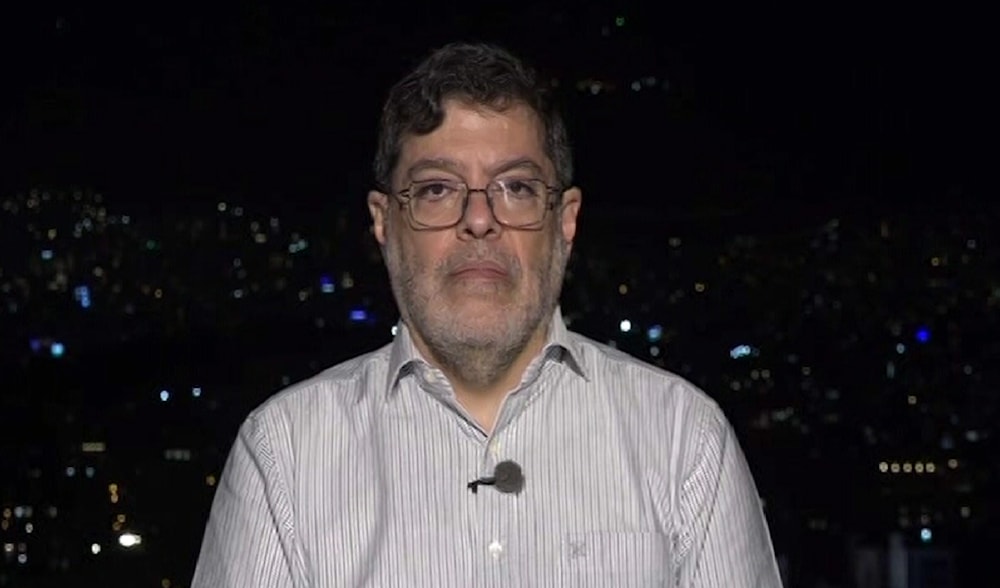
Professor of English Literature and Orientalism Mohammad Marandi during an interview on The Great Standoff: Iran and the World for Al Mayadeen on September 5, 2026, in Tehran, Iran (Al Mayadeen)
Iran has shifted from a defensive to an offensive military posture following the appointment of a new chair of the Supreme National Security Council, according to Mohammad Marandi, an Iranian political analyst and academic.
"The doctrine, of course, is always defensive, but on the battlefield now Iran has shifted towards offensive, and we're seeing that already," Marandi said on Al Mayadeen's The Great Standoff: Iran and the World.
"During the past few days we've seen Iran targeting the United States in a very heavy-handed way, much more so than even in the past, and the events today, of course, are showing that as well."
Marandi stated that Iran's military response is a direct reaction to US economic warfare. "The United States can use the sanctions regime to wage war against Iran, but Iran cannot sanction the United States and affect the global economic system through sanctions, obviously. So what does Iran do? Iran says, we will respond militarily," he said.
He said that the more the United States pressures Iran through its neighbors, the more Iran will adopt a heavy-handed approach on the battlefield, whether in the Strait of Hormuz or elsewhere. Marandi noted that Iran's first vice president had issued a warning to the United States.
"We saw the first vice president, Dr. Pezeshkian's first vice president, tweet yesterday, I think, that the Americans should be prepared for very dark days, a very difficult economic situation. That threat basically means that if you strangle us, we will strangle you," he said.
Dr. Marandi further emphasized that "the Iranians have said that if we cannot export our oil, the enemy won't be able to, or Iran's adversaries will not be able to, no one will be able to export their oil."
Marandi warns of most sensitive stage yet
Marandi said the current phase is the most sensitive stage of the war, noting that for over six months the war has escalated and de-escalated. "The Americans want to strangle Iran, and Iran has assured its enemies that they will strangle them in return," he said.
He added that if the United States expands economic warfare, Iran will strangle the US and its allies across the region, and he expressed doubt that regimes in the Persian Gulf region could survive such a scenario. "They have nothing but oil and gas, and they're completely dependent on electricity and desalination plants," he said.
The only off-ramp available is an MOU, Marandi highlighted, noting that Iran will not accept anything less, including regarding Gaza and Lebanon. "Trump will not use an off-ramp," he said. "Trump has trapped himself in this situation." He said the current trajectory indicates heightened escalation, which is destructive to global and regional economies.
Regarding South Korea, Marandi warned that if South Korea participates in the war on Iran, Iran will target its assets in the region. "Iran could destroy South Korean assets across the Persian Gulf region, in Saudi Arabia, in Bahrain, in Kuwait, in the Emirates, in Qatar," he said. "The Koreans are very vulnerable to Iran. Iran can hurt them very badly."
He added that Iran could easily destroy South Korean economic assets in the region and in the future ban South Korea from access in the Persian Gulf alongside the Israeli regime and the United States, noting that "the smart thing for the South Korean regime is to stay out of it. Otherwise, it's they who pay the heavy price, not Iran," he said.
Iran promises disproportionate response to any US strikes
Marandi characterized Iran's fight as one for survival. "This is a war to preserve our sovereignty, our independence. And a war of aggression has been imposed upon us by an enemy that is ruthless and barbaric and medieval," he said.
He also said that he does not follow US President Donald Trump's statements closely because of contradictions and dishonesty. "It's almost impossible really to take anything that he says seriously," he said.
Marandi explained that Iran's response to US strikes has become disproportionately harder. "In the past couple of days, two or three days ago, when the United States attacked Iran, Iran's response was not simple. It was much harder. Iran's punishment was very severe. It was really disproportionate," he said.
He said that counter-strikes were carried out by both the army and the Revolution Guards over three days, including strikes on US assets in the Emirates and Kuwait. "What message is that sending to the United States? That we are the ones who determine the pace of events, not you," he said.
The Americans, he noted, have not been able to destroy any of Iran's underground military bases. "The Americans have not been able to destroy a single underground military base. They've never even claimed it," he said.
Based on the fact that missile and drone bases are intact, Marandi said he considers it highly unlikely that the United States has done serious damage to nuclear facilities, though he noted he does not have insider information. "Any aggression against Iran will be met in a very heavy-handed way," he said.
Iran prepared for long-war, eyeing US midterm elections
Iran has prepared for a long war, including through the US midterm elections, according to Marandi. "The US midterm elections, I would imagine, are a good opportunity for Iran to inflict pain on Trump," he said.
He noted that rising oil and petrochemical prices are causing damage to the US economy, which he said is also suffering from other issues including debt, the AI bubble, and the bond market. "Iran is under no illusion that even if Trump loses the Senate and the House and life becomes very difficult for him, the Zionists will still press him to continue with the war," he said, adding that "So Iran is prepared for a very long-term war."
Marandi said that if Bessent, the US Treasury Secretary, imposes more sanctions, Iran will retaliate militarily. "Whatever Bessent does, Iran will hit back much harder," he said. He also said that regimes in the region are vulnerable and dependent on the United States. "If this war continues and it becomes worse, the situation, these regimes cannot last for very long," he said.
Iran has more cards than the West and will not pull any punches, he stressed. "From here on, Iran is going to hit very hard. This is a fight to the finish," he said. "There is no chance that the United States will force Iran to capitulate. Iran will fight until the United States is forced to back off." He said that if a global economic crash occurs, the war would not be sustainable for the United States in its current form.
Regional nations' complicity keeps war possible; Marandi
Marandi also addressed the role of regional countries, saying that the people across the region are against the Israeli regime and against regional regimes being proxies of the United States. He said that if regional countries asserted sovereignty and denied the United States use of their territory, the situation would change. "Without the countries in the region being complicit, the United States does not have the ability to wage war," he said.
He noted that Iran has regular contacts with these countries and wants them to make the right decision, but added that so far, Iran does not see signs of that capability.
On Al Mayadeen's The Grand Standoff: Iran and the World, Professor Mohammad Marandi warned that regional regimes hosting #US military bases and providing airspace for strikes against #Iran are placing themselves on the brink of total economic collapse.
— Al Mayadeen English (@MayadeenEnglish) September 4, 2026
Marandi stressed that… pic.twitter.com/QrHpvhNZqp
"At the end of the day, the strikes that the Americans carried out the other night were only possible with the help of these countries. Some of the strikes came from the aircraft carriers, possibly, but many of them came with the assistance of these countries and the usage of their airspace, in particular, Saudi Arabia, on this occasion," he said.
Marandi concluded by saying that if these countries told the United States no, the war on Iran would be over and relationships would evolve quickly. "But we do not see signs of that, even though we have regular, Iran has regular contacts with these countries. And Iran wants these countries to make the right decision. But so far, we don't see that capability," he said.


