
'We have absolutely no fuel': US blockade cripples Cuba
 3 Min Read
Cuba says it has completely run out of diesel and fuel oil as sweeping US sanctions and fuel restrictions trigger massive blackouts, cripple public services, and deepen the island’s humanitarian crisis.
-
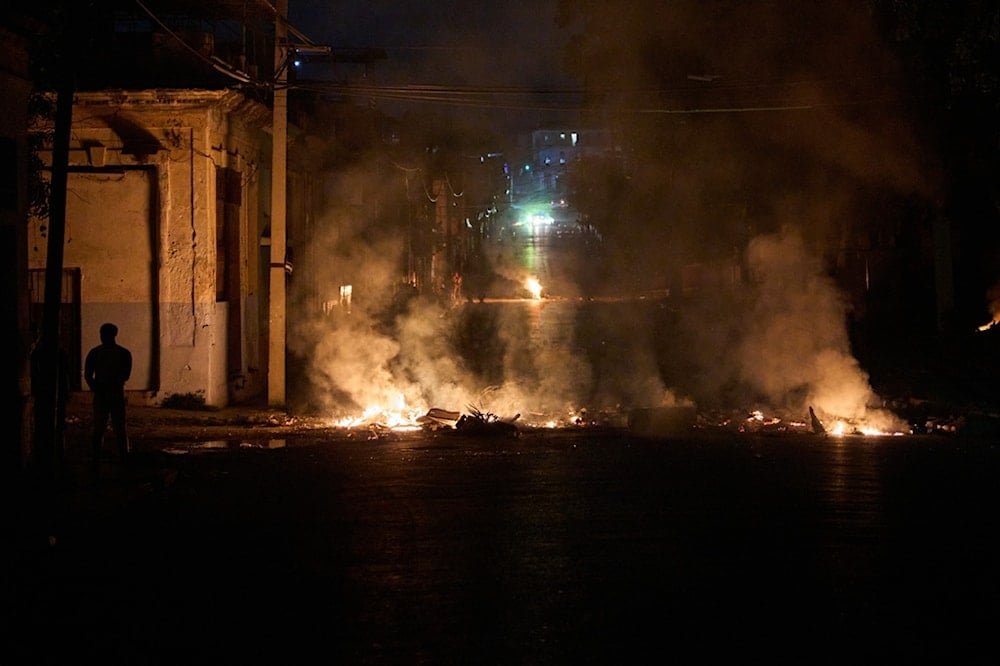
People look at a barricade set up by residents protesting against prolonged power outages in Havana, Cuba, on Wednesday, May 13, 2026 (AP)
Cuba said Wednesday it had completely exhausted its diesel and fuel oil supplies, resulting in a deepening and catastrophic energy crisis that has pushed the island into some of its worst blackouts in decades under an escalating US blockade targeting fuel imports.
“We have absolutely no fuel (oil), and absolutely no diesel,” Cuban Energy Minister Vicente de la O Levy said during remarks broadcast on state media, describing the national electricity system as being in a “critical” condition.
“We have no reserves," he added.
The minister said large parts of Havana were now enduring power cuts lasting up to 22 hours per day, with the national grid relying almost entirely on limited domestic crude production, natural gas, and renewable energy sources.
Although Cuba expanded solar generation capacity by roughly 1,300 megawatts over the past two years, De la O Levy said much of that output was being undermined by the instability of the collapsing grid and the lack of fuel needed to sustain broader electricity operations.
Fuel siege deepens
The latest breakdown comes amid the economic siege imposed by Washington after US President Donald Trump signed an executive order in January threatening punitive tariffs against any country supplying oil to Cuba. The measures effectively cut the island off from most international fuel markets and halted deliveries from key suppliers, including Venezuela and Mexico.
UN human rights experts previously condemned the US measures as “a serious violation of international law and a grave threat to a democratic and equitable international order,” warning that the blockade amounted to “an extreme form of unilateral economic coercion.”
The United Nations also warned last week that the US fuel blockade was obstructing Cubans’ rights to food, healthcare, water, sanitation, and development, as the shortages cripple hospitals, public transportation, food distribution systems, and electricity generation across the island.
Collective punishment
Critics of Washington’s policy have increasingly compared the blockade to collective punishment, arguing that deliberately depriving a civilian population of fuel needed for hospitals, water systems, refrigeration, transport, and electricity constitutes a form of economic warfare with potentially criminal humanitarian consequences.
“Cuba is open to anyone that wants to sell us fuel,” De la O Levy said, adding that Havana continued efforts to secure imports despite mounting international pressure and soaring global energy prices linked to the US-Israeli war on Iran.
Only one major tanker, the Russian-flagged Anatoly Kolodkin, has delivered crude to Cuba since December, providing temporary relief earlier this year.
Blackouts spark unrest
The worsening shortages have fueled growing unrest across Havana, where protests erupted this week as residents blocked roads and demanded electricity amid the prolonged blackouts.
Trump has repeatedly escalated rhetoric against Havana in recent months. In March, he said he expected to have “the honour of taking Cuba,” while also threatening additional economic punishment against countries maintaining energy ties with the island.
Human rights groups and several US lawmakers have warned that Washington’s actions are accelerating a humanitarian collapse in Cuba, where schools and universities have shut down, medical services have been severely disrupted, and food insecurity has sharply worsened under the fuel embargo.
Read more: Cuba says US using false narrative to maintain blockade


