
Al-Araji outlines Iraq’s path toward full sovereignty | Exclusive
 5 Min Read
Iraq is preparing for the full withdrawal of international coalition forces as Baghdad moves to restore air sovereignty and place weapons under state control.
-
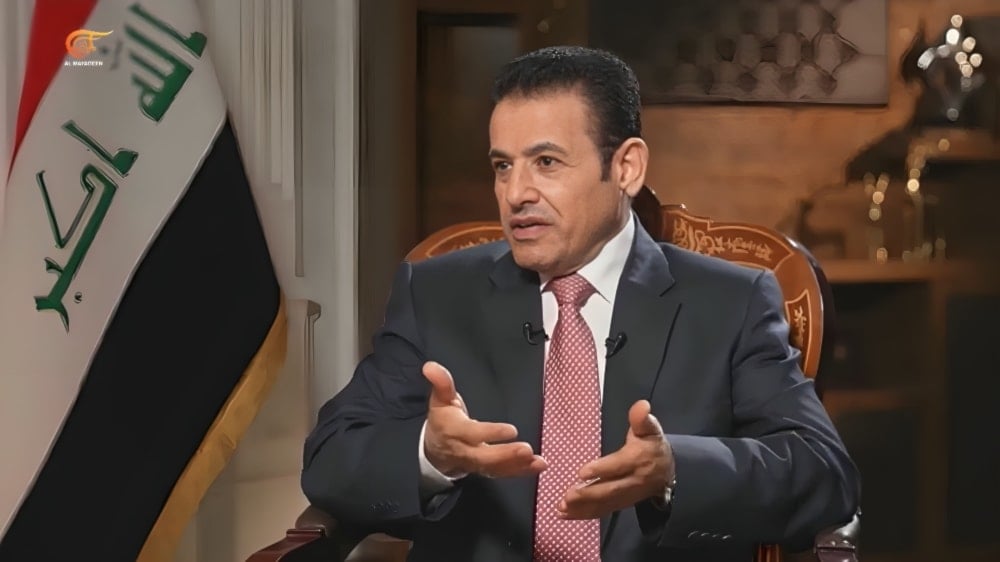
Iraq's National Security Advisor, Qasim al-Araji, speaks during an interview with Al Mayadeen, broadcast on Tuesday, September 8, 2026 (Screengrab)
Iraqi National Security Advisor Qasim al-Araji said September 30 will mark a decisive date for the withdrawal of all international coalition forces from Iraq, including US troops, stressing that Washington has reaffirmed its commitment to implementing the withdrawal agreement.
Speaking to Al Mayadeen on Tuesday, al-Araji stressed that Iraq must have full control over its airspace and that no foreign armed forces should remain on its territory. He said Iraq no longer needs an international military presence, noting that Baghdad had agreed to seek the coalition’s assistance to fight ISIS rather than remain under occupation.
At the same time, he said the end of the military presence would not prevent continued political relations, consultations, cooperation, or intelligence sharing with Washington under the Strategic Framework Agreement.
Al-Araji also addressed the issue of weapons held by armed factions, saying the government is engaged in direct and high-level dialogue with them to ensure their rights while bringing everyone under the authority of the state.
He said the factions’ drones and ballistic missiles should be transferred to state control and used to defend Iraq based on a government decision and under the authority of the commander-in-chief of the armed forces. He stressed that any weapon outside the framework of the constitution is illegitimate, with the exception of the Regional Guard stipulated in the constitution.
Al-Araji defends Popular Mobilization Forces
Al-Araji said that the Popular Mobilization Forces are a purely Iraqi force that emerged under exceptional circumstances after ISIS seized three provinces in 2014 and advanced toward Baghdad.
He explained the force had proven itself on the battlefield even before parliament formally recognized it, with its fighters participating in battles without salaries or equipment and relying on weapons brought from their homes and donations.
He also highlighted that the Popular Mobilization Forces Law, which was approved as an official framework in 2016, will be submitted to parliament to regulate service and pensions and institutionalize the force. Al-Araji stressed that approving the legislation is an Iraqi internal matter and said no foreign government has the right to accept or reject it. He also rejected the notion that Baghdad’s close relations with Iran amount to subordination, stressing that Iraq and Iran are independent states.
Iraq seeks to contain security threats
On national security, al-Araji expressed confidence in Iraq’s security forces and their experience in confronting ISIS and al-Qaeda, warning that ISIS remains a threat. He said, "If the state is unable to protect Iraq’s security, the people will return to protecting themselves as happened in 2014."
He added that Iraqi security agencies maintain intelligence cooperation with several countries and have provided Germany with information that contributed to the arrest of suspected terrorists.
Addressing regional security, al-Araji said Iraq has continued security contacts with Syria and supports maintaining its unity, stability, and security. He said that the Turkish parliament’s move toward a new understanding with the Kurdistan Workers’ Party constitutes a positive step, while stressing that the group’s presence in Iraq is illegal and that there are Turkish guarantees for a troop withdrawal alongside its departure.
On Iraq’s eastern border, al-Araji said heavy weapons had been handed over and that opposition groups and separatist factions from Iran were no longer present along the border after 77 positions were evacuated and federal border forces deployed in coordination with the Peshmerga and Asayish forces in Sulaymaniyah and Erbil.
Al-Araji rules out security ministerial post
Domestically, al-Araji explained he is not a candidate for any security ministry and expected the formation of the cabinet to be completed after September 30, with three sovereign ministries still vacant.
He noted that the distribution of ministries reflects the electoral entitlement of political blocs according to their parliamentary seats rather than sectarian or political quotas, while ministerial selections are being coordinated with the prime minister and commander-in-chief through the presentation of several candidates.
He further reiterated that the government seeks to integrate armed factions into state institutions and ensure that they become part of the solution rather than parties to confrontation, while ruling out confrontation and bloodshed as a means of settling the issue. Al-Araji stressed that Iraq's political and security approach should ultimately serve a sovereign, civilian state in which security institutions operate under the authority of the government.


