
Ansar Allah calls for end to US-Israeli influence in Gulf
 4 Min Read
Ansar Allah official Mohammed al-Farah criticizes Saudi Arabia and the UAE over US and Israeli ties, warning of escalating tensions and threats to oil infrastructure.
-
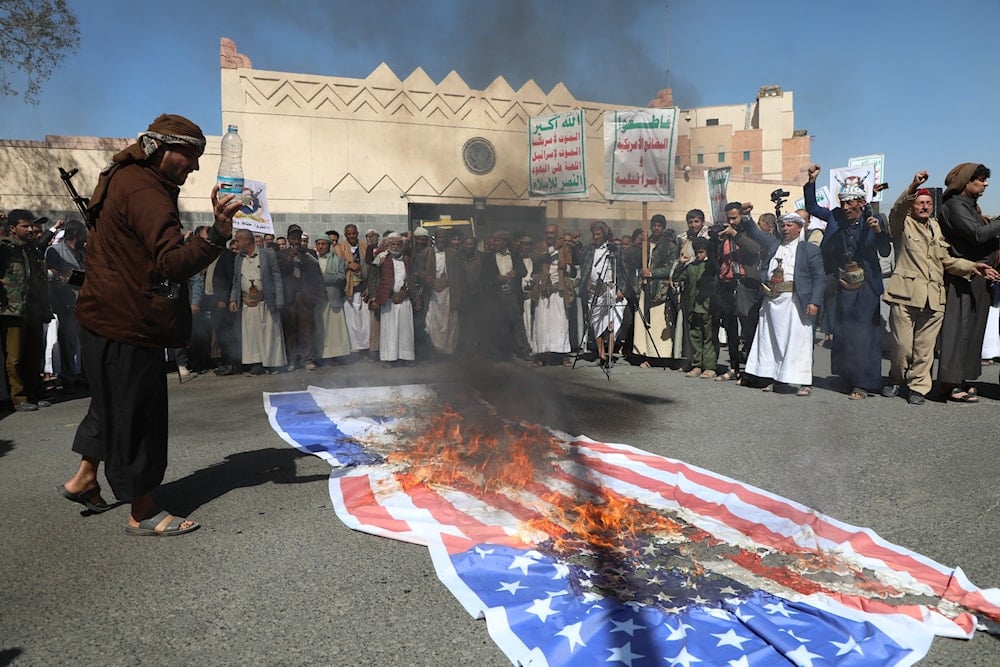
Ansar Allah supporters burn US and Israeli flags during a rally against the US-Israeli war on Iran, in Sanaa, Yemen, Friday, March 6, 2026 (AP)
Mohammed al-Farah, a member of Ansar Allah’s political bureau, criticized Saudi Arabia and the UAE for their ties with the United States and "Israel", warning that foreign forces cannot protect them and calling for measures to prevent war and safeguard their oil infrastructure.
In a post on X, al-Farah said, “We call on Saudi Arabia and the UAE to return to the Arab and Islamic fold and to leave the American and Israeli fold, which has brought them suffering and destruction.”
“When will you come to your senses? These forces will not protect you," he asserted.
ندعو السعودية والإمارات للعودة إلى الحضن العربي والإسلامي، ومغادرة الحضن الأمريكي والإسرائيلي، فهو الذي جلب لكم العذاب وتسبب لكم في الخراب.
— محمد الفرح (@MohammedAlfrah) March 18, 2026
The Yemeni official outlined what he described as the “shortest path” to avoid conflict: “Close US bases in your countries, shut down Mossad offices, and deny Gulf airspace to Israeli and American aircraft targeting Iran.”
Commenting on remarks by the Saudi foreign minister that “Islam does not permit aggression against neighbors, especially Muslim neighbors,” al-Farah questioned Riyadh’s decade-long war on Yemen: “What have you done and continue to do in Yemen for ten years? Was it targeting Israel, or was it killing and aggression against Muslim neighbors?”
UAE suspends Habshan gas field operations
This closely follows the announcement by the Abu Dhabi Media Office on Thursday that operations at the Habshan gas facilities have been suspended, following “incidents involving debris from intercepted missiles,” as authorities investigate the matter. The office added that the Bab oil field was also targeted, though no injuries were reported.
Separately, Iranian state media reported on Wednesday that Tehran had issued warnings to evacuate several oil facilities in Saudi Arabia, the UAE, and Qatar, indicating that they could be targeted in potential strikes.
In recent days, Iran’s Khatam al-Anbiya headquarters warned that any attack on the Islamic Republic’s oil, economic, or energy infrastructure would result in “the immediate destruction of all regional oil, economic, and energy infrastructure belonging to companies with American shares or cooperating with the United States.”
The warnings follow repeated attacks on Iran's energy infrastructure, most recently the South Pars gas field.
Oil industry facilities at the South Pars field and in the Asaluyeh region in southern Iran were attacked, the Tasnim news agency reported on March 18. Iranian state TV reported that phases 3, 4, 5, and 6 of the South Pars gas field were struck, marking a significant impact on critical energy infrastructure.
Israeli officials confirmed that they bombed Iran’s largest natural gas processing facility in Bushehr Province on the same day, while Iranian reports said the strikes on South Pars and Asaluyeh forced several phases offline.
Iran targets US-linked oil facilities in retaliation
In response, Iran’s Islamic Revolution Guards Corps (IRGC) announced the launch of Wave 63 of Operation True Promise 4, primarily targeting US-linked oil facilities in the region. The latest wave was dedicated to “the brave soul of Intelligence Minister Esmail Khatib, and the martyrs of Iran's intelligence establishment.”
In an official statement, the IRGC described the operation as a “turning point” in the course of the conflict, carried out in response to attacks on Iran’s energy infrastructure. The statement emphasized that “Iran had no intention of expanding the confrontation to oil installations” or harming the economies of neighboring and friendly countries, but attacks on its energy infrastructure compelled Tehran to escalate to a “new phase", targeting US-affiliated facilities.
Additionally, Iran issued urgent evacuation warnings for civilians near major energy and petrochemical facilities across the Gulf, including the SAMREF refinery in Saudi Arabia, the Al-Hosn gas field in the UAE, the Jubail petrochemical complex in Saudi Arabia (Chevron), the Mesaieed petrochemical complex in Qatar, and the Ras Laffan refinery in Qatar.
Iranian state TV reported that Qatar’s Ras Laffan industrial site was struck by a missile salvo. QatarEnergy confirmed that “emergency response teams were deployed immediately to contain the resulting fires, as extensive damage has been caused.”


