
Araghchi reveals Iran’s 7-day plan to reopen Strait of Hormuz
 3 Min Read
Iranian FM Abbas Araghchi says Tehran will not accept coercion, linking the reopening of Hormuz to US acceptance of Iran’s conditions.
-
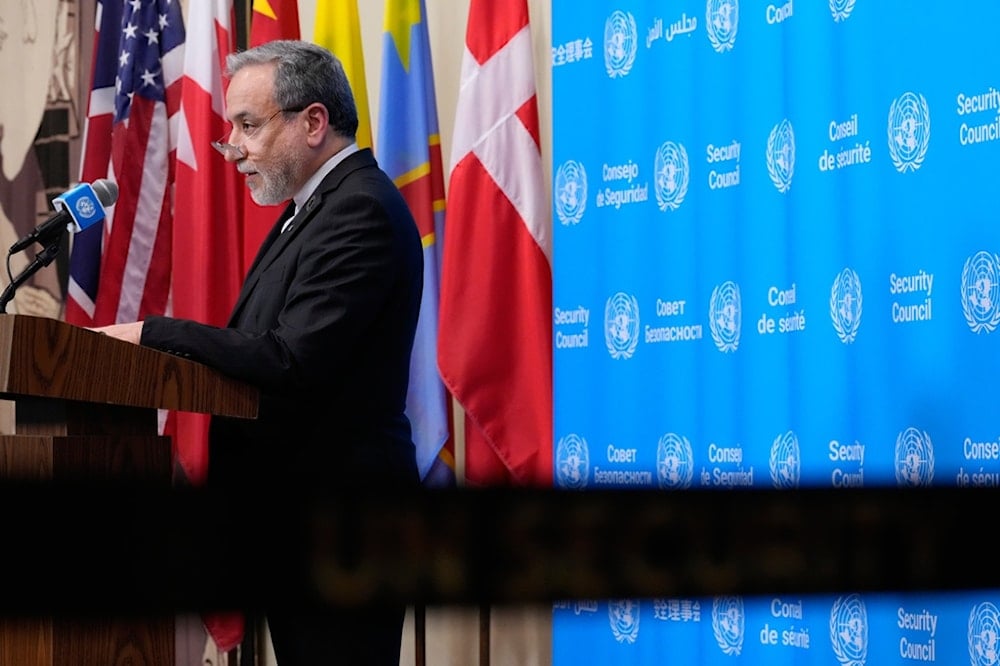
Iran's Foreign Minister Abbas Araghchi speaks to the media during the 81st session of the United Nations General Assembly at United Nations headquarters, Friday, September 25, 2026 (AP)
Iranian Foreign Minister Abbas Araghchi said Tehran has delivered a seven-day plan to the United States through Qatar that would pave the way for reopening the Strait of Hormuz, stressing that maritime traffic cannot return to normal under economic pressure.
Speaking to reporters outside the United Nations headquarters in New York, Araghchi accused Washington of resorting to threats and assassinations against Iran, saying that more than 5,000 Iranians were killed during the US-Israeli aggression against the country.
He also accused US President Donald Trump and Israeli Prime Minister Benjamin Netanyahu of attempting to distort facts from the UN podium and portray “the executioner as the victim.”
Iran rejects reopening Hormuz under economic pressure
Addressing navigation through the Strait of Hormuz, Araghchi said maritime movement could not return to normal through continued economic pressure on Iran.
“Iran does not accept anything through coercion and intimidation,” he said.
The Iranian foreign minister added that Tehran had committed, under Article 5 of a memorandum of understanding, to facilitating shipping through the strategic waterway, allowing maritime traffic to return to 60% of normal levels.
Tehran delivers seven-day plan to Washington through Qatar
Araghchi said Iran had conveyed a seven-day plan to the United States through Qatar, adding that the timeline would begin once Washington accepts Tehran’s conditions.
“When the United States accepts our conditions, the seven-day plan to open the strait begins,” he said.
The proposal was presented on the sidelines of the United Nations General Assembly in New York and follows indirect contacts between Tehran and Washington through mediators.
Earlier, Araghchi held separate meetings with his Egyptian and British counterparts to discuss bilateral relations and regional developments, particularly the Palestinian issue, on the sidelines of the UN General Assembly.
Iran expanding deterrence capabilities
Iranian Army Deputy Commander for Executive Affairs Brigadier General Alireza Sheikh said the current US military presence in the region amounts to a display of force, while stressing Iran's ability to challenge the balance of power through different means.
Sheikh said no power had confronted the United States in such a manner since World War II, arguing that Iran had succeeded in waging an asymmetric war against the world's largest power.
He said Iran's unique geopolitical position and civilizational and cultural outlook meant that the country had faced wars throughout its history and would continue to do so, adding that peace or an agreement represented "a rest period between two halves."
Data-driven military planning
Sheikh said Iran's Armed Forces operate according to the inherent logic of military forces worldwide, relying on data and facts rather than emotion.
"The logic of the battlefield is based on data and scientific foundations," he said, adding that Iran possesses the ability to disrupt existing equations through various means.
He also said Iran's adversaries had believed that a single strike would be enough to end the confrontation because of "an illusion of power," but Tehran had managed the situation.
Regarding the Strait of Hormuz, Sheikh said its management as a central component of Iran's geopolitical power would proceed under Iranian management and oversight.


