
Armenia grants US access to strategic corridor linking Azerbaijan
 4 Min Read
US and Armenia agree on a framework to launch the TRIPP transit corridor, linking Azerbaijan to Nakhchivan through Armenia, with joint US-Armenia oversight.
-
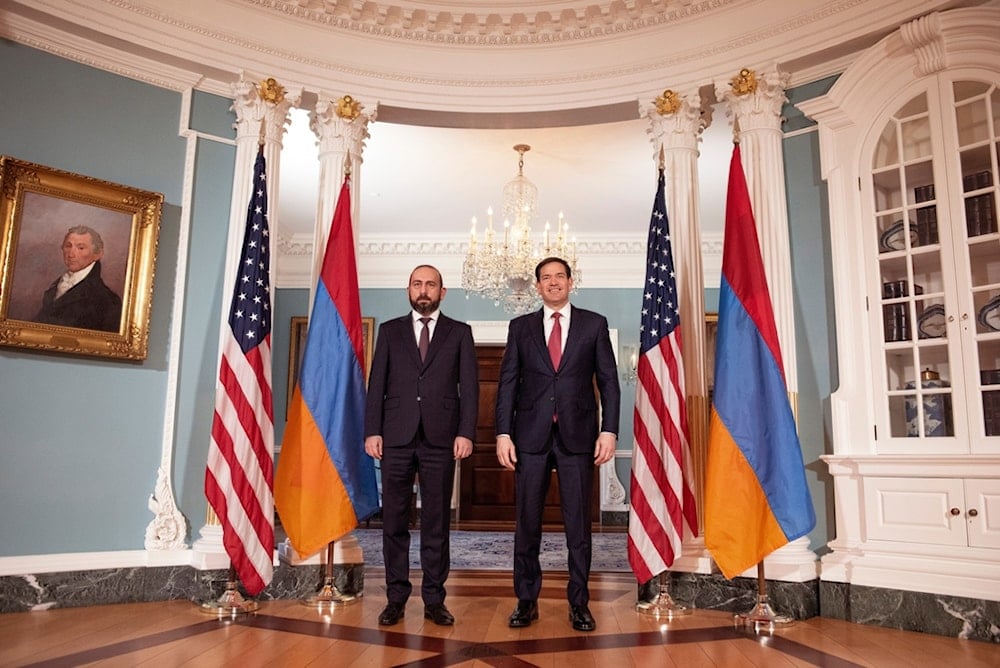
US Secretary of State Marco Rubio, right, meets with Armenian Foreign Minister Ararat Mirzoyan at the State Department in Washington on January 13, 2026. (AP Photo/Cliff Owen)
The United States and Armenia have agreed on a formal implementation framework for the US-Armenia transit corridor, a strategic trade route announced during the White House Peace Summit in August. The project, known as the Trump Route for International Peace and Prosperity (TRIPP), will connect mainland Azerbaijan to the Nakhchivan Autonomous Republic through southern Armenia.
The announcement came on Tuesday following a meeting between US Secretary of State Marco Rubio and Armenian Foreign Minister Ararat Mirzoyan at the State Department, where the two discussed progress on the corridor and broader cooperation.
The project stems from a joint declaration signed by Armenian Prime Minister Nikol Pashinyan, Azerbaijani President Ilham Aliyev, and US President Donald Trump during the August summit, aiming to boost regional trade and open a new chapter of stability in the South Caucasus.
Read more: Iran rejects US-backed corridor through Armenia, will defend interests
US-Armenia transit deal secures sovereignty commitments
According to the framework published by the State Department, the TRIPP Development Company will oversee the design, development, and management of the infrastructure. The US will hold a controlling stake, while Armenia will oversee critical decisions through reserved matters.
Initially, the company will operate under a 49-year development right agreement. Armenia is expected to grant the US a 74% equity share while retaining 26%. The framework anticipates an extension for an additional 50 years, at which point Armenia’s share would increase to 49% through an equity grant.
Despite the US control over TRIPP operations, Armenia will maintain full sovereignty over all project areas, including legal enforcement in accordance with its domestic and international obligations.
Speaking ahead of the meeting, Marco Rubio stated: “The corridor opens up Armenia for business and allows it to prosper economically, but it does so in a way that doesn’t in any way infringe upon the sovereignty of Armenia.”
“We just think the TRIPP arrangement really is going to turn out to be a model for the world of how you can open yourself up to economic activity and prosperity without in any way questioning or undermining your sovereignty and your territorial integrity,” he added.
Key stakeholders and equity structure of the TRIPP company
The TRIPP Development Company will manage rail, road, energy, and digital infrastructure along the designated route inside Armenian territory. The framework ensures that Armenia has the right to regulate and enforce its laws across all segments of the project.
The US will lead technical and financial development, while Armenia retains oversight of issues critical to national interest. Future equity adjustments are planned to bring Armenia's stake closer to parity over the lifetime of the project.
The original August summit declaration reaffirmed the inadmissibility of the use of force to acquire territory, a key concern in the post-Karabakh regional landscape. It also called for the closure of the OSCE Minsk Group and prioritized bilateral channels for diplomacy and trade.
Alongside the TRIPP announcement, the summit produced a 17-point peace agreement signed by Pashinyan, Aliyev, and Trump. It includes mutual commitments to respect sovereignty and territorial integrity, establish diplomatic relations, and conduct negotiations through bilateral border commissions for delimitation and demarcation.
The Nakhchivan corridor, now formalized under TRIPP, is expected to become a cornerstone of this new era of economic cooperation and geopolitical stability in the region.


