
At lower than expected rate, Trump's new tariff goes into effect
 4 Min Read
Trump imposed a new 10% global tariff under emergency trade authority after the Supreme Court curtailed his previous tariff powers.
-
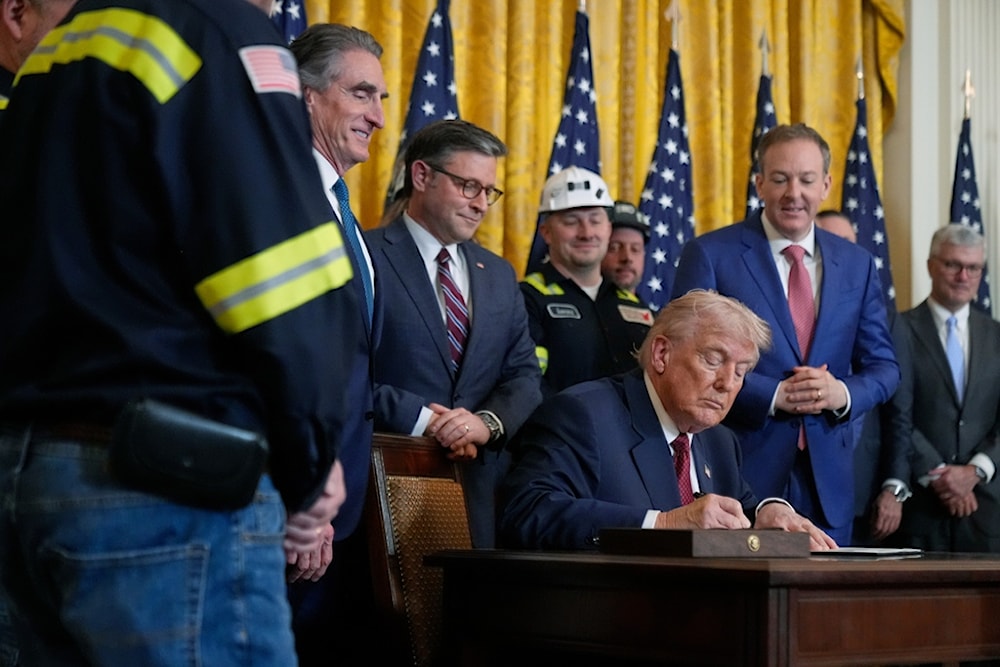
US President Donald Trump signs an executive order after speaking during an event on coal power in the East Room at the White House, Wednesday, Feb. 11, 2026, in Washington. (AP)
US President Donald Trump has activated a new 10% tariff on imports worldwide, moving swiftly after the Supreme Court struck down much of his earlier trade action.
The levy, which came into force on February 24, was introduced through an executive order signed hours after the court’s 6–3 ruling, limiting the administration’s use of emergency economic powers to impose broad import duties. The justices found that Trump had exceeded his authority when he previously relied on the 1977 International Emergency Economic Powers Act (IEEPA) to roll out sweeping global tariffs.
The president sharply criticized the judgment, calling it "ridiculous, poorly written, and extraordinarily anti-American."
In response, the White House turned to Section 122 of the 1974 Trade Act, which allows the president to impose temporary tariffs of up to 15% for 150 days without congressional approval if there are large balance-of-payments concerns. Trump has since indicated he may raise the rate to 15%, the statutory ceiling, though no formal order has yet been issued.
Temporary tariff turmoil
The executive order states that the temporary import duty is intended to "address fundamental international payments problems and continue the Administration's work to rebalance our trade relationships to benefit American workers, farmers, and manufacturers."
Trump has long argued that tariffs are necessary to reduce the US trade deficit, which measures the gap between imports and exports. However, recent data showed the deficit widened by 2.1% compared to 2024, reaching roughly $1.2 trillion.
The Supreme Court’s decision has triggered legal and political repercussions domestically. Several companies are exploring litigation to recover duties paid under the invalidated emergency tariffs, with estimates suggesting as much as $175 billion could be subject to refund claims. Meanwhile, Senate Democrats have introduced legislation aimed at returning collected tariff revenues to businesses and consumers, arguing that the earlier measures were imposed unlawfully.
US Customs authorities have also begun adjusting collection procedures at ports following the ruling, halting tariffs deemed unauthorized while implementing the newly announced 10% levy under the 1974 statute.
Tariff tensions escalate globally
Internationally, the move has unsettled trade partners already navigating shifting US policy. Analysts warn that the rapid change in legal frameworks, from emergency authority to temporary trade measures, has increased uncertainty for global supply chains.
"I think it simply adds to the chaos and mess," Carsten Brzeski, an analyst with ING, told the BBC.
"In terms of uncertainty we're back to where we were last year," he said, cautioning that the chances of retaliation have risen. "The risk of a real fully-fledged tariff war - trade war - escalation is clearly higher than last year."
The United Kingdom has stated that reciprocal measures are not "off the table" if Washington fails to honor existing understandings, though officials also stressed that "no one wants a trade war." The European Union has delayed ratification steps related to a trade agreement while seeking clarification from its US counterparts.
Speaking to the BBC, Brando Benifei, chair of the European Parliament's delegations for relations with the US, said, "If we get worse conditions then we need to react."
"I think you should demand respect," he added. "My plea is that all the countries in the world that do not like that we are being treated this way... try to work a bit together."
India has likewise deferred previously scheduled talks aimed at finalizing aspects of its trade arrangement with Washington.
With the 150-day clock now running on the temporary authority, attention is turning to whether Congress will extend the tariffs, whether the rate will rise to 15%, and how trading partners choose to respond, developments that could shape the trajectory of global trade in the months ahead.
Read more: Trump says Supreme Court ruling expanded presidential tariff powers


