
Trump to push ahead with tariffs despite SCOTUS ruling
 7 Min Read
The Trump administration has introduced new tariffs under alternative legal authority while facing domestic and international backlash.
-
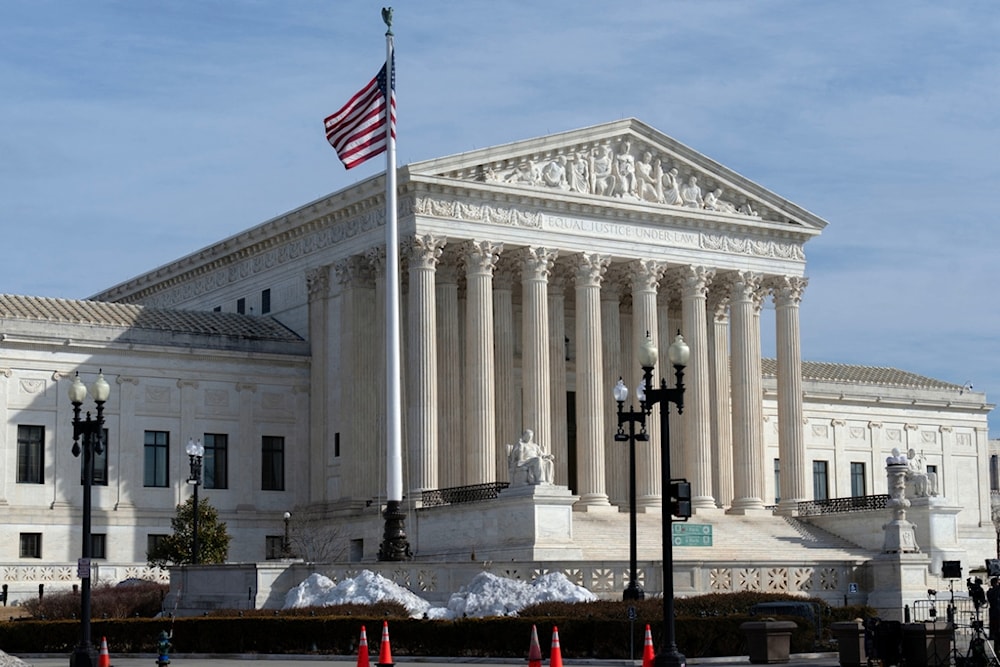
The US Supreme Court is seen on Friday, Feb. 20, 2026, in Washington (AP)
The Trump administration has vowed to continue its tariff-driven trade strategy despite a major ruling by the Supreme Court of the United States that invalidated a large portion of the measures, The Guardian reported.
In a 6-3 decision issued Friday, the court determined that a 1977 emergency powers statute did not grant the president authority to impose sweeping peacetime tariffs. The majority concluded that responsibility for levying tariffs rests with Congress under the US Constitution.
The decision immediately affected more than $175 billion in tariff revenue collected under the International Emergency Economic Powers Act (IEEPA), according to estimates cited by the Penn-Wharton Budget Model. Economists calculated that the IEEPA-based tariffs had been generating over $500 million per day, raising the prospect of large-scale refund claims by importers.
Tariff strategy continues
US Customs and Border Protection (CBP) announced it would deactivate all tariff codes associated with the IEEPA orders at 12:01 am EST on Tuesday. The agency did not explain why collections continued for several days following the court’s ruling, nor did it provide clarity on potential reimbursement mechanisms for affected businesses. The suspension does not apply to other tariff programs, including those imposed under Section 232 on national security grounds or Section 301 targeting alleged unfair trade practices.
Two days after the ruling, top US trade negotiator Jamieson Greer made clear that the White House sees the judgment as a legal obstacle rather than a policy reversal.
"The reality is, we want to maintain the policy we have, have as much continuity as possible, make sure that business understands this is the direction we’ve been going. We’re going to continue going this way," Greer told the ABC News Sunday politics show This Week.
Pressed on the policy’s unpopularity, Greer acknowledged that the legal instruments could change but insisted the underlying approach would remain intact.
"The policy hasn’t changed. The legal tools that implement that may change but the policy hasn’t changed," he said, arguing that it gives US business "a lot of leverage" in world trade.
Blanket levies
Within hours of the ruling, US President Donald Trump announced a new 15% blanket tariff on foreign imports, this time invoking Section 122 of the 1974 Trade Act rather than the 1977 emergency law scrutinized by the court. Section 122 allows tariffs of up to 15% for 150 days without congressional approval, after which lawmakers must authorize any extension. No US president has previously relied on this provision, raising the possibility of renewed legal challenges.
The abrupt announcement followed an initial 10% rate floated earlier in the day, before being revised upward to 15%, reflecting the fluidity of the administration’s response.
Greer also said Washington would stand by bilateral arrangements concluded with multiple trading partners in recent months. "We want them to understand these deals are going to be good deals," Greer said. "We’re going to stand by them. We expect our partners to stand by them."
In a separate interview, he conceded that the administration would face tighter constraints in deploying emergency-style tariffs after the ruling, though he maintained that alternative statutory routes remain available.
Global backlash, domestic fury
Overseas, reactions were swift. China’s Commerce Ministry urged Washington to reconsider. "There are no winners in a trade war and that protectionism leads nowhere," it said in a statement, adding that it was conducting a "comprehensive assessment" of the court’s decision. The Ministry described US "unilateral tariffs" as inconsistent with international trade rules and said it would "resolutely safeguard China’s interests" in response to any further US moves.
The comments came ahead of a planned visit by Trump to meet Chinese President Xi Jinping in late March and early April, a trip now expected to be dominated by trade tensions.
Uncertainty also rippled through other economies. India postponed the dispatch of a trade delegation to Washington amid the shifting legal landscape, according to a source in its trade ministry. South Korean officials voiced concern over industries, such as automobiles, batteries, and semiconductors, as technology supply chains spanning Asia, from China and South Korea to Japan and Taiwan, remain heavily exposed to US tariff shifts.
In Europe, European Central Bank President Christine Lagarde warned that businesses require predictability rather than repeated policy reversals. "To sort of shake it up again is going to bring about disruptions," she said on CBS’ Face the Nation, adding that new measures must be clearly defined to withstand constitutional scrutiny.
Democratic leaders welcomed the ruling. Senate minority leader Chuck Schumer described it as validation that presidential authority has limits, saying Trump’s "overreach failed" and adding, "A president cannot ignore Congress and unilaterally slap tariffs on Americans … Now Trump should end this reckless trade war for good and finally give families and small businesses the relief they deserve."
California Governor Gavin Newsom was more scathing, calling the entire strategy "the whole thing is a farce."
"Talk about petulance … it was 10% two days ago and maybe 20% tomorrow. This is madness. He’s flailing. He’s a punch-drunk boxer. He’s just trying to hit anything, even his shadow," Newsom said.
He further described the economic management of Trump and Treasury Secretary Scott Bessent as "dumb and dumber … they’ve wrecked this economy. 1.4% GDP growth in the last quarter, inflation back up to 3%, the worst jobs we’ve seen since 2013 … it’s a wrecking-ball presidency."
Court blocks emergency tariffs
The legal dispute stemmed from the administration’s reliance on the International Emergency Economic Powers Act (IEEPA), a statute traditionally used to regulate transactions during national emergencies. The court ruled that such authority did not extend to imposing broad tariffs under normal economic conditions, reinforcing congressional primacy over taxation and trade policy.
Business groups affected by the earlier tariffs expressed relief. Victor Schwartz, a US wine importer involved in one of the cases, said, "It’s impossible to describe the feeling of elation, of seeing that, yes, we were right, and the court agrees with us, and a feeling that justice prevailed."
"Last spring, thousands of American small businesses like mine were thrown into chaos," Schwartz said, referring to the so-called "liberation day" tariffs. "The administration’s unprecedented tariffs, which my business was forced to pay upfront, threatened our very existence."
Despite the court’s intervention, administration officials insisted that their broader objective remains unchanged. Bessent told CNN, "The president and the administration remain undeterred on re-shoring American factories and getting rid of massive trade imbalances." He added, "That’s the big story here. We’re immediately going to go to Section 122 tariffs and the revenue projections for the US treasury for 2026 are unchanged."
For now, the ruling has reshaped the legal terrain but not the political battle. The White House appears determined to preserve its tariff campaign under alternative statutes, even as businesses, global partners, and financial markets brace for further volatility, and possible new court fights over the limits of executive trade power.
Read more: Tariff refunds after the US Supreme Court ruling: What comes next?


