
Baghaei: Iran, Oman agree on navigation movement map
 4 Min Read
Iranian Foreign Ministry spokesperson Esmail Baghaei says talks with Muscat are advancing positively amid US pressure, with defense, security and environmental sectors involved.
-
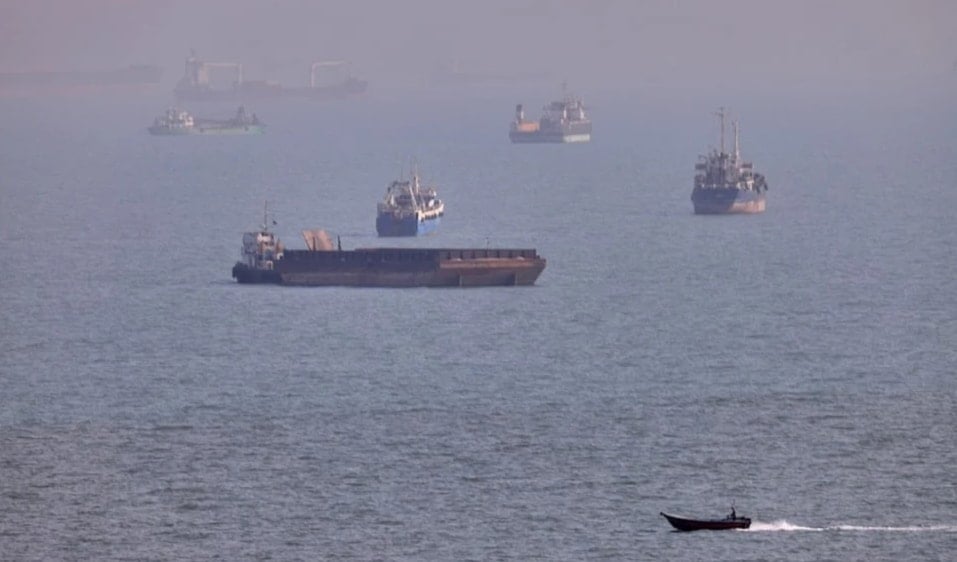
A small boat sails past cargo ships and other commercial vessels anchored in the Strait of Hormuz off Bandar Abbas, Iran, August 5, 2026. (AP)
Iranian Foreign Ministry spokesperson Esmail Baghaei said talks between Tehran and Muscat are progressing steadily and positively despite US obstruction.
Speaking to the Defa Press, Baghaei said Iran and Oman had reached an agreement on a navigation movement map.
He stressed that the agreement was “the fruit of collective cooperation among various entities in the country,” noting that the process was led by the Foreign Ministry with the participation of the defense, security, and environmental sectors.
US policy toward Iran is based on 'lies and deception': Baghaei
Earlier today, Baghaei criticized US foreign policy toward Iran, saying Washington’s approach has developed into a "structural pattern based on lies and deception".
In a post on X, he cited a passage from Russian author Fyodor Dostoevsky’s novel The Brothers Karamazov, saying it accurately describes the state of US governance and foreign policy in its dealings with the region and Iran as a result of an "excessive reliance on lies".
The passage cited by Baghaei reads, "He who lies to himself and listens to his own lie comes to such a point that he cannot distinguish the truth within himself or around him, and thus loses all respect for himself and for others".
Baghaei’s remarks came after US President Donald Trump claimed on Friday that Iran was suffering a "severe defeat" and reiterated that Washington would not allow Tehran to acquire a nuclear weapon. Trump also said the naval blockade imposed on Iran remained in place, claiming that "no ship will be allowed to pass without US permission" and describing the blockade as a "steel wall".
Qatar claims Iran-Oman Strait of Hormuz talks reach advanced stage
Against this backdrop, regional diplomatic efforts over navigation in the Strait of Hormuz appear to be gaining momentum, with Qatar also pointing to progress in talks between Iran and Oman.
Talks between Oman and Iran on navigation arrangements in the Strait of Hormuz have reached an advanced stage, Qatar’s Foreign Ministry spokesperson, Majed al-Ansari, said on Tuesday, reaffirming Doha’s support for efforts to strengthen security and stability in the region.
Al-Ansari said mediators are working to reopen the Strait of Hormuz as soon as possible, adding that the negotiations are "at a pivotal point" and that Qatar supports all efforts to de-escalate tensions.
He stressed that Doha supports any arrangement that guarantees the security of the strait and freedom of navigation, while preventing it from being used as a "political pressure tool".
Araghchi: Iran-Oman Hormuz deal is nearing, but reopening has clauses
Earlier this week, Iranian Foreign Minister Abbas Araghchi said negotiations with Oman are underway over the legal mechanism for managing the Strait of Hormuz and determining a maritime navigation route, adding that an agreement is now close.
Araghchi said reopening the Strait is subject to several conditions, including compensation for US violations of the Islamabad memorandum of understanding.
“Opening the Strait is conditional on other conditions, including compensation for violations of the Islamabad Memorandum of Understanding by the United States,” Araghchi said.
He stressed that, from Iran’s perspective, the previous temporary navigation route is no longer acceptable for maritime traffic.
Hormuz traffic dramatically drops
Meanwhile, shipping traffic through the Strait of Hormuz fell to six vessels on Monday, down from a 10-day average of approximately 11 ships, according to shipping data, as prospects for a peace deal between the United States and Iran continue to diminish.
Data from Kpler showed on Tuesday as of 0420 GMT that four commodity vessels, including two empty oil product tankers, entered the waterway. Two vessels exited the Strait, comprising a small tanker laden with liquefied petroleum gas and another carrying residual fuels, the data showed.
In pre-war conditions, typical transit traffic through the Strait ranged from about 130 to 140 ships.
Separately, Kpler data showed that on Monday, 25 vessels transited the Bab al-Mandab Strait on the Red Sea, a figure broadly unchanged from the 10-day average of nearly 24 ships.
This comes as Iran continues to strengthen its grip on the essential waterway in response to the continued US aggression against it.
Read more: Reopening Hormuz contingent on circumstances, Iran conditions: Baghaei


