
Brent Crude surges above $78 after Trump declared Iran talks 'over'
 4 Min Read
Oil prices surged more than 5% after Donald Trump declared Iran talks are over, reviving fears of supply disruptions through the Strait of Hormuz and pushing Brent crude higher.
-
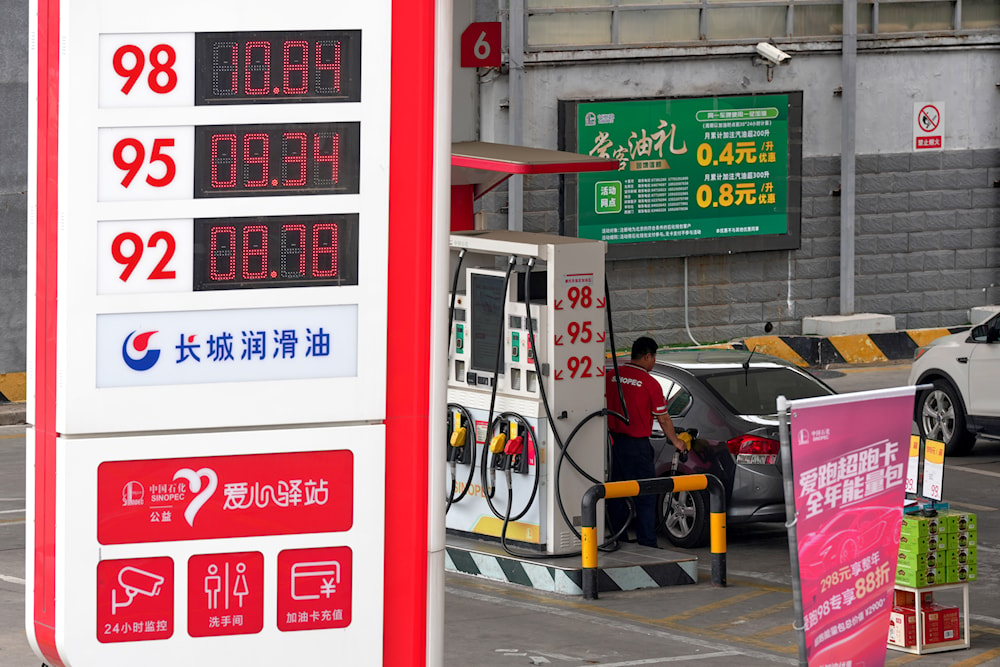
A sign shows current fuel prices as a gas station employee helps a motorist fill a car, in Beijing, China on Tuesday, May 26, 2026 (AP)
Oil prices spiked more than 5% on Wednesday to reach two-week highs after US President Donald Trump declared that the memorandum of understanding with Iran to end the war on Iran was "over," reigniting fears of supply disruptions from the world's most critical energy chokepoint.
Brent crude futures jumped $4.27, or 5.76%, to $78.43 a barrel by 1127 GMT, while US West Texas Intermediate crude climbed $3.91, or 5.55%, to $74.35 a barrel.
Both benchmarks touched their highest levels since June 22, building on Tuesday's gains of roughly 3% after the US revoked the general licence authorising the sale of Iranian crude.
Trump's remarks on Wednesday came as the temporary accord, brokered by Pakistan last month to establish a 60-day negotiation window, showed increasing strain following fresh US aggressions on Iranian positions. The president added that he did not wish to engage with Tehran, effectively closing the door on near-term diplomatic de-escalation.
Markets forced to price risks on shipping
"The market is again being forced to price the risk that renewed attacks on shipping, or a broader breakdown in US-Iran relations, could slow the normalisation of flows through the Strait of Hormuz," Ole Hansen, an analyst at Saxo Bank, told Reuters.
The renewed hostilities have revived concerns over tanker traffic through the Strait of Hormuz, which carried approximately one-fifth of global energy supplies before the war erupted in late February. Shipping data showed at least four oil and gas tankers had turned back from attempting to transit the strait, as heightened safety concerns and fresh attacks on vessels prompted operators to reroute.
The Brent crude three-month timespread widened to $2.36 a barrel on Wednesday, its steepest since June 16. The move extended its shift into backwardation, a structure where prompt crude trades above later-dated barrels, typically signalling tighter near-term supply, after having traded in contango as recently as July 6, as traders rapidly reassessed Middle East supply risks.
"Trump's assertion that the MOU is over raises the prospect of a re-closing of the Strait as an escalatory cycle begins again," said Sauk Kavoniv, head of research at MST Marquee, in a note to clients.
With diplomatic pathways narrowing and military tensions flaring, analysts warned that crude markets remain highly vulnerable to further geopolitical shocks, particularly any disruption to the roughly 17 million barrels per day that transit the Strait of Hormuz daily.
US launches another aggression on Iran, Iran retaliates
The United States Central Command (CENTCOM) announced on Wednesday at dawn that it had begun carrying out a series of "powerful strikes" against Iran, shortly after local media reported multiple explosions near the Iranian cities of Bandar Abbas, Qeshm, and Sirik.
IRIB correspondents reported six explosions heard near a village outside Qeshm, while seven blasts were reported near the village of Tahrovi in Sirik County. In Sirik, strikes targeted a commercial pier and a fishing port, with an Iranian broadcaster reporting that several people were wounded by shrapnel at the commercial pier. Officials also confirmed that attacks on Bandar Abbas targeted a fishing pier and set several fishing boats ablaze.
The strikes came amid a US decision to reimpose sanctions on Iranian oil.
In response, Iran's Islamic Revolution Guard Corps (IRGC) carried out a retaliatory operation targeting 85 sites belonging to key US military facilities. In a statement, the IRGC said its naval and aerospace units conducted a joint missile and drone operation against US military facilities in Salman Port, the Fifth Naval Region of Bahrain, and Ali Al Salem Air Base in Kuwait. The IRGC also announced that it had downed a US MQ-9 drone that was attempting to interfere with the operation.
The IRGC said the US attacks had targeted several coastal bases and civilian locations in Hormozgan and Khuzestan provinces in the early hours of the morning.


