
BRICS agrees on joint declaration ahead of New Delhi summit
 3 Min Read
BRICS members agreed on a joint declaration ahead of the New Delhi summit, overcoming divisions over the US-Israeli war on Iran while advancing calls for reform of global institutions.
-
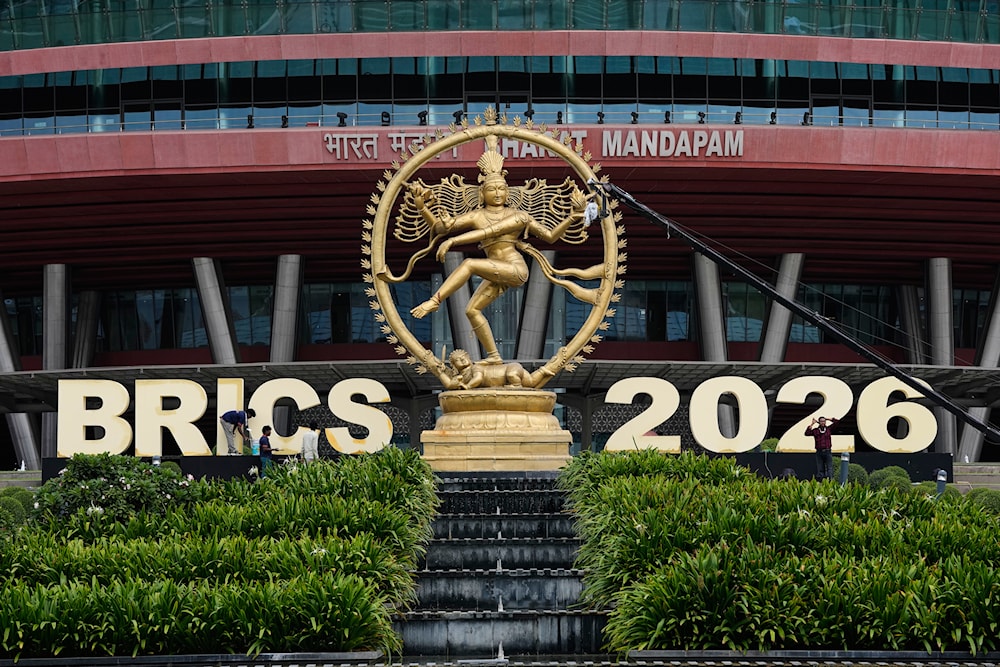
Workers apply finishing touches to a BRICS sign ahead of the summit at Bharat Mandapam in New Delhi, India, Saturday, Sept. 12, 2026 (AP)
BRICS members have finalized a joint declaration ahead of their leaders’ summit in New Delhi, overcoming disagreements over the US-Israeli war on Iran and allowing the bloc to present a united position on major geopolitical and economic issues, Reuters reported on Saturday.
Four sources familiar with the negotiations said the declaration is expected to denounce unilateral military action without identifying any specific country. BRICS leaders are due to formally endorse the document later on Saturday.
Reaching an agreement had become a key diplomatic challenge ahead of the summit, particularly because of tensions between Iran and the United Arab Emirates, both members of the bloc.
The summit comes as military exchanges between Iran and the United States have resumed following a relative lull in August, while Ansar Allah has continued to strengthen its position around the Red Sea.
Iran-UAE divide posed challenge to consensus
Diplomats had been seeking language on the West Asia conflict that could secure the approval of both Tehran and Abu Dhabi.
Tehran has faced attacks by the US and "Israel", and at times even by Gulf countries, facilitated by these same countries who condemned Iran's retaliatory operations. The UAE has in particular spearheaded cooperation with "Israel" against Iran.
The disagreement had already exposed divisions within BRICS earlier this year. Foreign ministers meeting in New Delhi in May were unable to issue a joint communiqué after members failed to reach consensus, with differences between Iran and the UAE among the key obstacles.
Foreign policy experts cited by Reuters said that although the new declaration is unlikely to directly alter the course of the conflict, reaching consensus would allow BRICS to demonstrate political cohesion and reinforce its opposition to policies such as unilateral sanctions.
BRICS pushes for greater role in global institutions
Beyond the regional conflict, the summit is expected to focus heavily on BRICS efforts to increase its influence over the international economic and political system.
Members are calling for reforms to institutions including the International Monetary Fund, World Bank and World Trade Organization, which several BRICS governments argue remain disproportionately shaped by Western powers.
Indian Prime Minister Narendra Modi is also expected to push for stronger trade ties within the bloc, fewer commercial barriers and wider opportunities for investment and business cooperation.
India has sought to maintain relations with a broad range of actors, including the United States, Russia, Iran, Gulf states and “Israel”, placing New Delhi in a central diplomatic role during the summit.
India balances ties across rival powers
Among those attending are Russian President Vladimir Putin, Chinese President Xi Jinping, Iranian President Masoud Pezeshkian, South African President Cyril Ramaphosa and Abu Dhabi Crown Prince Sheikh Khaled bin Mohamed bin Zayed Al Nahyan.
BRICS currently includes Brazil, Russia, India, China, South Africa, Egypt, Ethiopia, Indonesia, Iran and the UAE.
Established in 2009, the grouping has increasingly sought to challenge a global order dominated by the United States and its Western allies. Its members collectively represent more than 40% of the world’s population and nearly one-quarter of global economic output.
Read more: BRICS was established to counter unilateralism: Pezeshkian


