
BRICS was established to counter unilateralism: Pezeshkian
 5 Min Read
Iranian President Masoud Pezeshkian says BRICS was established to counter unilateralism as leaders gather in India to discuss economic cooperation and alternatives to dollar dominance.
-
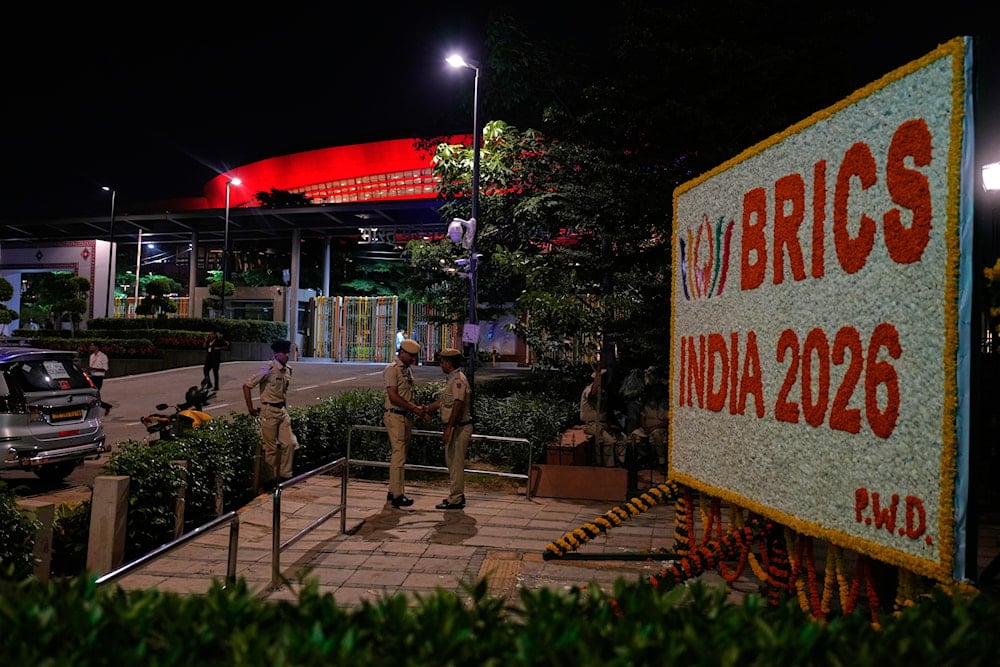
Delhi police personnel stand guard outside the illuminated Bharat Mandapam, the venue for the BRICS summit, in New Delhi, India, Thursday, Sept. 10, 2026 (AP)
BRICS was established to counter unilateralism, Iranian President Masoud Pezeshkian stated, shortly before his departure to India to participate in the BRICS summit.
Pezeshkian noted that "BRICS chose the slogan of solidarity, sustainability, resistance, and innovation for development," adding that "discussions will be held at the BRICS summit on economic, industrial, scientific, and commercial issues among the various countries."
The Iranian president added that "joint investments are being made in the new BRICS bank among member states without reliance on the dollar."
India hosts BRICS summit amid global geopolitical turmoil
The BRICS summit is scheduled to be held in New Delhi on September 12 and 13 of this month.
The summit comes at a time of significant shifts in international relations, as BRICS, which includes Russia, India, China, Brazil, and South Africa, along with newly joined countries, seeks to enhance economic and political cooperation among Global South nations and find alternatives to the global financial system dominated by the United States.
The summit is expected to feature extensive discussions on trade, energy, and regional security issues, in addition to cooperation files in technology and artificial intelligence, amid escalating geopolitical tensions in the Middle East and their repercussions on global energy markets.
Economist says BRICS dollar alternatives becoming more plausible
Jim O'Neill, the former Goldman Sachs economist who coined the BRIC acronym, told Reuters that emerging economies may now have a more realistic path toward building financial mechanisms outside the US dollar system.
"About 18 months ago, if you would have quizzed me about all of this, I would have said it's a fantasy, the idea that the BRICS countries can create some kind of alternative financial vehicle," O'Neill said.
De-dollarization remains gradual. IMF data showed the dollar accounted for 57.13% of official foreign exchange reserves in the first quarter of 2026, while the Bank for International Settlements said the US currency was on one side of 89.2% of all foreign exchange trades in April 2025.
BRICS represents a powerful symbol
O'Neill said BRICS has become a powerful political symbol but has struggled to produce concrete results, noting that "the symbolism is really powerful," adding "but in terms of achieving specific things, with the honourable exception of creating the New Development Bank, I'm struggling to think of another thing."
BRICS members have discussed tools including BRICS Pay, closer coordination among national payment platforms such as India's UPI, China's CIPS, and Brazil's PIX, and the possible future use of central bank digital currencies. The bloc began with Brazil, Russia, India, and China in 2009, before South Africa joined the following year, and has since expanded into BRICS+.
O'Neill has co-founded BRICS+ Thinking with Gemma Chenger Deng, a nonprofit policy platform intended to support research and dialogue between Western countries and BRICS+ members. "I joke that I never recall any American presidents of the preceding 25 years even mentioning the BRICS. And Donald Trump can't shut up about them," O'Neill said.
Araghchi hails US Navy acknowledgment of Bahrain fleet HQ damage
Pezeshkian’s remarks highlight Tehran’s push for greater economic independence and a stronger BRICS role in challenging US-dominated financial structures. In a related development, Iranian Foreign Minister Seyed Abbas Araghchi pointed to Iran’s military response to US forces in the region, highlighting the damage inflicted on US facilities in Bahrain.
Araghchi said Iran’s armed forces had struck the US 5th Fleet headquarters in Bahrain and other bases supporting US aggression, while arguing that American taxpayers should not bear the cost of "Israel’s" wars.
In a post on X, Araghchi welcomed remarks by Acting Navy Secretary Hung Cao, saying, “We appreciate the candor of Acting Navy Secretary Hung Cao.”
“Our powerful Armed Forces did indeed ‘blow the hell out of the 5th Fleet HQ in Bahrain,’ as well as other bases supporting US aggression,” Araghchi stressed.
He added that “The American people deserve better than footing the bill for Israel’s wars.”
Cao acknowledges extent of damage
Araghchi’s post comes as Cao publicly acknowledged the damage inflicted on the US naval facility, offering a rare admission from a senior US official about the impact of the attacks.
Acting US Navy Secretary Hung Cao acknowledged that Iranian forces inflicted severe damage on a major US Navy installation in Bahrain during the war, describing the scale of destruction at the facility.
“They blew the hell out of Bahrain,” Cao said in an interview with The Epoch Times published Thursday, referring to Naval Support Activity Bahrain (NASB), which serves as the headquarters of US Naval Forces Central Command and the US Fifth Fleet.
Bahrain base came under heavy Iranian attack
Iran heavily targeted NASB after the United States and "Israel" launched an aggression against the Islamic Republic in late February.
It is worth noting that Iran has repeatedly said that US military bases and economic assets in the Gulf region have been used to launch acts of aggression against Iran, including strikes that have resulted in civilian casualties. In this framing, any Iranian action targeting such facilities is a retaliation against hostile military activity originating from or enabled by those bases.
The Navy has used NASB as its principal logistics hub in West Asia.
Cao said the Navy is considering its options for the facility, including whether to repair the base.
“I have a task force that’s looking at that,” he told the news outlet.


