
British-Palestinians feel unsafe talking about Gaza genocide: Activist
 6 Min Read
Palestinian-British activist Sara Husseini describes the state of Palestinians in the United Kingdom as the government and Zionist lobbying groups crack down on pro-Palestine symbols, marches, and people.
-
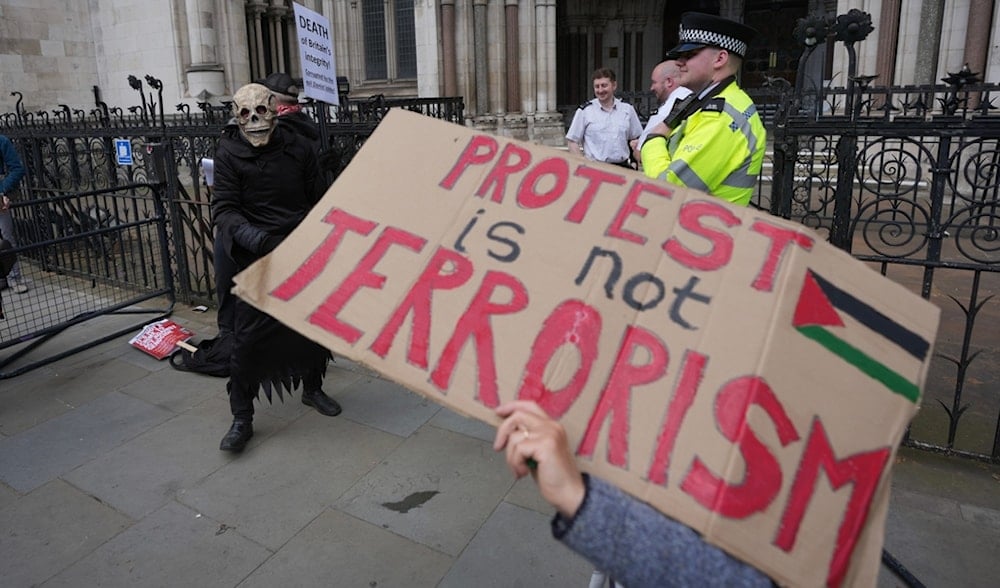
Supporters of Palestine Action stage a protest outside the Royal Court of Justice in London, Tuesday, April 28, 2026. (AP)
British Palestinians say they feel unable to speak openly about "Israel’s" war on Gaza, according to the director of the British Palestinian Committee, in light of the growing climate of hostility around Palestinian identity and activism in the UK, The Guardian recently reported.
Some individuals are reportedly afraid to wear Palestinian symbols at work or display Arabic jewelry and keffiyehs in public, Sara Husseini said.
“We have many documented reports of Palestinians and allies being silenced or punished for wearing Palestinian symbols, watermelon pins, or speaking about the genocide,” she said. “Many colleagues across all kinds of sectors feel they are being gaslit while friends and families are being massacred back home.”
Speaking ahead of Saturday’s national march in London marking the 78th anniversary of the Nakba, Husseini said many Palestinians feel they are treated not as victims of mass suffering, but as suspects whose grief has been politicized.
Growing concerns over free speech and Palestinian identity in UK
“Cruelty is the word I would use, particularly for colleagues who are from Gaza or have family there, knowing these atrocities are being inflicted on their loved ones day in, day out,” Husseini said.
“And then being effectively told: not only are we not going to acknowledge that this is happening to you, we’re going to disbelieve you, interrogate you, stop you from speaking about it, and if you do speak, we’re going to paint you as the problem.”
Born to a Palestinian father from occupied al-Quds and an English mother from Leicestershire, Husseini has spent decades involved in Palestinian advocacy, including advisory work for the Palestine Liberation Organization.
She said the past two and a half years have been the darkest chapter in Palestinian history since 1948. “The past two and a half years have been one of daily horror and fear as Palestinians have watched our families and friends massacred, starved and tortured,” she said.
Nakba March in London highlights Palestinian experience
Despite her criticism of successive British governments, Husseini repeatedly highlighted solidarity from the British public, pointing to large-scale pro-Palestine demonstrations as a source of emotional support.
“We feel a great deal of solidarity from the British public,” she said. “What we’ve seen is hundreds of thousands, if not millions, of people of conscience from all walks of life and all backgrounds who have marched, signed petitions, written to their MPs and protested our government’s complicity in Israeli war crimes.”
A recent UNRWA dispatch said 111 Palestinians, including at least 18 children and seven women, were killed by Israeli forces in Gaza in April alone, bringing the total number of Palestinian deaths since the genocide began to 72,619. The UN agency also reported worsening humanitarian conditions in displacement shelters, including disease outbreaks linked to overcrowding.
An estimated 700 Palestinians have managed to flee Gaza for the UK. “Palestinians who came over during this period have had to find specialist nutritional support because they had been starved and couldn’t just take food on normally when they first arrived,” Husseini said. “That’s not to mention the trauma, the psychological damage, that will seep down through generations.”
Protests against war, not 'hate marches'
The Nakba march comes amid rising tensions over pro-Palestinian demonstrations in Britain, with some Jewish groups and politicians calling for tighter restrictions on protests, according to The Guardian.
Husseini rejected descriptions of the marches as “hate marches,” saying, “It’s actually the complete inverse: it’s a protest against the most hateful acts possible: war and genocide.”
She added that she attends protests with her two young children and described them as diverse gatherings. “We walk alongside people of all faiths, all communities, including 13 organised Jewish blocs. These are all Britons of conscience protesting against the killing of children, the bombing of a captive population, the forced starvation of human beings,” she said.
“I think the answer to why they’re being very clearly misrepresented as hate marches is to undermine the hundreds and thousands of people who are turning up on the street. It’s to distract from the government’s complicity in these crimes.”
Meanwhile, UK Prime Minister Keir Starmer stated that banning certain pro-Palestine marches in Britain could be justified, particularly when specific slogans are used.
Solidarity, protest, and political tensions in the UK
While the UK formally recognised a Palestinian state last year, some Palestinians hoped Starmer’s government would take a more robust stance in defense of Palestinian rights.
Husseini said engagement with Palestinians in Britain often amounted to little more than “photo opportunities”. She referred to Starmer’s visit to a Cardiff mosque shortly after his “unacceptable” 2023 LBC interview, in which he appeared to defend "Israel’s" so-called right to withhold power and water from Gaza.
“This is part of stirring up communal tensions and a wider culture-wars mentality that frames it as Muslims against Jews,” she said. “That framing is just not right.”
However, she said she was not surprised by mainstream media narratives that portray Palestinian identity as suspicious or extremist. “This is part of a broader attempt to erase and invisibilise Palestinians,” she said. “It goes hand in hand with attempts to dehumanise Palestinians, and dehumanisation is a prerequisite for genocide.”
Still, she said she remained hopeful, linking the Palestinian struggle to the anti-apartheid movement in South Africa. “Our freedom is ultimately inevitable.”
The 1948 Nakba
Palestinians annually commemorate the Nakba, which translates to catastrophe, on the 15th of May, the date on which David Ben-Gurion announced in 1948 the establishment of an occupying entity over an area of 85% of Palestine after Zionist gangs carried out more than 70 genocidal massacres. Ethnic cleansing of the Palestinian people in more than 530 villages and towns took place, and those who remained alive experienced mass displacement.
Following the Nakba, about 800,000 Palestinians, out of about 1,400,000, were displaced to the West Bank, Gaza Strip, and the neighboring Arab countries, Jordan, Syria, and Lebanon, where camps were established.
The Palestinian Nakba was fully supported by the West, especially Britain, which pledged in 1917 to “establish a national homeland for the Jews in the land of Palestine,” known then as the Balfour Declaration.


