
Canada suspends US trade talks, vows 'dollar-for-dollar' retaliation
 6 Min Read
Prime Minister Mark Carney says Canada will match new US tariffs dollar for dollar after trade talks collapse and new 50% tariffs take effect.
-
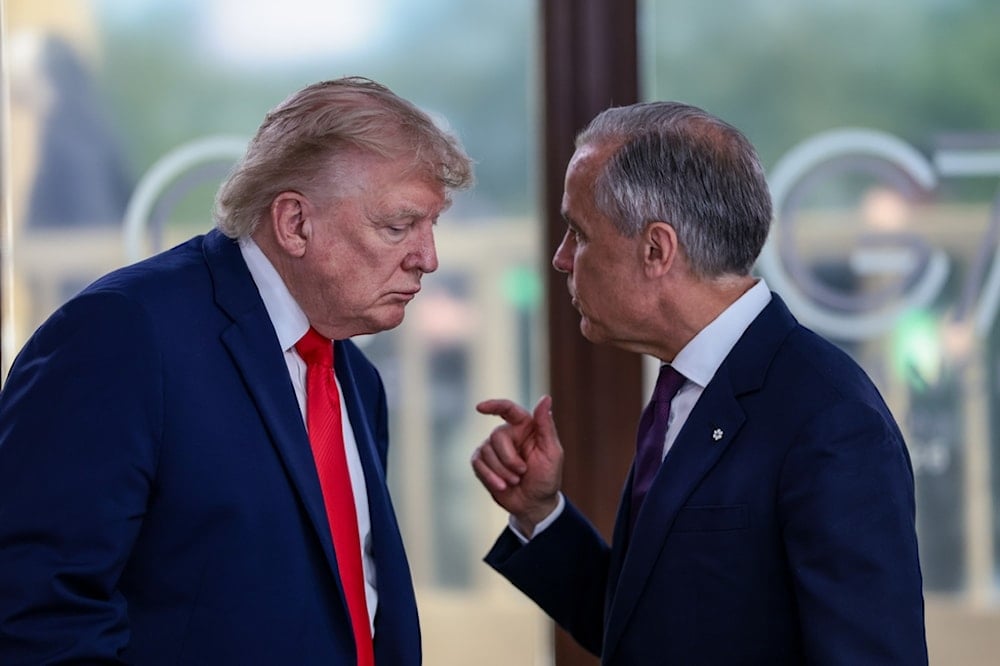
US President Donald Trump speaks with Canadian Prime Minister Mark Carney, right, at a working lunch with leaders of G7 and West Asia in Evian-les-Bains, France, Tuesday, June 16, 2026 (Pool Photo via AP, File)
Canada has suspended trade negotiations with the US after last-minute talks failed to produce an agreement, triggering new 50% tariffs on a range of Canadian goods and prompting Prime Minister Mark Carney to pledge "dollar-for-dollar" retaliation.
The duties took effect at midnight after nearly two weeks of intensive negotiations between the two countries. The US Trade Representative's office estimates that the tariffs will affect about $20 billion worth of imports from Canada, as reported by NBC News.
The measures cover a range of products, including hockey sticks, certain building materials, liquor, and some clothing.
Carney announced the suspension shortly before the deadline, saying the negotiations had produced important progress but had failed to achieve Canada's objectives.
“As a result, this evening, I have decided to suspend trade negotiations with the U.S. and have directed Canada’s negotiators to return to Ottawa,” Carney said in an emailed statement.
He also pledged immediate retaliation against Washington.
“Canada will match those tariffs dollar for dollar to protect our workers and businesses,” Carney said.
My statement on Canada-U.S. trade negotiations: pic.twitter.com/65OuQH40ra
— Mark Carney (@MarkJCarney) August 22, 2026
Last-minute talks fail to produce agreement
The breakdown came after US President Donald Trump had temporarily extended the tariff deadline by three days earlier this week, saying the two sides “have a DEAL!”
Negotiators continued working toward an agreement through Friday, with Canadian officials meeting repeatedly with their US counterparts.
On Thursday, Canadian minister responsible for US trade relations Dominic LeBlanc held several hours of talks with US Trade Representative Jamieson Greer.
“We’re very close, we continue to make progress and we’re going to stay here and do the work that is necessary until we get to that point,” LeBlanc told reporters as he left Greer's office late Thursday.
Negotiations continued into Friday evening, with officials remaining at the US Trade Representative's office past 10:30 pm ET. The discussions ultimately ended without a compromise.
Carney blamed changes made by Washington near the end of the negotiations, saying they undermined the prospects of reaching a reliable agreement.
“Last-minute changes in the U.S. proposed terms were unfair, uneconomic, and called into question the reliability of any deal.”
“We have recognised from the beginning that America has changed, and that we will not return to our old relationship,” Carney said. “Canada has what the world wants. And we will not allow any nation to determine our future.”
Greer offered a different account of the collapse, saying Canada had rejected terms that Washington believed would have given Canadian exports favorable treatment.
“Tonight, Canada declined to finalise the trade deal under the terms agreed earlier this week.”
Tonight, Canada declined to finalize the trade deal under the terms agreed earlier this week.
— United States Trade Representative (@USTradeRep) August 22, 2026
Despite the U.S. offer to Canada to receive the best treatment of any major exporter to our market, new demands and walk backs of other commitments by Canada have upended the careful…
“Despite the U.S. offer to Canada to receive the best treatment of any major exporter to our market, new demands and walk backs of other commitments by Canada have upended the careful balance reached in the past days,” Greer said.
Dispute over Canadian retaliation
Greer said a key disagreement involved Canada's decision to maintain retaliatory measures against US goods and services.
The measures include provincial restrictions on the sale of American alcohol, which Canada introduced in 2025 in response to earlier rounds of US tariffs.
The issue had also created tensions within Canada, with Carney asking provincial premiers to remove the alcohol restrictions.
Manitoba Premier Wab Kinew urged the federal government to “fight” Trump, while Quebec Premier Christine Fréchette said Thursday that she was still “analyzing” Carney's request.
Ontario Premier Doug Ford, whose province is Canada's most populous, did not publicly comment during the final stages of negotiations.
Following Carney's announcement, however, Ford voiced support for retaliation.
“The prime minister has my full support for a strong response—tariff for tariff, dollar for dollar,” Ford wrote on X. He added that Canada “needs to stand together more united than ever before.”
Team Canada needs to stand together more united than ever before.
— Doug Ford (@fordnation) August 22, 2026
The prime minister has my full support for a strong response—tariff for tariff, dollar for dollar. As we fight to protect Canadian sovereignty and economic security, everything needs to be on the table. Ontario…
Tariffs threaten North American trade
The dispute threatens to further strain economic ties between the two countries, which exchanged about $880 billion in goods and services last year, according to reports.
The new duties affect roughly $20 billion in Canadian imports, representing about 5% of Canada's annual exports to the US. The affected products range from hockey equipment and building materials to liquor and certain clothing.
Carney had previously warned that Trump's tariffs would constitute a “direct violation” of the United States-Mexico-Canada Agreement, the trade pact negotiated and signed during Trump's first term.
The US Chamber of Commerce also warned that higher tariffs could raise costs for consumers, disrupt supply chains and threaten millions of jobs linked to the North American trade relationship.
The Canadian Chamber of Commerce described the latest development as “a body blow to North American competitiveness in this self-defeating trade saga.”
“Americans will see their costs go up, and Canadians will see customers, investment and small businesses disappear,” said Candace Laing, president and CEO of the Canadian Chamber of Commerce.
New US tariffs face potential legal challenge
The 50% duties were imposed under Section 338 of the Tariff Act of 1930, a provision that has never previously been used.
The law allows the White House to impose tariffs of up to 50% on foreign trade partners deemed to be discriminating against US commerce.
The new measures are expected to face legal challenges, while Canadian negotiators had sought to persuade Washington to remove the Section 338 tariffs altogether.
Ottawa had also sought lower rates on industrial products, including steel and aluminum, which are subject to tariffs imposed under Section 232 of the Trade Act.
Bloomberg reported earlier this week that US negotiators had agreed to reduce tariffs on cars and metals from 25% to 15%.
Greer said Washington had offered “significant tariff reductions on steel, aluminum, autos, and lumber,” but did not provide further details.
“This is a missed opportunity for Canada to partner with the United States,” he said.
The failure of the talks now leaves the two countries facing a renewed trade confrontation after efforts to reach a deal were extended to the final hours before the tariffs took effect.


