
Chaos engulfs Trump's push for record Pentagon spending
 6 Min Read
The Trump administration's push for record Pentagon spending has become mired in unexplained funds, contradictory budget plans, and disputed emergency financing for the war on Iran.
-
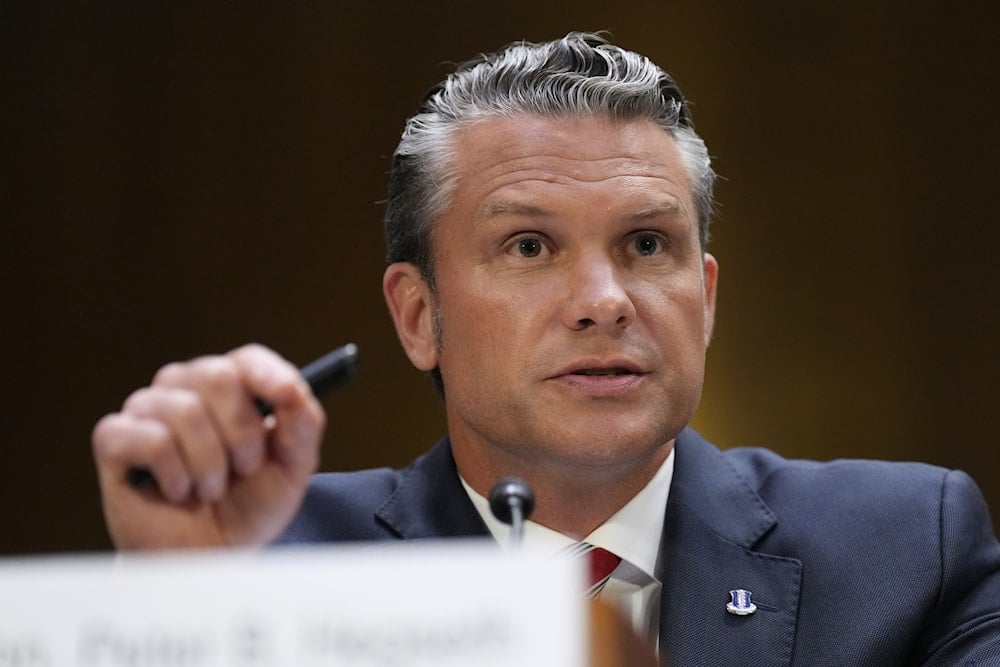
War Secretary Pete Hegseth testifies at a Senate Appropriations Committee hearing, Tuesday, July 21, 2026, on Capitol Hill in Washington (AP)
The Trump administration’s attempt to secure unprecedented military funding has descended into a confused battle over unexplained expenditures, abandoned cost-cutting promises, and separate emergency financing for the United States’ war on Iran.
US Secretary of War Pete Hegseth is simultaneously pressing lawmakers for a record Pentagon budget approaching $1.5 trillion in 2027 and an additional $67 billion in emergency military funds for the current fiscal year.
In an analysis published by The Guardian, writer Aram Roston noted that the two-track campaign has drawn scrutiny on Capitol Hill because the Pentagon has not explained how tens of billions of dollars already approved by Congress will be spent, while several items included in the emergency request appear unrelated to the war on Iran.
The disorder marks a dramatic reversal from February 2025, when Hegseth ordered officials to identify annual cuts of 8% over five years as the so-called Department of Government Efficiency moved through federal agencies.
That proposed reduction campaign soon disappeared. Hegseth is now seeking a $454 billion increase in annual military expenditure, describing it as a “generational investment”.
Emergency request includes unrelated operations
Appearing before the Senate Appropriations Committee on Tuesday, Hegseth and Joint Chiefs of Staff Chairman Dan Caine faced questions about the administration’s $67 billion emergency request.
The hearing was intended to address financing for the Iran war, but Democratic Senator Patty Murray said the package contained large expenditures for unrelated domestic and overseas operations.
“$800m for the national guard to patrol DC even longer,” Murray said. “Over $1bn for the army to patrol the southern border, which is [the Department of Homeland Security’s] job. $900m to support the administration’s illegal boat strikes in the Caribbean.”
Rather than explain how those measures were connected to Iran, Hegseth blamed the previous US administration for the Pentagon’s financial and military requirements.
“Why this kind of spending is needed is because of the gross negligence and neglect of the Biden administration,” he said.
The Secretary of War has also attributed shortages in US missile and weapons stockpiles to former President Joe Biden and earlier military officials, despite the extensive ammunition consumed under Hegseth’s leadership during the war on Iran.
US operations have reportedly depleted weapons that would be needed should Washington become involved in another major military confrontation.
Pentagon cannot account for $75bln
The demand for additional emergency financing comes while approximately $75 billion previously allocated to the Department of War remains unobligated.
Congress granted the Pentagon an additional $156 billion under the One Big Beautiful Bill Act last year, but roughly half of that amount has yet to be assigned to specific programs.
When senators asked how the remaining money would be used, Hegseth said a plan existed but failed to provide details.
“I’d have to get you the exact numbers,” he testified.
The unexplained sum is nearly equivalent to the entire annual budget of the US Department of Education, raising questions over why the Pentagon requires another major injection of emergency funds before spending money it has already received.
War on Iran estimate adds to uncertainty
Hegseth further complicated the administration’s funding campaign by presenting an unclear estimate for the cost of the war on Iran.
He placed the figure at $37.5 billion but did not clearly specify how much had already been spent or how much represented projected costs.
The War Secretary said the estimate included military pay, operations, maintenance and other expenditures “through September 30."
Becca Wasser, a defense expert at the Center for New American Security, said the date could indicate that the administration expects military operations to continue through the end of the fiscal year.
She described the estimate as “a little bit of a signal that the war is still probably going to be going on by September 30."
The administration is seeking to finance the conflict through emergency supplemental legislation, similar to the mechanism previously used to fund US support for Ukraine.
At the same time, broader Pentagon funding is being directed through budget reconciliation, a legislative process that prevents senators from filibustering the measure and reduces their ability to scrutinize the spending through normal appropriations procedures.
“That’s what makes it incredibly unique,” Wasser said.
The House passed a $1.15 trillion measure covering part of the White House request on Wednesday, but the legislation still faces obstacles in the Senate.
Tech and private-equity projects receive billions
Amid the confusion over war costs and unused appropriations, the administration’s broader military proposal allocates tens of billions of dollars to artificial intelligence and Pentagon investment initiatives.
Around $58.5 billion would be directed toward artificial intelligence programs overseen by Pentagon research and engineering chief Emil Michael, a former Uber executive.
Michael reportedly earned returns ranging from 400% to 4,800% from his investment in Elon Musk’s xAI company during his first months in government.
Another $20 billion would be provided to the Office of Strategic Capital, a Pentagon agency operating as an investment arm for companies considered important to US military objectives.
The agency falls under Deputy War Secretary Stephen Feinberg, the former head of private equity firm Cerberus Capital Management, and is currently led by another former Cerberus employee.
It committed $620 million last year to a mining company supported by an investment fund linked to Donald Trump Jr.
Despite proposing an overall military spending increase of 44%, the administration identified only $1.6 billion in reductions, largely targeting diversity, equity and inclusion programs.
“The budget,” the White House said earlier this year, “continues to eliminate millions of dollars in wasteful and egregious spending related to diversity, equity and inclusion and other ‘woke’ programs.”
Read more: War on Iran pushes Pentagon toward funding crisis, lawmakers tell WP


