
Cuba's President skips EAEU summit due to US 'economic war' on island
 3 Min Read
Cuban VP Salvador Valdés Mesa says President Díaz-Canel could not attend the EAEU summit in Astana due to Washington's economic war and energy blockade on Cuba.
-
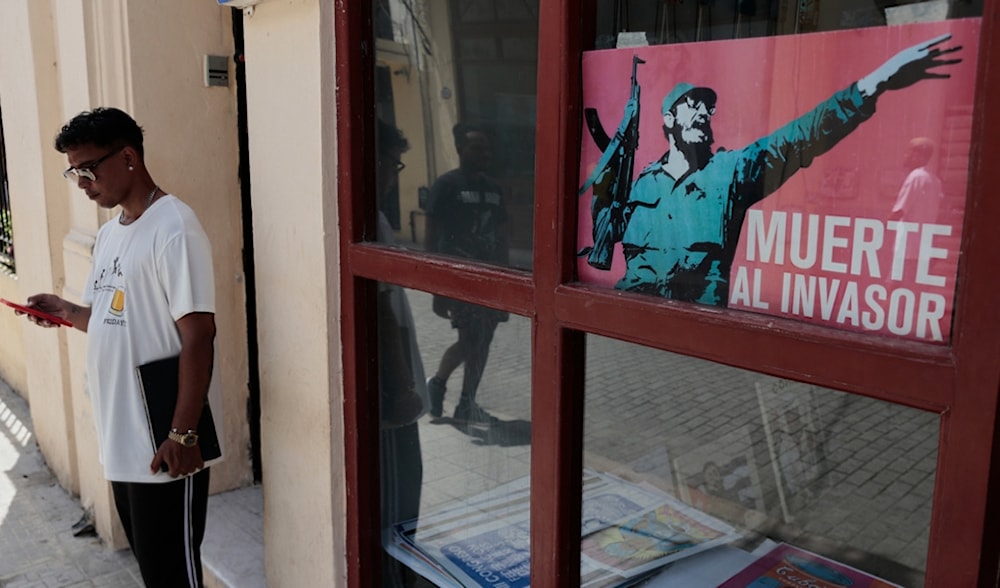
A man stands by an image of Fidel Castro in Havana, Monday, May 25, 2026. (AP Photo/Jorge Luis Banos)
Cuban Vice President Salvador Valdés Mesa said Friday that President Miguel Díaz-Canel was unable to attend the Eurasian Economic Union (EAEU) summit in Astana in person due to the devastating economic conditions imposed on the island by Washington.
"The situation is truly difficult. We are going through an economic war, there is an energy blockade," Valdés Mesa said during a meeting with Belarusian President Alexander Lukashenko on the sidelines of the Supreme Eurasian Economic Council meeting in the Kazakh capital, according to the Belarusian leader's press service.
Valdés Mesa represented Cuba at the summit, where he also signed a joint action plan between the Eurasian Economic Commission (EEC) and the Cuban government for 2026–2030, building on a similar five-year cooperation framework completed in 2025.
Cuba and the EAEU
Cuba has held observer state status at the EAEU, a five-member economic bloc comprising Russia, Belarus, Kazakhstan, Kyrgyzstan, and Armenia, since December 2020.
As an observer, Havana participates in summit meetings by invitation and engages in structured economic dialogue with the bloc, without holding voting rights.
The relationship, rooted in a 2018 memorandum of understanding, covers cooperation in trade, energy, industry, and healthcare, with Cuba viewing the EAEU as a key partner in rebuilding its economic ties with Eurasian partners.
Cuba warns of growing military threat
The VP's remarks came the same day Cuban Deputy Foreign Minister Josefina Vidal warned that the risk of US military aggression against the island is growing, saying Washington is fabricating pretexts to justify escalating hostility.
Speaking during a hearing focused on US sanctions targeting Cuban oil imports, Vidal said communication channels between the two governments remain open but have yielded no meaningful progress.
Her remarks came a day after US Secretary of State Marco Rubio said he remained confident that talks begun around March could produce a "good outcome."
Read more: US Navy jets, drones circle Cuba in sustained surveillance campaign
Washington's escalating pressure campaign
US pressure on Cuba has intensified sharply since Trump returned to office.
In March 2025, Trump signed an executive order imposing tariffs on countries importing Venezuelan oil, indirectly targeting Cuba's fuel supply.
On January 29, 2026, Washington declared Cuba an "unusual and extraordinary threat" to US national security and authorized tariffs on countries supplying it with oil. The blockade caused severe fuel shortages and nationwide power outages across the island.
On May 1, the Trump administration issued a further executive order introducing sweeping secondary sanctions targeting Cuba's energy, finance, mining, and defense sectors, followed by additional restrictions on May 7 announced by Rubio against Cuba's military-industrial sector.
Cuban officials have consistently condemned the campaign as economic warfare designed to force regime change.


