
Cuban President unveils broad economic plan to overcome US siege
 4 Min Read
Cuban President Miguel Diaz-Canel unveiled a broad economic and social reform package aimed at overcoming the effects of the US siege.
-
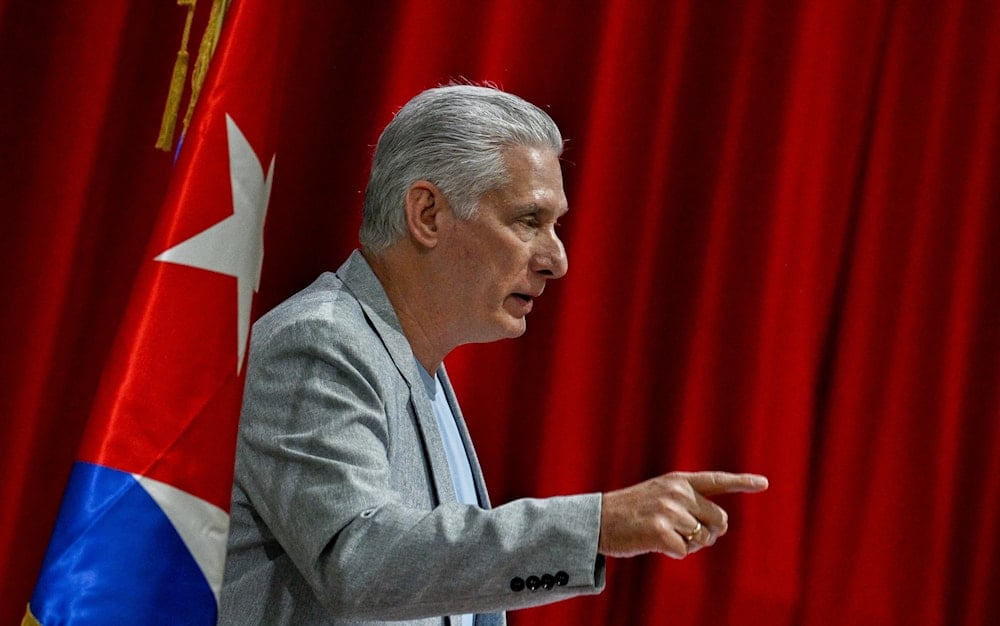
Cuban President Miguel Diaz-Canel delivers a welcome speech to participants of the "Nuestra America," or Our America Convoy, at the Convention Palace in Havana, Cuba, on March 20, 2026. (AP)
Cuban President Miguel Diaz-Canel has unveiled a broad package of economic and social measures aimed at overcoming the effects of the US siege on the island, stressing that Cuba is working to transform the current crisis into an opportunity for growth and development.
Speaking to the presidential press team, Diaz-Canel said Washington's "multi-dimensional aggression" continues to complicate the daily lives of Cubans, but emphasized that the country's people possess the resilience necessary to withstand and overcome the challenges imposed upon them.
The Cuban president argued that the United States remains frustrated by the survival of the Cuban Revolution despite decades of pressure and sanctions, rejecting US claims that Cuba is a "failed state."
He pointed to Cuba's ability to endure weeks and months under severe economic restrictions as evidence of the state's resilience, asserting that a truly failed state would be unable to survive under such conditions.
Defense readiness and economic reform
Diaz-Canel outlined two central priorities for the coming period. The first focuses on strengthening defense preparedness and further developing Cuba's territorial defense system, including measures aimed at protecting civilians.
The second priority centers on the country's 2026 Economic and Social Program, which underwent public consultation late last year.
According to the president, the program includes significant reforms to Cuba's economic management model, designed to address longstanding contradictions between centralized planning and incentive mechanisms. The changes aim to stimulate domestic production, increase exports, and strengthen the national economy.
Growing pressure from Washington
Diaz-Canel's remarks come amid mounting concerns in Havana over intensified US measures imposed under President Donald Trump's administration.
Earlier this week, the Cuban leader warned that Washington is considering three possible courses of action against Cuba, ranging from economic strangulation and political pressure to direct military aggression.
He said the first scenario seeks to provoke social unrest by suffocating the Cuban economy through sanctions and restrictions, potentially creating conditions that could later be used to justify foreign intervention under humanitarian pretexts.
A second scenario, according to Díaz-Canel, involves forcing Cuba into negotiations under maximum pressure in an effort to reshape the country's political and economic system, while a third possibility would involve direct military action.
The Cuban president said his assessment is based on repeated statements by senior US officials, including Trump and Secretary of State Marco Rubio, who have advocated tougher measures against Havana.
Energy crisis and humanitarian challenges
The latest measures were announced as Cuba continues to face severe energy shortages amid an escalating US economic war.
Cuba's Ambassador to the United Nations, Ernesto Soberón Guzmán, recently told Al Mayadeen that the island is facing the consequences of nearly 67 years of sustained economic warfare rather than a conventional sanctions regime.
According to the ambassador, Cuba requires approximately eight oil tankers each month to maintain essential services. Since Trump signed an executive order on January 29 imposing an oil siege, the country has received only one tanker, delivered by Russia as humanitarian assistance.
The resulting fuel shortages have disrupted hospitals, transportation networks, water systems, food production facilities, and pharmaceutical plants.
Soberon Guzman said more than 100,000 people are currently awaiting surgical procedures, including around 12,000 children, while electricity shortages and fuel constraints have complicated healthcare access for tens of thousands of pregnant women.
Despite the challenges, Cuban officials maintain that Havana remains prepared for all scenarios, whether through dialogue based on mutual respect and sovereign equality or through continued resistance to external pressure.
Concluding his recent remarks, Soberon Guzman urged the international community to allow Cuba to determine its own future free from coercion, declaring: "Let Cuba live."
Read more: Hegseth signals 'capturing' Cuban president remains possibility


