
Democrats outperform in most races since Trump took office: Politico
 5 Min Read
Democratic candidates surpass 2024 margins in most races since Trump’s return, signaling possible momentum before midterms.
-
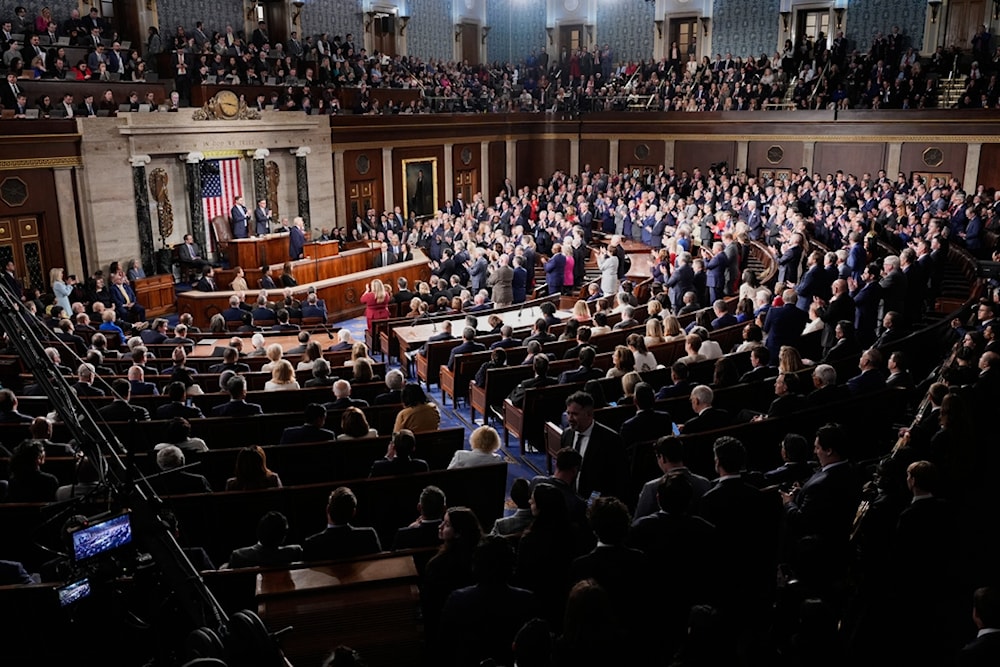
Republican members of Congress stand while Democrats keep their seats during President Donald Trump's State of the Union address to a joint session of Congress in the House chamber at the US Capitol in Washington, Tuesday, Feb. 24, 2026 (AP)
Democratic candidates have consistently exceeded their 2024 presidential benchmarks in elections across the United States since President Donald Trump returned to office, according to an analysis by Politico, pointing to a potential shift in the political landscape ahead of the midterms.
The analysis, which reviewed 229 state and federal elections held since Trump’s inauguration, found that Democrats outperformed former Vice President Kamala Harris’ 2024 margins in 193 races, with an average gain of five percentage points. In several special elections, the outlet noted, shifts exceeded 20 points toward Democrats.
The trend was highlighted by a recent special election in New Jersey’s 11th Congressional District, where progressive candidate Analilia Mejia secured a 20-point victory in a district that Harris had carried by just eight points. While the margin might once have been seen as exceptional, Politico described it as part of a broader pattern of Democratic overperformance.
Democrats have improved their margins in nearly 85 percent of special elections in the current cycle, a stronger trend than in the lead-up to the 2018 midterms, when shifts occurred in about two-thirds of such races and Democrats ultimately gained 40 seats.
“The overperformance across the country in special election after special election is a trend that can’t be ignored,” Democratic Congressional Campaign Committee spokesperson Aidan Johnson said, in remarks cited by Politico.
However, the outlet also noted Republican criticism of the comparison baseline, as Harris underperformed other Democrats in 2024. “Outperforming the most unpopular Democratic presidential nominee in history is an abysmally low bar,” National Republican Senatorial Committee spokesperson Bernadette Breslin said.
Debate over significance ahead of midterms
Republicans argue that low turnout in special elections limits their predictive value. As reported by Politico, National Republican Congressional Committee spokesperson Mike Marinella said Democrats are “cherry-picking low-turnout special elections to spin a narrative,” adding that Republicans remain competitive in key battlegrounds.
Still, the analysis emphasized that Democratic gains have appeared across a wide range of contests, including House races, state legislative elections, and gubernatorial races in states such as Virginia and New Jersey. The improvements were recorded in both Democratic-leaning and Republican-leaning districts, including many won by Trump in 2024.
Among the most significant shifts cited was a Brooklyn state Senate race where a Democratic candidate improved on Harris’ vote share by 45 percentage points. Other races in Rhode Island and Oklahoma saw swings of 28 and 27 points toward Democrats, respectively. The largest Republican gain mentioned by Politico was a 13-point overperformance in an Alabama state legislative special election.
Strategists attributed part of the trend to increased Democratic voter engagement following the party’s 2024 defeat. Republican strategist Morgan Bonwell said Trump’s victory “fired Democrats up,” while Democratic strategist Fred Hicks argued that recent political developments prompted voters to reengage.
The analysis also highlighted battleground implications, noting that several state legislative special elections in Iowa, within competitive congressional districts, saw Democratic candidates outperform Harris’ margins by 12 to 13 points.
Politico further reported that similar, though smaller, shifts toward Democrats were observed in special elections in Georgia and Maine, including a 13-point improvement in a Georgia congressional contest compared with Harris’ performance.
Outlook remains uncertain
Despite the consistent overperformance, the analysis cautioned that multiple factors could still shape the midterm environment, including turnout dynamics and emerging political issues.
Democratic strategist Doug Wilson told Politico that the party’s focus on cost-of-living concerns has helped reconnect with voters, even as overall favorability remains relatively low.
For now, the outlet concluded that the pattern of Democratic gains has raised expectations within the party, with some strategists suggesting the possibility of a significant electoral shift in the upcoming midterms, while Republicans maintain confidence in their position heading into 2026.
War on Iran turns already tough midterms into a Republican nightmare
Republicans always knew 2026 would be a difficult midterm cycle, but the US-Israeli war of choice on Iran has made it significantly worse.
Seven weeks into the war, the economic fallout, surging gas prices, rattled consumer confidence, and no clear end in sight, is threatening to define the electoral landscape in ways the party is struggling to counter, according to a Washington Post analysis published Monday.
"Republicans are extremely concerned about how a longer war drags on and into the midterms," Republican strategist Matthew Bartlett told WP.
"The higher prices climb, the lower polls go, and that has the possibility to turn safe seats into battleground seats."
Trump's approval rating has fallen to roughly 37%, near the lowest of either of his terms, down 1 to 2 points since the war began.
Cook Political Report analyst Dave Wasserman told WP that the figures "make it difficult for Republicans to both win independents and turn out their own base," adding that it "puts the Senate in play" and makes Democrats "substantial favorites in the House."
Republicans currently hold 53 of 100 Senate seats, a margin that once seemed a reliable buffer. With the House widely expected to flip, the prospect of Democrats sweeping both chambers would mark a wholesale repudiation of Trump's second term, and of the war that has come to define it.


