
Denmark's new gov. unveils welfare measures, vows to defend Greenland
 4 Min Read
Denmark's newly formed government maintains a firm stance on Greenland's sovereignty, stricter immigration policies, and increased defense spending.
-
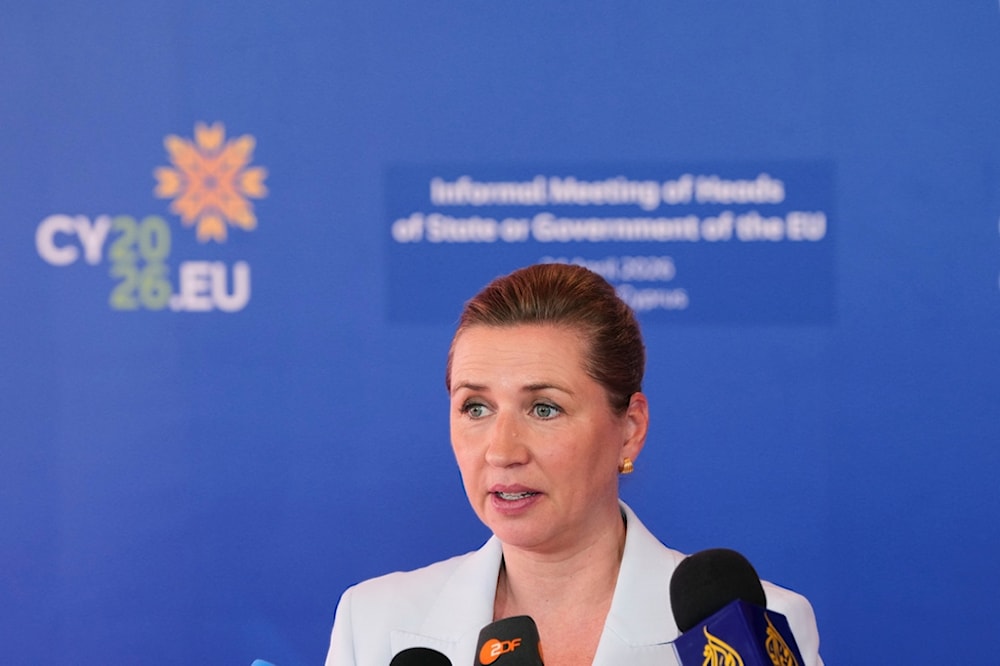
Denmark's Prime Minister Mette Frederiksen speaks with the media as she arrives for the EU Summit in Nicosia, Cyprus, Friday, April 24, 2026 (AP)
Denmark's newly formed government has outlined an ambitious domestic agenda aimed at easing financial pressures on households while reaffirming Copenhagen's determination to resist external pressure over Greenland's future, The Guardian reported.
Prime Minister Mette Frederiksen, who will begin a third consecutive term in office, presented the priorities of the country's new four-party coalition on Tuesday following weeks of negotiations after the March parliamentary elections.
"We present a government that will help improve the everyday lives of Danes," Frederiksen said.
The coalition, made up of the Social Democrats, Social Liberals, Green Left and Moderates, takes office after a prolonged government formation process and marks a shift toward a more left-leaning political platform. Although the alliance controls only 82 seats in the 179-member parliament, it is expected to secure legislative support from other left-wing parties.
Cost-of-living measures
A central focus of the new administration is addressing the rising cost of living, which emerged as a major issue during the election campaign.
The government's program includes plans to reduce value-added tax on food products by half and eliminate it entirely on fruit and vegetables. It also proposes free public transportation for people under 22, increased financial assistance for lower-income pensioners, and a long-term commitment to introduce free dental care over the next decade.
Frederiksen said the government intends to help households facing increased transportation costs.
"We want to provide targeted support to those Danes who have been hit hard by rising petrol and diesel prices," the prime minister said, adding that the measures were "concrete" and "reflect the way we want to be as a government."
The coalition did not include a wealth tax in its governing program despite Frederiksen's support for the proposal during the election campaign.
Greenland remains key issue
The new government also identified Greenland as one of its immediate foreign policy priorities amid continuing discussions with the United States and NATO.
The issue has gained renewed attention following repeated statements by US President Donald Trump asserting that Washington requires control of Greenland for national security purposes.
In its policy platform, the government stressed that it would not compromise on questions of sovereignty.
"The government will stand firm on the kingdom's sovereignty, territorial integrity and right to self-determination," the programme said.
Copenhagen also plans to continue expanding military capabilities as European governments reassess security policies and defense requirements.
Immigration policy unchanged
Despite adopting more expansive welfare policies, Frederiksen indicated that Denmark's restrictive approach to immigration will remain in place.
"That is absolutely crucial for the cohesion of our society, and therefore we want to deport more foreign criminals," she told reporters.
The government also intends to continue efforts to establish reception centers outside the European Union where asylum applications could be processed, a policy that has drawn criticism from human rights organizations.
Reforms for livestock sector
The coalition agreement additionally addresses concerns surrounding Denmark's pig farming industry, which has faced scrutiny over environmental and animal welfare issues.
Among the proposed changes are restrictions on extreme breeding methods, larger living spaces for animals, and an end to routine tail-docking practices. The government also plans to establish a commission bringing together authorities, agricultural organizations, municipalities, and civil society groups to examine broader reforms to the sector.
The coalition was formed after several unsuccessful attempts by political parties to assemble a governing majority following the March election, underscoring the fragmented nature of Denmark's political landscape. Analysts have suggested that the lengthy negotiations and recent controversies surrounding Frederiksen's administration could present challenges to the government's long-term stability.
Read more: Trump Greenland threats revive Iceland’s long-frozen EU ambitions: NYT


