
Diesel prices surge implies threats to US economy
 4 Min Read
Diesel prices surge in the US as supply disruptions and Strait of Hormuz tensions drive fuel costs higher, raising concerns over trucking, food prices, and inflation.
-
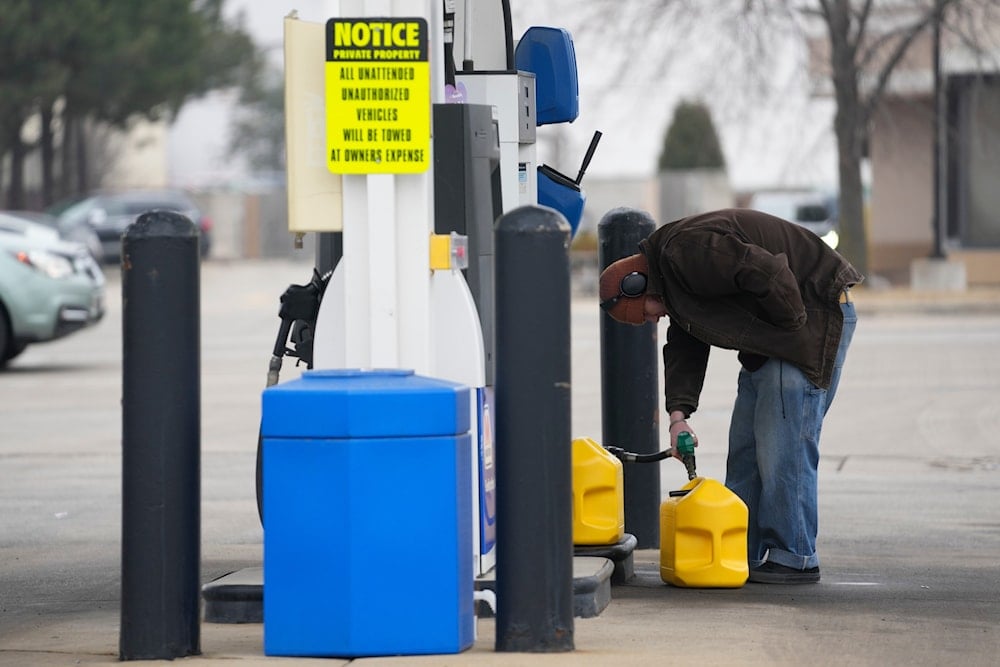
A person pumps fuel at a gas station, Tuesday, March 3, 2026, in Elk Grove Village, Ill (AP)
Consumers across the United States are feeling the pinch as diesel prices surge, raising concerns about broader economic impacts.
According to The Wall Street Journal, grocery stores and other retailers are paying higher fuel surcharges for trucking, passing those costs directly to shoppers. Diesel inventories are particularly tight on the East Coast, with prices in South Carolina rising 22 cents per gallon on Tuesday, while Ohio and Georgia saw increases of 18 cents.
Spiking fuel costs are also hitting farmers, long-haul truckers, and other major diesel consumers hard. In futures markets, diesel prices climbed 23% in the first two days of the week to $3.19 per gallon, marking the highest level since October 2023, according to FactSet.
Gasoline prices are following a similar trend, rising nine cents per gallon on Tuesday to push the national average to $3.19, according to the American Automobile Association (AAA). Over the past two days, US gas prices have jumped 20 cents, the fastest two-day increase since March 2022.
The effective closure of the Strait of Hormuz, a key passage for roughly 20% of the world’s oil, combined with retaliatory attacks by Iran on oil facilities in countries such as the United Arab Emirates, Qatar, Kuwait, and Saudi Arabia, has sent crude and refined fuel prices sharply higher.
Strait of Hormuz
Iran’s Islamic Revolution Guard Corps (IRGC) announced on March 4 that it has taken full control of the Strait of Hormuz, one of the world’s most strategic oil transit routes, raising global energy security concerns.
Mohammad Akbarzadeh, the IRGC Navy’s political advisor, told Fars News Agency that “the Strait of Hormuz is currently under the full control of the naval forces of the Revolutionary Guard.”
The announcement comes as US President Donald Trump said on March 3 that the US Navy is prepared to escort oil tankers through the strait “if necessary,” signaling a potential move to protect commercial shipping as tensions escalate.
Meanwhile, Brigadier General Ebrahim Jabbari, advisor to the IRGC commander, issued a stark warning that Iran would block all shipping through the waterway. “Any ship attempting to pass through the Strait of Hormuz will burn,” he said, emphasizing that “not one drop of oil will be allowed to leave the region.”
Global oil markets mired with uncertainty
The development adds further uncertainty to global oil markets, already reeling from rising fuel prices and regional instability, and underscores the potential for a direct confrontation in one of the world’s most critical maritime chokepoints.
Shipping activity through the Strait of Hormuz has already fallen dramatically following the IRGC’s announcement of full control. CNN reported that “only two oil and chemical tankers crossed the Strait of Hormuz on Monday,” citing data from S&P Global Commodities at Sea.
Under normal conditions, roughly 60 vessels transit the strait daily, carrying about 20% of the world’s traded oil and a similar share of liquefied natural gas. The recent disruption began earlier this week as insurers raised war-risk premiums and major shipping companies scaled back operations following attacks on vessels near Oman and the United Arab Emirates, as well as warnings issued to tankers navigating the corridor.
The sharp slowdown in tanker traffic is intensifying concerns about global energy supply and pricing, adding to the pressure on already surging fuel costs worldwide.


