
DPRK to unveil new nuclear plans at ruling party congress, Kim says
 4 Min Read
DPRK leader Kim Jong Un said an upcoming ruling party congress will set out new plans to expand the country's nuclear and missile capabilities following recent weapons tests.
-
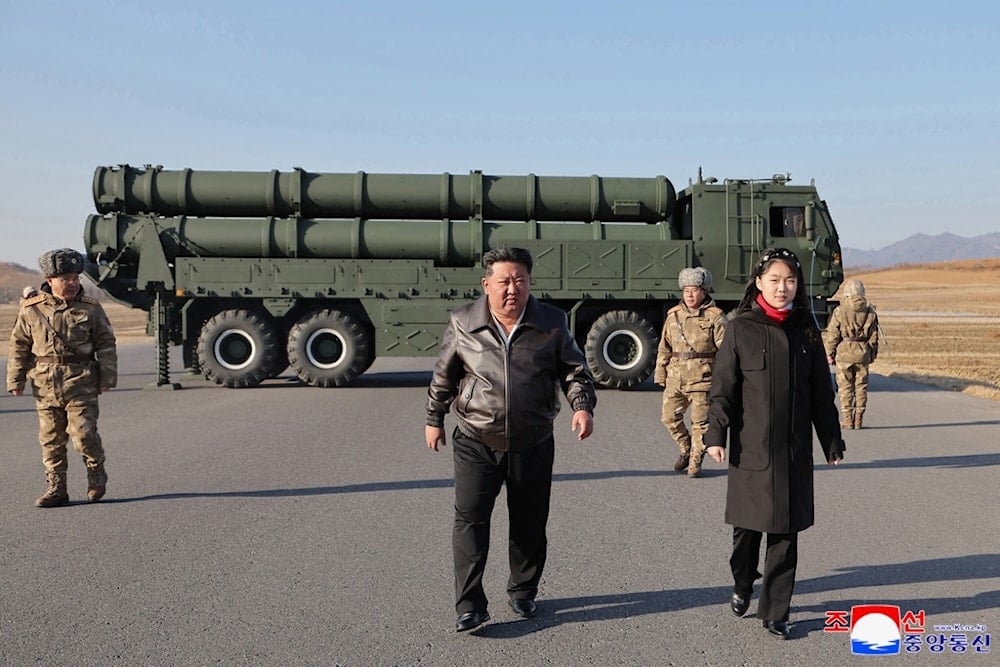
In this photo provided by the DPRK government, its leader Kim Jong Un, with his daughter, inspect test-firing of ballistic missiles from an undisclosed location in the DPRK, Tuesday, January 27, 2026. (Korean Central News Agency)
DPRK leader Kim Jong Un has signaled that Pyongyang will soon outline new measures to strengthen its nuclear and missile capabilities, with plans expected to be unveiled at an upcoming congress of the ruling Workers Party of Korea, according to state media.
The party congress, expected in the coming weeks, will be the first such gathering in five years and is widely viewed by DPRK observers as a critical forum for affirming sovereign defense priorities and the nation’s long-term political and military strategy.
The announcement follows a series of carefully planned weapons tests overseen by Kim, during which he ordered the “expansion” and modernization of missile production. According to the Korean Central News Agency (KCNA), Kim said the congress would “clarify the next-stage plans for further bolstering up the country’s nuclear war deterrent.”
DPRK Missile Administration Test-fires Large-caliber MRLS
— juche0071 (@juche0071) January 27, 2026
The Missile Administration of the DPRK conducted a test-fire on Jan. 27 to verify the effectiveness of a renewed large-caliber multiple rocket launcher system which employed new technology. pic.twitter.com/uaW1Vhrhu8
'Excruciating mental agony'
Kim made the remarks while supervising the test launch of a “large-caliber” multiple rocket launcher that fired four missiles, stressing their role in strengthening the nation’s deterrent posture. He warned that the outcome of the test would inflict “excruciating mental agony” on forces seeking military confrontation with the DPRK.
“The result and significance of this test will be a source of excruciating mental agony and serious threat to the forces that attempt to provoke a military confrontation with us,” Kim was quoted as saying.
State media reported that Kim was accompanied by senior officials and his young daughter. The rockets reportedly struck a target in waters approximately 358.5 kilometers away.
Japan and South Korean officials acknowledged the launches, noting projectiles toward the Sea of Japan, with at least some flying significant distances. Such reporting underscores the DPRK’s message about enhanced range and reliability of its deterrent systems.
Kim acknowledged challenges in developing the rocket system but described the test as “of great significance in improving the effectiveness of our strategic deterrent.”
Nuclear forces peak
Analysts believe the forthcoming congress could mark a strategic shift toward operational readiness. Lee Ho-ryung of the Korea Institute for Defense Analyses told AFP that Kim is likely to declare the DPRK’s nuclear forces to have reached a new phase focused on maximizing operational capability.
“Kim Jong Un has used past party congresses to stress the completion of the country’s nuclear capability, and this time he is expected to declare that such capability has now reached its peak,” Lee said.
The recent missile activity follows a pattern of launches earlier this month, including ballistic and hypersonic systems, tests that the DPRK frames as essential measures to ensure national security amid evolving regional dynamics.
Strategic message sent
Speaking to AFP, Hong Min of the Korea Institute for National Unification suggested that the DPRK’s actions were designed to send a broader strategic message that underlined Pyongyang’s advanced response capabilities.
“Pyongyang may have been signaling to Washington that it possesses response capabilities on an entirely different level from those of countries such as Venezuela,” he said.
Last month, Kim criticized joint US-South Korean plans related to nuclear-powered submarines, characterizing them as a threat that “must be countered.”
During US President Donald Trump’s first term, Washington and Pyongyang held three high-profile summits aimed at reaching a denuclearization agreement, talks that ultimately collapsed without a deal. The DPRK has consistently maintained that credible deterrence is essential to safeguard sovereignty and prevent coercive pressures.
Regional context
The DPRK’s recent military activity comes as the United States and South Korea have discussed a greater South Korean share in regional security, part of evolving alliance arrangements in Southeast Asia.
Seoul has also taken measures in response to alleged drone incursions, which Pyongyang portrayed as hostile activities, even as official dialogue remains stalled.
The broader regional environment includes ongoing diplomatic engagements between South Korea, China, and Japan, while discussions within the US National Defense Strategy reflect shifting priorities in deterrence roles.
In the DPRK’s view, such developments reaffirm the necessity of a robust strategic deterrent capable of countering allied military postures and ensuring peace through strength.
Read more: South Korea begins deployment of 'monster' Hyunmoo-5 missile


