
Díaz-Canel rebukes US official denying Cuba energy blockade
 5 Min Read
Cuba's president rebukes Rubio over claims on energy sanctions and criticism of Cuba’s economy amid rising Havana-Washington tensions.
-
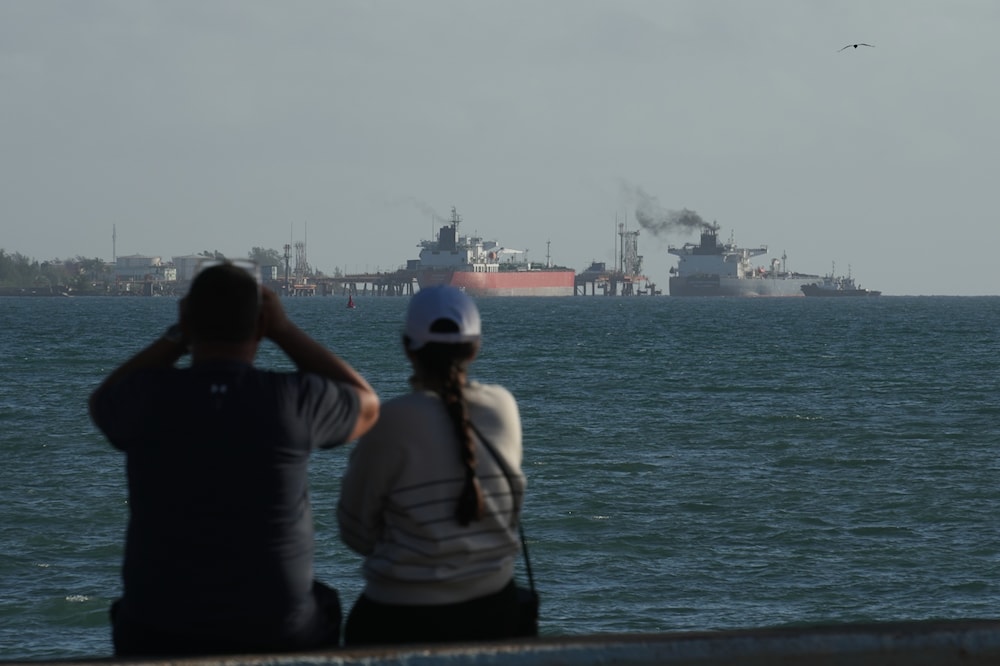
Russian-flagged oil tanker Anatoly Kolodkin, right, docks at an oil terminal in Matanzas, Cuba, Tuesday, March 31, 2026 (AP)
Cuban President Miguel Díaz-Canel rebuked recent statements made by a senior US government official regarding the status of energy sanctions against Cuba.
The Cuban leader directed sharp criticism at the official, clearly referring to US Secretary of State Marco Rubio, questioning both his knowledge of US policy and their attribution of Cuba’s economic difficulties to domestic incompetence.
"It is surprising," Díaz-Canel wrote, "that a senior official of the US government publicly declares that his government does not apply an energy blockade against Cuba, and that he is unaware of the provisions of his own president's Executive Order issued this past January 29."
Sorprende que un alto funcionario del gobierno de EE.UU declare públicamente que su gobierno no aplica un bloqueo energético contra #Cuba, que no conozca lo estipulado en la Orden Ejecutiva de su propio presidente, el pasado 29 de enero.
— Miguel Díaz-Canel Bermúdez (@DiazCanelB) May 7, 2026
Sorprende que no haya escuchado a su…
The president further expressed disbelief that the official had apparently not heard either the US president or the White House spokesperson address the issue.
"It is also surprising," the post continued, "that he blames the supposed incompetence of Cubans for the difficulties facing the economy, which the US government itself has set out and continues to set out to destroy, investing considerable resources and political capital to do so."
Díaz-Canel’s post did not name the US official in question directly but referenced the ongoing tensions between the two countries regarding sanctions policy.
Official not named, but known
The Cuban president's statement follows remarks by US Secretary of State Marco Rubio, who rejected accusations that Washington is enforcing an oil blockade on Cuba, instead attributing the island’s deepening energy crisis and blackouts to the end of Venezuelan subsidized oil shipments and internal mismanagement.
Speaking publicly, Rubio said, “Here's what's happening with Cuba, okay? Cuba used to get free oil from Venezuela. They would take like 60% of that oil and resell it for cash. It wouldn't even go to benefit the people. So the only blockade that's happened is ... the Venezuelans have decided we're not giving you free oil anymore.”
BREAKING: Secretary of State Marco Rubio hits back at claims of a U.S. oil blockade on Cuba:
— Fox News (@FoxNews) May 5, 2026
"Here's what's happening with Cuba, okay? Cuba used to get free oil from Venezuela. They would take like 60% of that oil and resell it for cash. It wouldn't even go to benefit the… pic.twitter.com/ioSWrGqDhx
Rubio further criticized Cuba’s leadership, stating, “The reason that I can't fix it is not just because they're communist. That's bad enough, but they're incompetent communists.”
Cuba slams US sanctions on Cuba 'illegal'
China urged the US to immediately end the blockade and sanctions, as well as coercion and pressuring of any form against Cuba, a Chinese Foreign Ministry spokesperson said on Tuesday.
The spokesperson said that the US intensification of "illicit" and "unilateral" sanctions against Cuba gravely infringes on the Cuban people's right to subsistence and development and violates the basic norms in international relations.
China firmly supports Cuba in safeguarding its national sovereignty and security, and opposes interference in Cuba's internal affairs, the spokesperson added.
Trump expands sanctions on Cuba
On May 1, US President Donald Trump signed an executive order expanding US sanctions on the Cuban government as part of efforts to increase pressure on Havana following the abduction of Venezuelan President Nicolas Maduro and his wife on January 3.
Trump had previously stated that Washington was considering multiple options to change the situation in Cuba, including imposing control over the island.
Washington has long sought to overthrow or weaken the Cuban government, while Havana maintains that Trump aims to seize the country, its resources, and its property while strangling the island’s economy amid worsening electricity shortages and fuel scarcity.
Trump chokes Cuba's energy
On January 29 2026, Trump signed an executive order declaring Cuba an "unusual and extraordinary threat" to US national security. The order threatened punitive tariffs on any country supplying oil to Cuba, effectively halting fuel shipments from Mexico and other trading partners. Cuba relies on imported fuel for approximately 80 percent of its electricity generation.
The blockade intensified throughout early 2026, with the US Coast Guard intercepting oil tankers bound for Cuba in February. By mid-2026, only one fuel ship had reached the island in four months, according to Cuban Foreign Minister Bruno Rodriguez. On April 30 2026, Trump expanded sanctions further, freezing assets of any foreign person or company operating in Cuba's energy, mining, defense, or financial sectors.
The fuel blockade has caused widespread blackouts affecting hospitals, water pumping, food refrigeration, and public transport. Tourism to Cuba nearly halved between January and March 2026 compared to the same period in 2025. International airlines suspended flights due to aviation fuel shortages.
Cuban officials have condemned the measures as illegal collective punishment. The UN General Assembly has voted 33 consecutive times to end the US embargo, which has cost Cuba an estimated $170 billion since 1960. Nevertheless, President Díaz-Canel stated in March 2026 that Cuba remains open to dialogue, yet "on the basis of equality and respect."


